 Netwrck
Folk Horror.
The Last Delivery
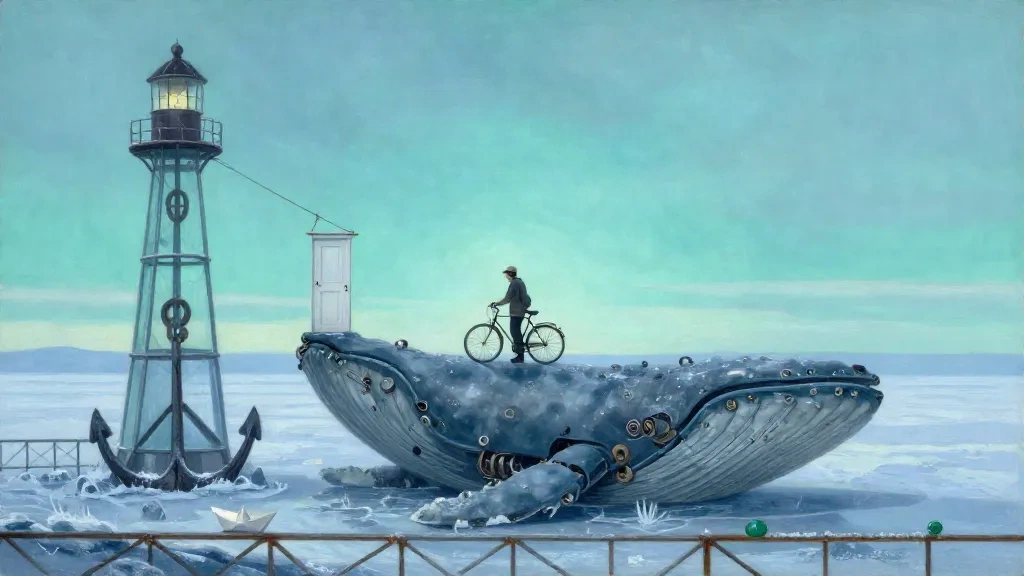
On the morning Mara found the letter from herself, the sea had no waves. Her bicycle stood on the whale’s iron flank, its thin wheels resting beneath a lighthouse built from salvaged anchors and pale glass. Below, the mechanical whale slept against the frost, ribs rising beneath its black hide, each breath loosening a blue spark from its vents.
The letter had arrived without a stamp.
To Mara, courier of impossible roads,
The future has closed its doors. Do not deliver the parcel. Do not listen for me.
Her name was in her own hand. The ink smelled of iron. The date was tomorrow.
Behind her, the lighthouse keeper watched the horizon through a telescope made from a cracked lens. “There has not been a sunrise in nine years,” he said. “Not a proper one. The light comes, but it arrives from underneath.”
Mara tightened the straps on her satchel. Inside lay twelve letters, each addressed to a person who had never existed. Since the dawn had stopped, couriers from every province had been arriving with bundles of mail from years that had not happened. They called it the Gap. Mara called it an insult.
She wanted to know why the future had stopped sending letters. More precisely, she wanted someone to admit that it had done so on purpose.
The Treaty of Listening Ears
The road to the coast ended at a white door.
There was no wall around it, no house, no street. Only frost whitening the grass and the whale’s immense black body behind her. Mara wheeled her bicycle toward the handle. The bicycle understood closed doors better than any lock. Turn one latch, and it would carry its rider through.
She had first used it in the city, when a locked storeroom opened onto the attic where her mother kept unsent letters. The bicycle never broke doors. It translated them.
The white door opened onto a courtroom buried in the whale’s spine.
There was no judge, clerk, or jury. Twelve empty chairs faced a lectern covered in green glass. On the wall hung an old treaty, its parchment stained pale as bone. The land had signed it during the first winter. In exchange for shelter, the people had granted the land permission to listen to every spoken promise, every whispered fear, every thought that crossed the mind without being spoken.
One clause had been underlined in red.
Permission to listen does not include the right to answer.
Behind the lectern stood a woman made of frost. She held a small green stone in one hand and a paper boat in the other.
“You have broken the treaty,” she said.
“I haven’t said anything.”
“You came to ask.”
The whale shuddered. A bell rang somewhere below the floorboards.
A Door Under the Dawn
The woman placed the paper boat on the treaty. Rain began inside it, though no cloud hung above them.
“The future did not stop,” she said. “It was sealed. The land listened to tomorrow’s first promise and heard this: No one will arrive. Every life after that moment was folded away to keep the promise true.”
Mara looked at the green stone. It was warm, though the courtroom remained below zero.
“Then why send letters?”
“They are not letters from tomorrow. They are refusals.”
The frost-woman opened her hand. The green stone split, showing a tiny blue flame inside.
“Someone is keeping the door shut. Every dawn, they renew the promise. If the land listens again, the future returns—but so does what the land heard during the first winter.”
Mara understood then. The treaty had not imprisoned time. It had imprisoned an answer.
She mounted her bicycle. “If the land can listen,” she said, “it can hear a correction.”
The frost-woman glanced toward the paper boat. “You are not authorized to speak for it.”
“No. I’m authorized to deliver mail.”
She pedaled toward the white door. This time, it opened without being touched.
The Soft Cyan Morning
Beyond it lay the lighthouse gallery, suspended in an impossible dawn. Cyan light poured beneath the horizon, turning the frost pale blue and the whale’s iron plates almost transparent. Inside the whale, thousands of sleeping mechanisms began to tick in unison.
At the railing stood a small figure in a postman’s coat. Its face was hidden beneath a brass visor. It held out a stack of letters.
“Tomorrow’s post,” it said.
Mara took the letters. Every envelope bore her handwriting.
“Are you the one who stopped it?”
The figure pointed behind her.
In the whale’s vast shadow, the old treaty had grown roots. Its clauses were unfolding across the sleeping machinery like vines. One root pressed against the lighthouse foundation. Another curled around the green stone on the gallery floor.
Then, from far below, came the sound of paper folding itself into a thousand boats.
The figure said, “If you read them aloud, tomorrow will open. If you remain silent, the land keeps its promise, and you remain the last courier.”
Mara looked at the letters. She did not know whether they contained apologies, accusations, or merely names. She knew only that a road without messages was not a road, but a grave with signs on it.
So she raised the green stone to the impossible dawn and read.
Her voice was small at first. Then it filled the whale. It passed through iron, frost, and the old treaty without breaking a single word. The land listened.
At last, the future answered.
Not with a sunrise. Not with a storm.
With a bicycle bell, ringing somewhere behind a door that had finally been opened by the person it had been waiting for.





