 Netwrck
Folk Horror.
The Door in the Rib
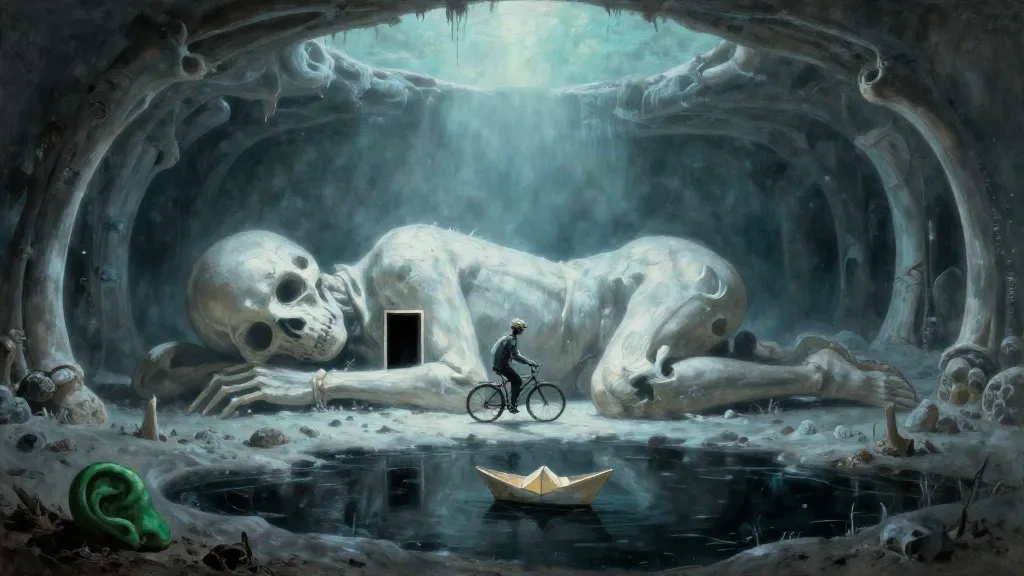
Ina delivered the last letter of the morning to a house with no door. Frost silvered the village steps, and above them the enormous ribs curved into a grey winter sky, supporting a roof of cloud that everyone called the giant’s breath. She lifted the envelope from her bicycle basket. The paper was warm. Its seal bore tomorrow’s date.
The village had received no post from the future since the year the giant turned in his sleep. Outbound letters still left with the morning train, but their return slips had begun to come back blank. Ina asked the postmaster how long the future had been silent. He lowered his voice.
“Since you were born,” he said.
That was not an answer. It was a measurement.
Her bicycle leaned against a wall that had never contained a door. The door appeared only when she pressed the warm letter against it: narrow, black, and fitted with a brass slot. Her bicycle rolled forward on its own. One wheel crossed the threshold before she could dismount.
Ina followed.
The Land’s Permission
Beyond the door lay a road beneath the village, its lamps burning with cold blue fire. The bicycle glided between the giant’s ribs as if rails had been laid there. Doors hung in the bone walls—cellar doors, nursery doors, sea doors marked with salt stains. Each had a letter slot.
When Ina touched one, the treaty appeared.
It had been made before the village was built, between the people above and the thing below. The land had surrendered its ears, its roofs, and the spaces inside its dreams. In exchange, the giant would sleep. The village would receive a harvest in every season. And when the final century came, it would be allowed to listen.
She found the final clause written in green: What listens may not be listened to.
From a hundred doorways came voices. Her mother arranging cups. The postmaster counting future mail. Children playing in streets that did not yet exist. Ina pressed her ear to the bone and heard a city falling into a river before the river had been made.
The bicycle bell rang behind her.
The Boat With No Water
Ina followed the sound deeper into the giant. The road ended in a chamber where a frost-black lake lay motionless beneath an opening in the ribs. Impossible cyan light pressed through the opening, though no sun stood there. A paper boat waited at the shore, folded from tomorrow’s letters.
Beside it lay a green stone shaped like an ear.
The treaty spoke from the walls. It said the lake contained every message the future had not yet sent. The village had been drinking from it for a hundred years. Each delivery returned a sound to the living world: a voice, a step, a laugh. The land had been fed by the future’s expectation of being remembered.
Now the future was silent, and the lake was losing its dawn.
Ina lifted the paper boat. Beneath it, the water showed the giant’s face. One eye was open.
“You stopped us,” she said.
The treaty answered through every door at once. We did not stop you. You stopped listening.
The Last Delivery
Ina put the green stone in her pocket and launched the paper boat. It crossed the lake without leaving a wake. When it reached the far shore, the cyan light began to brighten. The giant breathed.
Doors opened throughout the chamber.
Behind one, the postmaster received a letter written in a year he had not lived. Behind another, a child heard her future self singing. The village was flooded with footsteps from places that had not happened yet.
The bicycle shook itself awake. Its bell spoke clearly for the first time in a hundred years.
Ina wrote a delivery report on the back of the last envelope:
Item: tomorrow.
Condition: wet.
Recipient: the living.
She rang the bell.
Far above, every sleeping house began to answer.





