 Netwrck
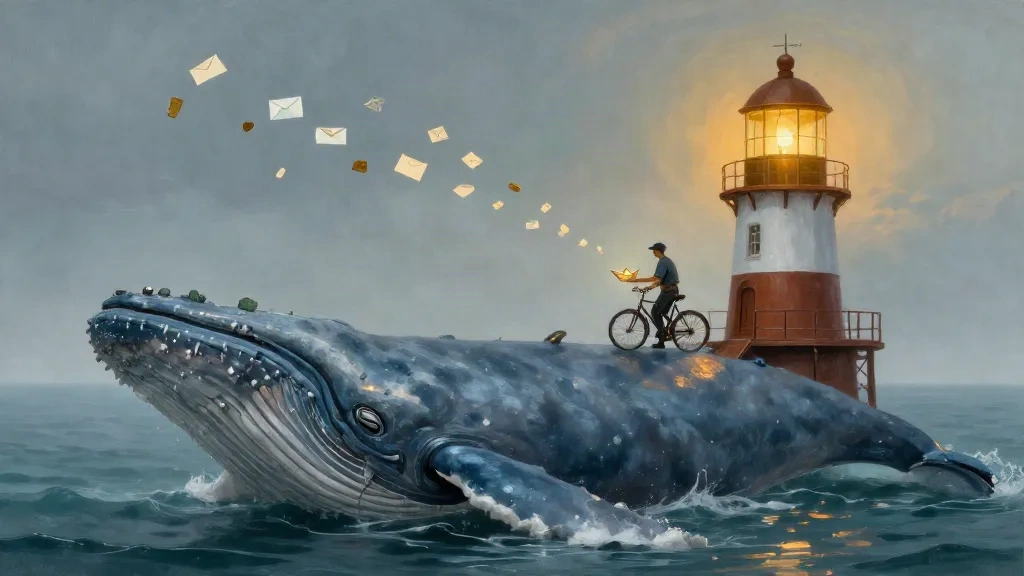
Historical Fantasy.
Through the Door at the Stairwell
On the winter morning Mara Vale received a letter without a stamp, she was oiling the hinge of a bicycle that refused ordinary roads.
She was perched on the lantern deck of Turret Hesper, a lighthouse riveted to the warm flank of a mechanical whale asleep in the northern sea. The whale’s iron skin shone steel blue beneath the fog. Somewhere beneath her feet, brass ribs expanded and settled with a long tidal breath. Candlelight, reflected from the great lens, trembled across the tobacco-brown walls.
The letter said: No future has been dispatched.
Mara tucked it into her coat and began her search. Her bicycle had passed through closed doors since the year she inherited it from her mother. It did not break locks. It persuaded them. One turned its key; another drew back its bolt; a third simply opened onto a hallway that had never been there.
She found the first future room beneath the whale’s left eye. It was filled with unopened letters, packed in steel drawers beneath a portrait of the queen. The second lay behind the sealed door of the old customs house. There, letters waited in baskets, their ink still wet, their seals unbroken.
Not one had reached the lighthouse.
The Land’s Quiet Privilege
The treaty was kept in the harbor magistrate’s archive, wrapped in oilcloth and sealed with wax the color of old tobacco.
Article Nine permitted the sovereign land to listen wherever a message crossed its territory. Article Ten permitted the land to hold any message it judged likely to disturb the public peace. The treaty had been signed in 1782, when the first mechanical whales still carried coal across the winter strait. Its words were solemn, but their teeth were small.
Mara’s bicycle rolled through the archive door before she touched the handlebars.
“You cannot file a complaint against the land,” said the magistrate. He did not look up from his ledger. “The land is the plaintiff, defendant, and court.”
“Then let me hear the case.”
He pushed a brass horn across the desk. Its bell was shaped like a seashell.
Mara listened.
At first came the sea: a thousand iron lungs drawing air. Then came the towns, their kettle lids, their sleigh bells, their arguments at breakfast. Beneath them she heard footsteps.
Thousands of people walking through one narrow room. They moved in careful lines, carrying letters to nowhere, knocking on walls, whispering into drains.
“The land is listening,” the magistrate said.
“No.” Mara tightened her hand around the horn. “Something is pretending to be the land.”
The Green Stone in the Bell
At midnight she descended through the whale’s belly.
The passage narrowed around her wheels. Blue lamps gave way to dark water sliding between polished plates. In the great bell-shaped chamber at its center, a green stone floated above a basin of mercury. A paper boat circled it, no larger than a child’s hand.
Mara recognized the boat. Her mother had folded that boat from the last letter she ever sent.
She lifted the green stone. The water below her turned black, and a voice came up through it: the voice of her daughter, speaking from a day that had not happened.
“Mara, do not ask what became of me. Ask who signed the treaty.”
The voice repeated itself, then dissolved into static.
The green stone showed her. On the treaty’s final page, beside Article Ten, a small dark hand rested beneath the magistrate’s seal. The signature had been scraped away.
“The land is listening,” the stone said.
“No,” Mara whispered. “The land is afraid.”
A Door Made of Morning
She carried the stone, the boat, and the latest undelivered letter to the lantern room.
There she opened the bicycle’s worn leather pouch and took out the brass horn. The horn had been her mother’s too, its rim bitten smooth on one side.
Mara mounted the bicycle and pedaled toward the locked door leading into the sea.
The door resisted. Her mother’s horn answered with one low note. The green stone cracked, spilling green light into the floorboards. The paper boat unfolded itself, grew paper-thin, and became a bridge.
Beyond the door lay morning.
It was not sunlight. It was the hour before sunrise, filled with every road not yet traveled. Mara saw cities with their first lamps burning, children sleeping beneath unfamiliar stars, a girl with her daughter’s face waiting at a station. On the other side stood a postman holding a bundle of letters.
“They are not lost,” he said.
“No. They are being kept.”
Mara placed the horn against the door.
She sounded it once.
The note passed through the sleeping whale, through the lighthouse, through every stone and locked room in the country. It was not loud. It was clear.
For the first time in eighty-three years, the land heard itself answer.
The sealed doors opened. The letters rose from their drawers and baskets, streaming east like pale birds. The green stone broke into ordinary green pebbles. Mara’s paper boat drifted away, folded once more by a wind that had finally been allowed to exist.
At dawn, she did not know whether her daughter had sent the silence or merely inherited it. But she knew the future was not gone.
It had been waiting behind a door, listening to the land.





