 Netwrck
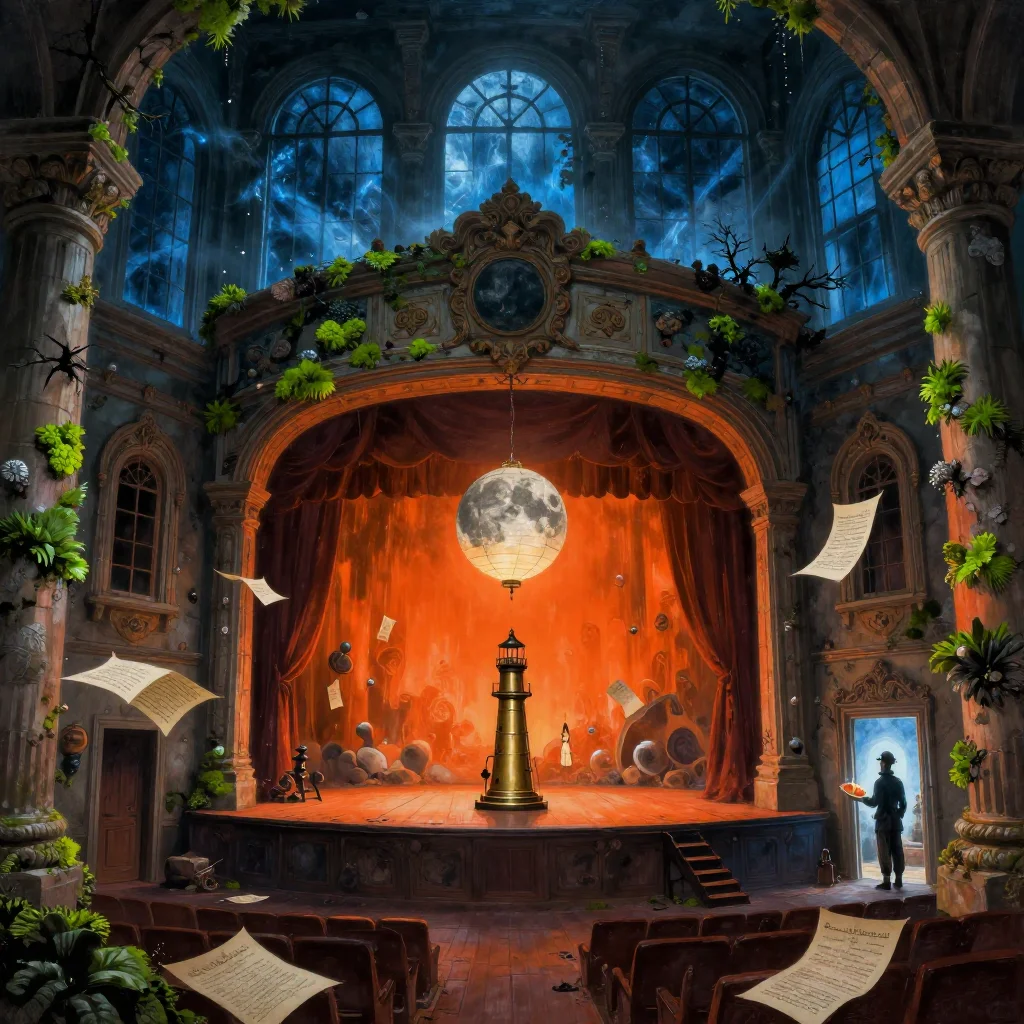
Surrealism.
The Theatre of Ended Things
Every night at four, the theatre performed tomorrow’s discarded endings. Its audience arrived carrying tickets printed from calendars that had not happened. In the wings, bundles of manuscripts waited under blue storm-light, their final pages already frayed by neglect.
Silas Vale kept the weather desk beneath the balcony. He was a lighthouse keeper, though his beacon no longer stood near the sea. It stood behind him on a brass cart, its lamp pointing into the theatre’s ceiling, where a small moon hung upside down beneath a paper lantern. The moon measured storms from other worlds. The lantern measured what remained of them.
He entered each arrival in a ledger: ash rain in the valley of sleeping machines; green thunder beneath a desert with no horizon; blue hail, falling upward through a childhood remembered by nobody. The theatre allowed impossible weather, Silas had been told, so long as it never touched the audience.
Name the Person You Cannot Forget
On the seventh night, a woman entered wearing a coat salted with coral. She carried no ticket. Instead, she held a scalloped shell beneath one ear, listening to the sea trapped inside it.
“I am Mara Venn,” she said. “I was the lighthouse keeper before you.”
Silas knew the lie by its weariness. Records placed the former keeper in a municipal archive, where his name had been copied onto a map of a coastline. Mara’s face, however, had begun to blur at the edges. Each time she spoke, one detail disappeared: the green of her eyes, the scar at her chin, the number of fingers closing around the shell.
Across the theatre, people murmured forgotten lines from plays they had never seen. Their names vanished in the pauses. A child forgot the color of a door. An usher forgot which side of the stage contained the audience. The city had entered a collective forgetting, and Mara was its first casualty.
“Save me,” she said. “Not the performance. Me.”
She had one night before the final page of her story was swept into the furnace. Silas did not need a prophecy to know the cost. He opened the municipal ledger and found the rule governing them: Every impossible thing is technically illegal. The sentence had been added to the city charter after the first theatre fire, in handwriting so careful it seemed to apologize.
The Ordinance Against What Cannot Be
Silas searched the ordinances until the small moon trembled. Impossible rain, section nine. Impossible memory, section fourteen. Impossible rescue, section sixteen, with a penalty of permanent disappearance.
He could not challenge the rule directly. The theatre inspector, a narrow woman with a face folded into paper, appeared in the orchestra pit.
“A lighthouse keeper cannot change a discarded ending,” she said. “A keeper is an observer. The law is specific.”
“And a person?”
“A person is a condition, not an impossible thing.”
She smiled as if he had passed an examination and failed it simultaneously.
Silas climbed to the weather desk and took down the brass lantern. He set it beneath the upside-down moon, filling the stage with a small amber sun. Then he opened the ledger and began rewriting tomorrow.
He entered the storm from the desert with no horizon, declaring it the only weather authorized inside the theatre. He entered the upward blue hail, granting it the right to strike the roof without damaging the seats. With each entry, the impossible things obeyed him. They were still illegal, but now they were permitted violations with a witness.
Down in the pit, the inspector objected. Silas turned the page toward her. “You said the ordinance makes impossible acts illegal. It does not say the act cannot be recorded.”
For a moment, she considered the sentence. Mara’s name appeared faintly in the margin, no longer fading.
A Theater Full of Borrowed Weather
At midnight, Silas began the rescue as if it were a performance. He placed the paper lantern on stage, named the color lichen, and called the sky to bear witness. The blue storm-light descended in a curtain. The audience leaned forward, forgetting their names for different reasons.
Mara climbed into the lantern’s glow. Her features returned one by one, gathered from the shells in the walls, the rain marks on forgotten tickets, the unfinished sentences of the city. She remembered the lighthouse. She remembered Silas. She remembered herself.
But remembering her erased the storm. The theatre shook. The small moon cracked along its lower edge.
Silas understood then that memory was not a possession. It was a current, and collective forgetting was the tide withdrawing from the shore. He could not keep Mara by restoring her alone. He had to make the room remember everyone.
He opened the weather desk. “Blue hail, upward,” he said. “Ash rain, from the sleeping machines. Green thunder, under the desert. All these worlds are occurring here.”
Every impossible storm arrived at once. They collided harmlessly, each one named and witnessed. The audience began speaking in borrowed recollections. A baker recalled the first snow. A child remembered the color of every door. The usher found the audience’s side.
By dawn, Mara was no longer the only person the city could hold. She took Silas’s hand beneath the lantern, while the inverted moon poured blue light over the theatre.
The Ending That Refused to Burn
When the furnace was lit, its heat touched the final page of Mara’s discarded story. The paper blackened, then stopped. The municipal rule flared across the ceiling in letters too large for the room.
The inspector reached for her stamp, but Mara spoke first. “I am not impossible,” she said. “I am remembered.”
The theatre turned slowly beneath them. Tomorrow’s endings gathered in the rafters, waiting for another performance. Silas returned to his desk and opened a fresh ledger. On its first page he wrote the weather of this new world: burnt orange dawn through lichen stone, with one small moon reflected in a paper lantern.
He did not classify it as exceptional. The city had learned, at last, to make room for what it could not name.





