 Netwrck
Science Fiction.
Winter Terminus
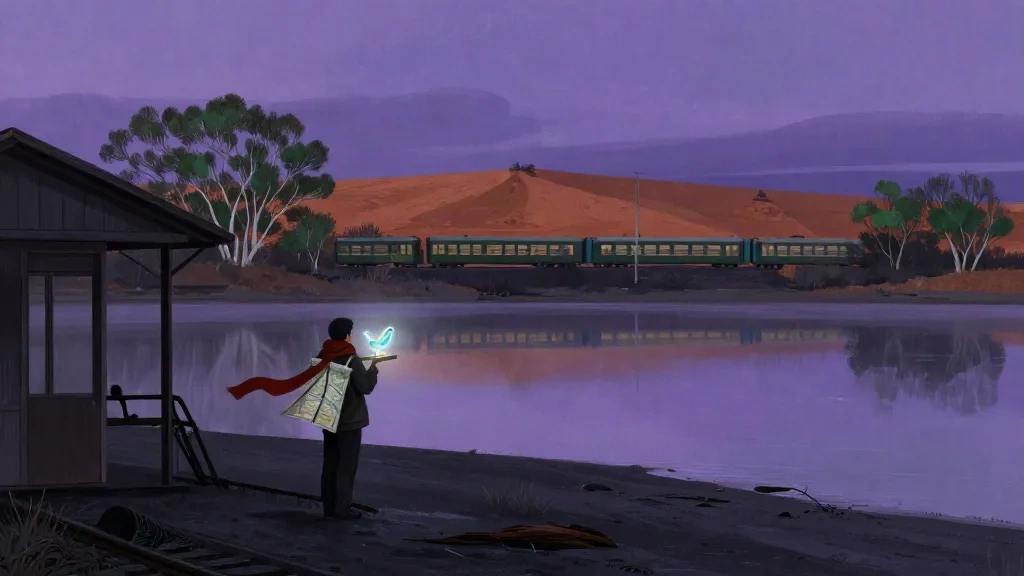
Snow packed the station roof in a white crust, yet the departure board shone green beneath its ice. WINTER → ELDER SUMMER, it announced, though the platform clock disagreed with every star. At noon the temperature fell; at one it rose, and each time the wind carried the green smell of crushed eucalyptus leaves.
Nera waited beside the ticket window with his ferry pole resting against the tiled wall. For eleven years he had crossed the lake that surfaced whenever the winter tide withdrew. It appeared as a black oval beyond the sleepers, then widened until its shore touched the station foundations. Passengers boarded from the water, stepping out of seasons that no longer touched theirs.
Among them was the woman in the red scarf.
“You are late,” she said.
“The lake is not.”
He glanced at the small glass bird in her palm. Its wings caught the violet light beneath the eaves. During the crossing, it reflected the wrong number of wings, as if several birds were trapped inside it.
“I need the map,” Nera said.
The woman unfolded it between them. It was painted on vellum thin enough to show the table beneath. Rivers wandered toward their sources. Mountains floated upside down in a sea of cloud. One black line crossed everything.
“I am looking for one person,” he said. “The one who remembers the original version of the world. Before the station divided the seasons. Before the lake began appearing only at low tide.”
“And you believe that person is here?”
“My grandmother said the first winter ended when everyone agreed to forget the summer. She said one witness remained.”
The train gave a low whistle. Beyond the window, snow erased the rooftops.
The Honest Map
The ferry moved across water without wind. Nera pushed the pole down, and the bottom caught nothing. Each stroke opened a seam of silver beneath the hull.
He turned to the map. “Show me Elder Summer.”
The paper rearranged itself under his hands. Rivers became borders. A coastline folded into a mountain range. The black line slid away from the station and stopped beside a small red mark in an unnamed country.
“That is not Elder Summer,” Nera said.
“You asked honestly,” the woman answered.
He studied the altered routes. A blue lake had appeared where a desert had been. Along its shore stood a tower with a glass dome, and beneath the tower, drawn in ink so fresh it shone wet, were three words: She remembers nothing.
The ferry struck a submerged bell.
Every passenger turned toward the sound. Below them, the lake brightened, revealing the old city in fragments: a bridge painted blue, a clock with no hands, a garden where statues faced the wall. Nera recognized the tower from his grandmother’s descriptions, but here its dome was intact and its garden burned.
“You have used the map before,” he said.
The red scarf moved in a wind that did not touch the water. “Everyone who uses it honestly changes the road. The map cannot show a destination without altering what approaches it.”
He folded the vellum. The black line vanished.
“Then we travel toward the lie,” he said.
The woman looked at him for the first time. Beneath the scarf, her face was young, but her eyes carried the dust of old rooms.
Low Water
They left the ferry at a platform hidden beneath the lake. The station master lowered a brass lantern into the water. Its flame burned without smoke. Along the tunnel walls, winter hung in crystal while summer pressed green leaves against the other side.
Nera climbed toward the tower. The map opened itself inside his coat. Each honest step made a new road appear: a stair through fire, a stair through snow, a stair that ended beneath their feet. He stopped trying to read it and moved by the tower’s reflection.
At the entrance waited a man with Nera’s face.
“You came at the wrong hour,” the man said. “The original world is closing.”
“Where is the witness?”
“Every person who remembers it forgets one thing when they try to name it. Your grandmother surrendered the sound of rain. The stationmaster surrendered the taste of oranges. I surrendered the color of the sky before the separation.”
He looked upward. Above the glass dome, the sky hung like bruised fruit: dark red at its center, purple at the edges, threaded with green.
The glass bird in the woman’s hand began to sing. Its notes were small, bright, and crowded.
“That is not a bird,” the man said. “That is a memory taking shape.”
“Whose?”
“The world’s.”
The map slid from Nera’s coat and spread itself across the floor. Roads, rivers, seasons, vanished rooms: all of it churned toward a single point—the witness, or the place where the witness had been.
What the Map Could Not Hold
They entered the tower together. Inside, thousands of suspended leaves trembled without air. Each leaf carried a scene: a child sleeping beneath summer lightning, a soldier boarding a winter train, two women sharing an orange on a shore that no longer existed.
At the center stood a child with Nera’s red scarf.
Nera crossed the room. “Do you remember the world before?”
The child looked at the glass bird. “I remember being remembered.”
The map ignited without flame. White heat erased its roads, leaving only the black line. It pointed down.
Below the tower, the lake had reached its lowest tide. Mud, bones, and blue bricks emerged beneath the water. The child stepped onto the exposed lakebed. The scarf lifted, though there was no wind.
“If I show you,” the child said, “the road will change.”
“I know.”
“If I remember it, it may not come back.”
Nera understood then. The map changed because it was preserving a world by refusing every other outcome. Even truth had become a lock.
He held out his hand. “Do not show me. Point.”
The child pointed not toward the old city, but toward the tiny station house on the far shore. Its window glowed in a season that had never belonged to any timetable.
They crossed the mud together. The ferryman left his pole behind. The woman held the glass bird close, and its hidden wings beat once.
At the station house, a woman opened the door. Her face was Nera’s grandmother’s. Behind her, rain fell upward from a blue summer garden.
“You came,” she said.
Nera looked at the map in his hands. It had become blank.
“Yes,” he said. “But you will have to tell me without the help of a road.”
She stepped aside. The winter station filled with the scent of eucalyptus, warm rain, and fruit. Somewhere beyond the tracks, the last train began to depart for a season no map could contain.





