 Netwrck
Historical Fantasy.
The House With a Fever
By the time Mara Venn reached Bellweather House, the windows were sweating and the kitchen had drawn its shutters. A brass nameplate, polished for forty years, read BELLWEATHER, though the family inside had been using the name Foundry ever since its last death.
Mara was a village nurse in the low gravity districts, trained to mend fractures, fevers, and the quieter sicknesses of houses. A house grew homesick when its rooms were filled with memories no one would speak. It bolted its cupboards, hid the stairs, and turned every guest’s coat backward. Children learned to visit with bread because bread did not object to being handled.
Bellweather had passed beyond sulking. The front door breathed in measured bellows. From within came two voices arguing through the floorboards.
“You promised we would leave together,” said Ilyan.
“I promised the stationmaster would stop lying about the timetable,” said his sister, Sava.
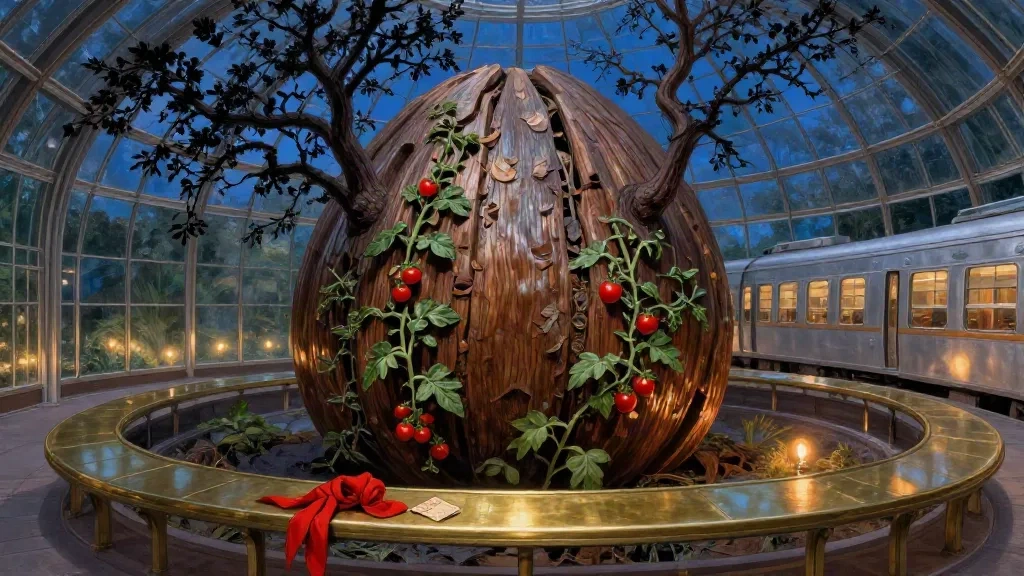
Mara set down her medical case. In her pocket, a red scarf lay folded around a train ticket. The scarf belonged to their mother, who had worn it aboard the first orbital harvesters and never removed it. The ticket was dated today. Sava’s name had been crossed out and rewritten in blue ink.
Endings on the Platform
Stationmaster Orren Vey found Mara beneath the greenhouse’s eastern dome. He stood among tomato vines and black cherry trees, stamping his schedule onto a brass board. Above him, the seed’s shell gleamed steel blue, its ancient bark veined with sap that shone like reflected candlelight. The trees rooted inside it had been extinct for three hundred years. Their leaves remembered storms, winters, and forests that had vanished before humanity learned to orbit.
“The house is ill,” Mara said.
“The house is confused,” Orren said. “Endings get filed as departures. I know how to correct a record.”
“The record is not the problem.”
“Every ending is a scheduling error.” He held up two tickets, one in each hand. “I can make the last train wait until morning. I can make it wait until next season, if the platform permits.”
Mara looked through the glass. Beyond the greenhouse, rails curved around the seed and vanished into a silver horizon. The station floated above the night side of a world, its buildings lit by the slow white pulse of distant cities.
“Their mother left without saying farewell,” Mara said. “I found this in the house.”
She unfolded the red scarf. One corner had been darned with tobacco-brown thread.
Orren’s expression softened. “She left because the line opened. People make promises to the wrong object.”
What the Seed Remembered
Bellweather’s kitchen finally admitted them. Every chair faced the wall. A coal stove smoked in its chimney, though the room was warm. At the table sat Ilyan, an engineer with soot beneath his fingernails, and Sava, a seed-keeper with a cut across her palm.
“She meant to wait,” Ilyan said. “I knew the platform timetable better than she did. I told her the first train was a test, and the real departure came later.”
“The real departure never came,” Sava said.
Mara recognized the fever of the house: not infection, but withheld truth. Its walls had absorbed the silence. When the last ember guttered, those forgotten words would become architecture.
She placed the ticket between them. “Repair the relationship before one of you leaves.”
“How?” Ilyan asked. “I cannot undo a year.”
“You can stop making her departure the last word.”
Outside, Orren rang his station bell. The note traveled through the seed’s bark, and for a moment the buried forest answered with a rustle of leaves. Every extinct tree in the greenhouse turned toward the kitchen.
Sava took the red scarf. Ilyan unfolded the ticket, smoothing its creases until the old date appeared beneath the blue correction. They read together what their mother had written on its reverse:
Neither of you is late. I am only taking the earlier road.
Then they spoke until the station clock changed. They spoke of their mother’s fear, their own silences, and the home they had made inside the house’s memory.
One Door Left Open
At departure, Orren delayed the train by seven minutes, calling it a signal fault. He was wrong about the fault, but for once his belief was useful.
Bellweather’s windows cleared. The front door swung inward. Its cupboards released a room full of spoons, and the stairs came down one by one like guests no longer pretending to be furniture.
Ilyan boarded first. Sava followed, carrying the red scarf and the corrected ticket. At the threshold she looked back, not at Mara, but at the house.
“I will return,” she said.
The house answered with every window opening at once.
As the train drew away, Mara saw the seed remembering a forest that had never survived. In its reflected candlelight, the platform looked less like a place of leaving than a promise kept in steel.
Orren erased the departure time and wrote, beneath it, arrival pending.





