 Netwrck
Weird Fiction.
Patients Without Doors
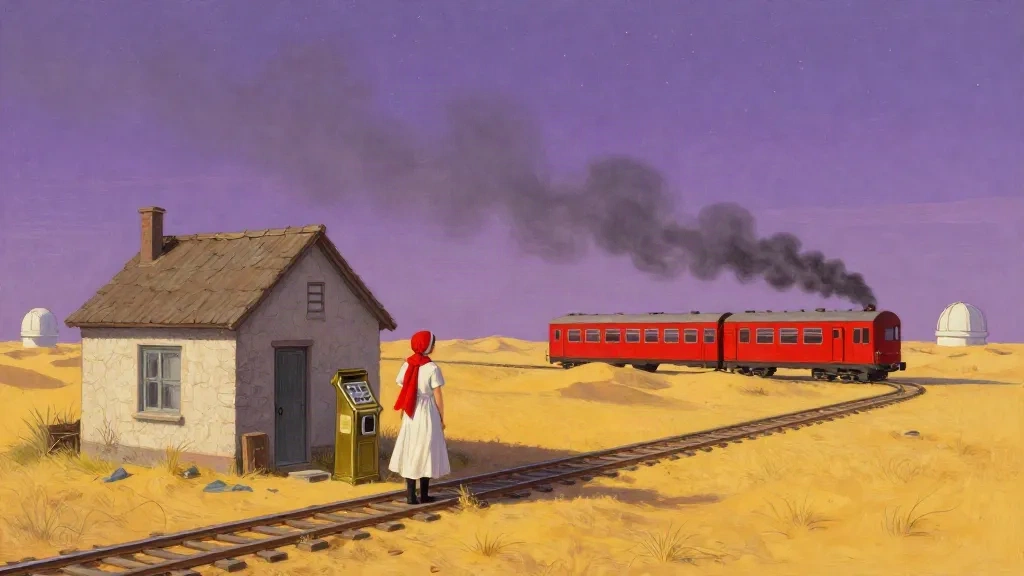
Mira found the first homesick house at dawn, curled beside the observatory like a yellow cat. Its windows had turned inward, its stairs climbed back into the ceiling, and from its chimney came the low complaint of someone packing a bag in the wrong life.
She was the village nurse, though village doctors treated people and Mira treated dwellings. She carried a red scarf against the desert wind and a narrow black case of medicines: iron nails for loose thresholds, blue thread for rooms that could no longer agree on where they belonged, a silver bell for summoning absent owners home.
Inside the house, she found a travel trunk buckled with grief. She replaced its rusted latch and said, “You do not have to leave yet.” The house exhaled. One window turned outward, revealing a street of low plaster buildings beneath a saffron moon.
“There,” Mira whispered. “Something to come home to.”
Her sister Laleh arrived before noon, wrapped in dust and silence. They had not spoken since their mother’s funeral, when Mira had blamed Laleh for leaving and Laleh had blamed Mira for staying. For six years they had shared the same daughter-shaped absence without admitting it.
Messages in the Red Dust
The stars above the observatory had always sent messages. Usually the signals arrived as silver scratches: recipes, weather warnings, the private arithmetic of distant civilizations. Lately they had been sending departures.
At fourteen minutes past two, the eastern sky brightened into a railway timetable.
17:40 — platform of unfinished sentences.
18:05 — platform where sisters may exchange platforms.
19:00 — final service. All passengers must be themselves.
Mira read the last line until the letters blurred. Laleh had a ticket sewn into her coat: the red train departing at sunset for a city where their mother’s papers were kept. She planned to sell the house, take their father’s old post, and disappear into work that asked no memories.
“Then say what you need before she goes,” Mira said.
“I have said it.”
“You said she left. You never said I stayed because I was afraid you would need me.”
Laleh looked away. Between them, the dead train whistle seemed to pass through both ribcages.
The Stationmaster’s Error
At sunset they went to the observatory’s lower platform. Its stationmaster was a narrow man in a plum coat who slammed tickets into a brass machine and declared every sorrow a clerical mistake.
“Grief,” he said, punching Mira’s ticket. “Departure delayed through insufficient correspondence.”
“Death cannot be rescheduled,” Laleh said.
“Everything can.” He pulled a lever. In the smoke-grey air, tracks appeared where no rails had ever lain, running between the dunes toward a white station on the horizon. “The dead leave daily. They are punctual. The living confuse grief with fate. We correct the confusion.”
He stamped both their tickets. Far away, a red signal blazed.
“Board separately,” he said, “or your separate arrivals will be interpreted as marriage.”
The machine clicked again. A carriage slid from the white station, empty except for their mother, who sat inside combing smoke-grey hair and wearing the blue dress buried with her.
Neither sister moved.
Then Mira saw the flaw. The carriage cast its shadow before sunset. The stationmaster’s timetable ran backward.
“You said every ending is an error,” she told him. “But this train departs before it arrives.”
Arrive Before Leaving
She rang the silver bell. Every homesick house in the village turned its windows toward the platform.
Mira placed her ticket on the machine. “I came to bring my sister home.”
Laleh stepped beside her. “I came because she asked.”
The carriage door swung open. Their mother looked up, but the sisters did not board. Instead, they helped the stationmaster reverse his signal. Metal groaned beneath the saffron sky. The red train rolled backward out of sight, its red scarf trailing from Laleh’s wrist, the ticket returning whole to her hand.
By morning, the star timetable had vanished. The stationmaster had vanished. In their place stood a small stone house with two doors, one facing village, one facing desert.
Laleh kept her ticket. Mira kept the red scarf. Neither pretended the old wound had vanished; some houses settle unevenly. But each night, they wound the blue thread around the same threshold, and the rooms agreed, at last, on where to begin.





