 Netwrck
Historical Fantasy.
The Door in the Orchard
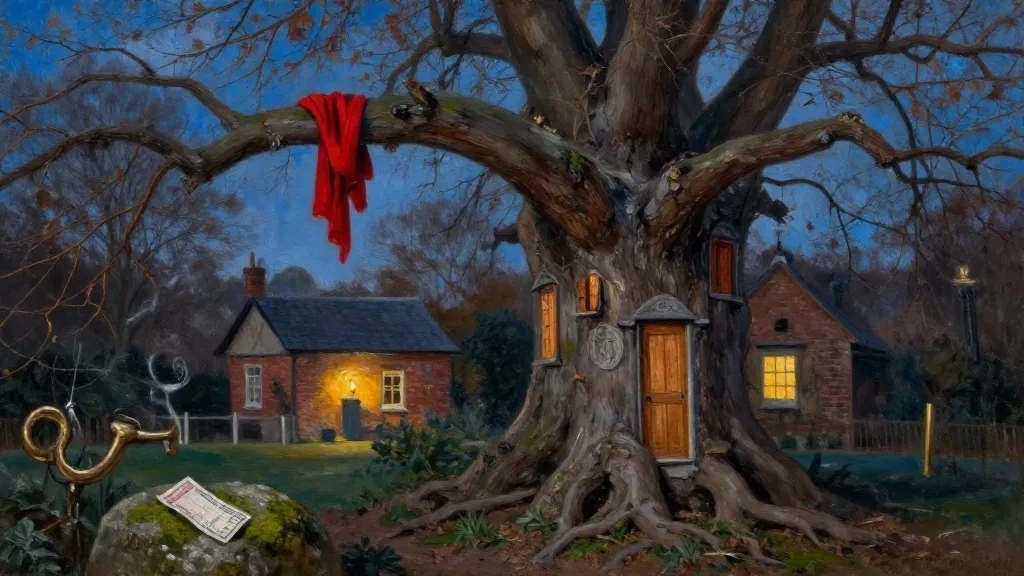
By autumn, the old tree had grown forty-one doors, though no gardener could say where its wood began or where the hinges ended. Some opened onto narrow rooms in Bristol, onto salt marshes in Cornwall, onto a kitchen where someone was kneading dough beneath blue smoke. The village called them travel doors, but Elian Voss called them patients.
She was the nurse of Lower Fen, dressed in steel-blue wool and carrying a leather case smelling of camphor. A house became homesick when its former people began leaving. Doors rattled overnight. Milk soured in the same cup. Children woke crying for streets that no longer existed. Elian treated these places with salt, clean sheets, boiled onions, and difficult questions.
On the eastern wall of the botanical garden, a small brick house shook beneath the tree’s roots. Its windows shone with reflected candlelight, though no candle burned within. From its chimney drifted the smell of tobacco and old rain. Inside, two sisters sat on opposite sides of a bare table.
“You always arrive when it is nearly over,” said the elder, Margaret.
“I arrive before,” Elian replied, “if someone lets me in.”
On the table lay a red scarf and a train ticket dated the following morning. The ticket was for a single passage to London, bought by the younger sister, Ruth. Margaret had not spoken to her in seven years, since the night their father died and each accused the other of leaving him alone.
Stationmaster of Endings
At dawn, a stationmaster arrived beneath the orchard with a lantern and a ledger. His coat was tobacco brown, and his brass buttons had been polished until they reflected the sky.
“A schedule error,” he said, studying the house. “Their mother intended one departure, not two. If I can correct the timetable, neither of them need leave.”
He pulled a brass key from his pocket and approached the largest door in the tree. Elian knew the key: it belonged to the old railway terminus, now buried beneath the hill. Once it opened, it never opened the same way twice.
“Endings are not mistakes,” she said.
“Every ending is a scheduling error,” he replied. “A departure placed in the wrong column. A destination not properly announced.”
He turned the key. The door swung inward, revealing the garden’s lawn beneath a night sky. Along the horizon ran a silver train, its carriages full of people whose faces Elian knew. A woman in green smiled from the third window. A boy held a red scarf.
Margaret stood abruptly. “That is impossible.”
“Not impossible,” said the stationmaster. “Only inconvenient.”
Elian seized the red scarf from the table. The wool was damp. When she wrapped it around her hand, the house shuddered and she heard Ruth’s voice from years before: You always wait until everyone else has gone.
She had not waited then. She had chosen the sanatorium at Bracken Hill, believing duty was the same as love. Ruth had chosen London and a life that did not include a dying father, a silent sister, or the house on the eastern wall.
What the House Remembered
That afternoon, Elian searched the house room by room. The walls had softened into images. In the parlor, Margaret was a child in a white dress, reading a letter aloud while their mother laughed. In the pantry, Ruth was seventeen, burning the same letter in a blue flame.
The house did not know which memory was true. It knew only that both sisters had been loved and both had been abandoned.
Elian found a ledger beneath the floorboards. Every resident had written one promise beside a name. The final page belonged to Ruth. She had written: I will come back when the roses bloom.
Below it, Margaret had added: I will wait.
Elian carried the ledger to the orchard. The stationmaster was drawing tracks across the wet ground with a piece of chalk. The tree doors trembled in a windless afternoon.
“You want to fix the ending,” Elian said. “But neither of them wrote the ending. They wrote a promise, and fear cut it down.”
“Fear can be rescheduled.”
“No. It can be spoken.”
At dusk, she returned to the house with the red scarf, the ticket, and the ledger. Margaret sat by the window. Ruth stood in the doorway, her coat already buttoned.
Elian placed the ticket between them.
“I treated this house for six months,” she said. “I listened to its walls, its pipes, and its memories. None of them told me what you owe each other. That belongs to you.”
Ruth looked at the scarf. “I kept this because I wanted you to follow me.”
Margaret’s face changed. “You wanted me to chase you.”
“I wanted you to choose me.”
The stationmaster’s key clattered in the corridor. A train whistle sounded inside the wall.
The Line Between
Elian led them through the smallest door, beneath the lowest branch. It opened onto the station platform, where reflected candlelight trembled across steel-blue rails. The midnight train waited, its windows burning gold.
Margaret took Ruth’s hand. The red scarf slipped from Elian’s wrist and fell across the platform.
“Come with me,” Margaret said.
Ruth shook her head. “I have a life there.”
“Then let me know where you live.”
For the first time, Ruth smiled. She drew a chair beside the platform bench, took out a pencil, and wrote an address on the unused ticket. The stationmaster lunged for it, but Elian caught his key.
“A destination properly announced,” she said.
The train departed. It carried Ruth’s luggage, not Ruth. The tree doors closed one by one, and the house on the eastern wall stopped shaking.
At dawn, Elian returned the red scarf to Ruth. On the garden wall, new green shoots had appeared where no branch had grown. They would open onto ordinary rooms: a bakery, a schoolroom, a kitchen with smoke from a morning fire. The house had learned that love did not require one door to remain open forever.





