 Netwrck
Adventure.
The Kitchen Before Morning
At Coldlight, the shadows arrived first.
They slipped beneath the lodge eaves while the guests were still climbing the last frozen stair, long black smears crossing the snow toward the kitchen door. Mara had learned not to look directly at them. Her grandmother had warned that shadows were only late arrivals, and late arrivals were always hungry.
Mara was a cook because her family had been cooks for three generations. She had inherited the blue-enameled pot, the copper measuring cups, and the small silver key that opened a cellar no one used. She had not inherited much belief in legends, except the one her grandmother had repeated every winter: On the night the lake froze black, a table was set for the missing. A family returns through the food.
That morning, Mara found twelve names written in flour beside the stove. Some were old customers. Some were dead.
One was her own.
The Dry River
The recipe came to her in pieces, as though an invisible cook were whispering over her shoulder. Browned onions, fennel seed, bone broth, and a handful of black cherries simmered until the kitchen filled with the scent of summer. Mara added a pinch of salt at the end, then set a black umbrella beside the stove, though snow had not reached that corner.
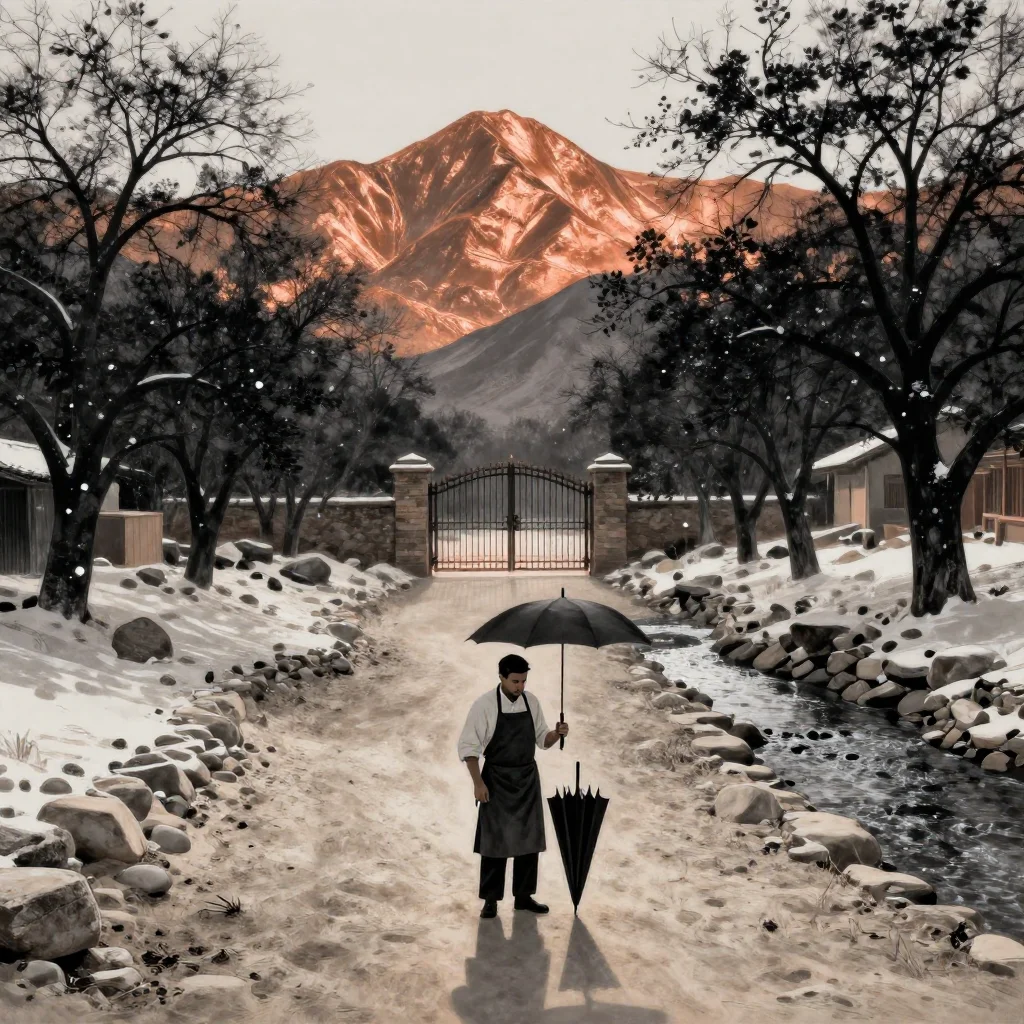
Her grandmother used to say that an umbrella kept the rain from finding your head. Coldlight had no rain. It had the dry river behind the lodge, a pale stone channel that ran beneath the resort and disappeared into the mountain. In summer, meltwater filled it. In winter, the stones showed every boot that had crossed there.
Mara walked the riverbed after closing the dining room. The pale stones were empty.
Then one bootprint appeared, then another. They moved uphill, though nobody walked. At the bend stood an iron gate, black with frost, its bars sunk into the riverbed. A brass plaque read: ONE MEMORY ENTERS. ONE MEMORY STAYS.
Behind it, Mara saw a warm room crowded with diners. Her grandmother sat nearest the door, younger than Mara had ever known her, stirring a pot.
The Guests at the Table
Mara returned to the kitchen and served the stew.
The first guest was a woman who had ordered soup every Thursday for thirty years and had died in a car outside the market. The second was a bellboy whose name Mara knew only from an old photograph. The third was a child with frost in her eyelashes. They did not ask for seconds. They asked her to remember them correctly.
Each story she told made another person appear. Soon the dining room overflowed with former guests, their coats steaming, their voices filling the rafters. Some demanded that the past be restored. Some demanded that the living forget them.
Mara found her father among them. He had left when she was eleven, but he had eaten at the table before leaving, and the recipe had preserved the exact shape of his hunger.
“You promised we would meet again,” he said.
“I promised I would keep your chair,” Mara replied.
Her grandmother rose. The gate behind the kitchen began to glow beneath the floorboards.
The Cost of Crossing
Mara understood then. The legend was not a resurrection. It was an invitation.
The living could enter the world of the remembered, but only by giving up a memory of equal weight. She had one memory left that the dead could not take from her: the afternoon her grandmother taught her to make broth, rain striking the kitchen window, the smell of onions warming in the pan.
Without it, the recipe would remain, but the person who had learned it would become a stranger to its origin.
She ladled the final bowl of stew and walked to the gate. The black umbrella rose from the snow beside her, opening by itself against the falling flakes.
At the threshold, her grandmother shook her head. “You cannot pay twice,” she said.
Mara understood. She had already paid once by remembering the diners, allowing them back into the living world. If she surrendered the broth lesson now, the gate would take her grandmother from her forever.
So Mara did something the legend had not accounted for.
She gave the gate the recipe itself.
Black cherry, fennel, bone broth, the final pinch of salt. The memory vanished from her mind, but the flavor remained in her hands.
The gate opened onto a winter morning. The shadows bowed. Every guest looked at Mara, then at the empty place where her grandmother had stood.
Mara served them one last time.
By dawn, the dining room was empty. The black umbrella lay folded by the stove, dry beneath the pale stone sky. Outside, the dry river gleamed copper in the first light.
Mara did not remember who had taught her the recipe.
She remembered that it had been hers to keep.





