 Netwrck
Mythic Fiction.
Guests Before Snow
At the Vesper Veil, shadows reached the resort before the guests did.
They slipped beneath the shutters first, cobalt pools crossing the frozen lake and climbing the white trunks of the birches. Then the coaches arrived, coughing snow from their wheels, carrying skaters, diplomats, widows, and children who stamped their boots into the blue mat by the kitchen fire.
Mara Vale stood at the salt-beige counter with her sleeves rolled to the elbow. She was the resort’s cook, though the guests called her the keeper of the hearth and the winter woman, as if she had hatched the cold herself.
Every recipe in her family had one peculiar ingredient: a memory.
Broth remembered the field where onions first grew. Bread remembered the hands that shaped it. Cakes remembered birthdays, departures, apologies swallowed at the table. Mara believed the old stories. Her grandmother had claimed the Vale women could summon the people who had once eaten their cooking, not as ghosts, but as shadows with borrowed appetites.
No one in Mara’s family had proved it.
Her grandmother had died before the winter tables were set. Her mother had forbidden the final recipe, the one written on the back of a grocery ledger in ink the color of dried blood. For proving a legend, the note said, the kitchen must serve the one who cannot return.
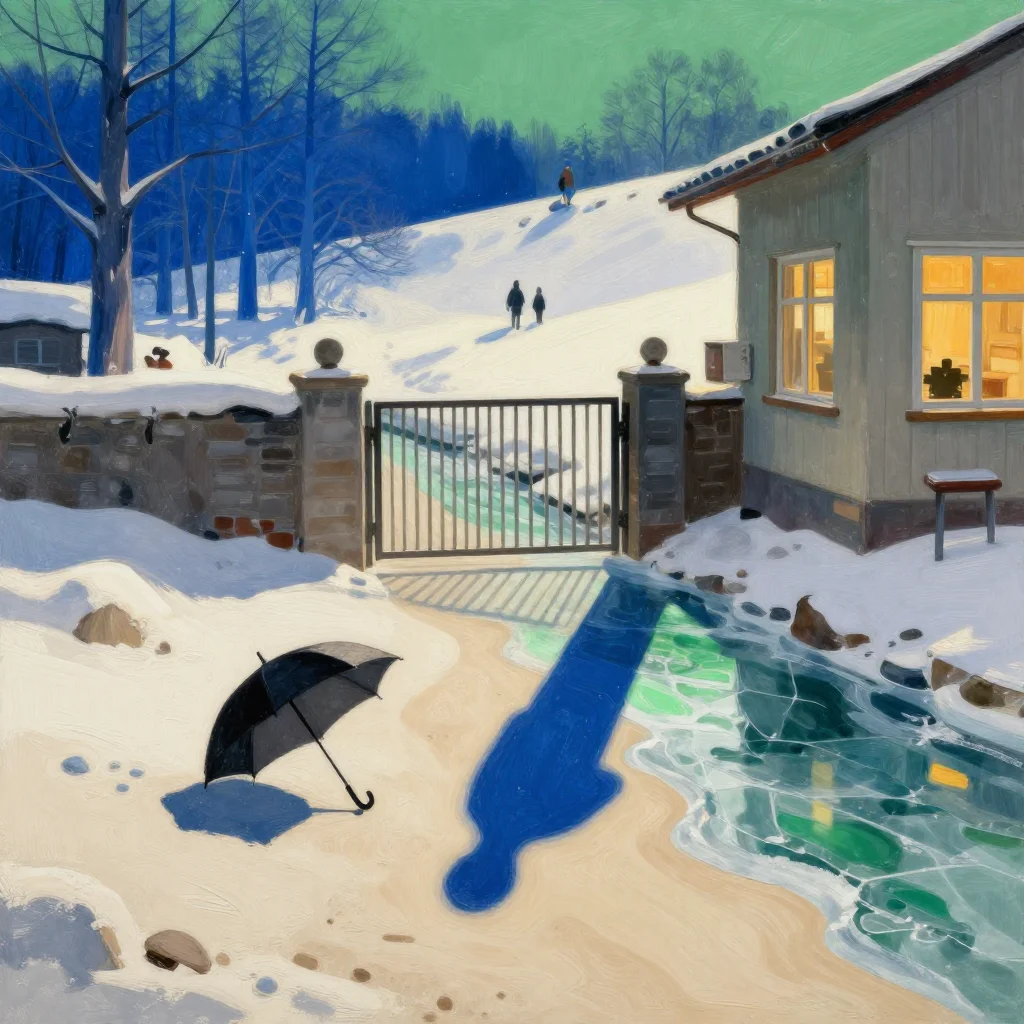
That morning, a black umbrella stood outside the kitchen door though no snow had fallen. It leaned against the wall, beaded with seawater though the nearest ocean lay eighty miles away.
The Recipe for an Empty Chair
Mara’s concrete desire was simple: proof.
She needed the resort’s old register, the leather book listing every table since the Vesper Veil had opened. If her grandmother’s words were true, the final name in the book would be the name of the dead guest who could summon the gate.
The register lay beneath the dry riverbed behind the pantry, where a stream had run before the resort’s first dam. Winter had reduced the channel to pale sand threaded with stones. Every morning, shadows crossed that sand and vanished beneath the floorboards.
Mara found the book inside a locked flour tin. The last entry was dated thirty years earlier: Table Nine. Elias Rook. Sea-glass soup, black-butter bread, winter apples.
Elias Rook had been her grandmother’s brother. He had walked into the snowstorm that night and never returned. Their family called it an accident. Mara called it a lie.
She cooked the meal using the recipe on the ledger’s back. Sea-glass soup, chopped herbs green as frozen water. Bread blackened in the pan with a smell of coal and cedar. Apples poached until their skins shone like stones beneath a moon.
When she placed the dishes on Table Nine, the black umbrella opened by itself.
Its ribs cast a cobalt shadow across the table. The shadow lengthened, divided, and became a man.
Elias Rook sat down. He had his grandmother’s sharp mouth and their mother’s scarred chin.
“You took your time,” he said.
“I needed proof.”
“The gate is below us.”
The Cost of Opening
Under the pantry, the dry riverbed began to run.
Not with water. With black water, thin as ink, carrying leaves, buttons, silver spoons, and the pale reflections of people who had not yet arrived. It moved beneath the floorboards toward a door set into the resort’s oldest wall.
The gate had no handle. Only a narrow slot shaped like a key.
Elias reached into his coat. He placed a small brass key on the table beside the soup.
“Your grandmother paid with her name,” he said. “I paid with the memory of leaving. Open the gate, and I will be returned. But the resort must forget me. Every photograph, every guest’s recollection, every name spoken at this table. The cost cannot be paid twice.”
Mara looked at him. “If I open it, will I still know you?”
He looked at the umbrella in the corner. “You may remember the key. You will not remember the lock.”
She could pay the cost with a lie: announce the legend false, keep the memory, and let the gate remain shut. The family would have its story, and Elias would remain a shape made of hunger and weather.
Or she could open it and lose him twice.
Footsteps entered the kitchen. Guests appeared in the doorway, their bodies following their shadows across the sand. They watched Mara lift the brass key. Some remembered Elias. Some had loved him. Some had eaten beside him without ever learning his name.
The gate waited.
Mara understood then that a family legend was not a story about the past. It was a debt passed forward in the shape of hope.
What the Kitchen Kept
She turned the key.
The black river rose and filled the dry bed. The gate opened onto a corridor of cobalt shadow, deep and without walls. Elias stood, buttoning the coat he had worn on the night he vanished.
“Did you prove it?” he asked.
“I proved you existed.”
He smiled. “Not enough.”
Then he walked through.
The gate did not roar. It exhaled. Every shadow in the resort bent toward it: the guests, the tables, the umbrella, the salt-beige walls, the snow beyond the windows. For one breath, the kitchen contained every person who had ever eaten there, living and dead, known and forgotten.
Mara held the key until it became warm, then until it became smooth, then until it disappeared into her palm.
When morning came, the resort was unchanged except for the dry riverbed. It no longer held sand. A clear stream ran through it, green as sea glass, over stones arranged like a long table.
Guests asked Mara why the stream had appeared. She told them it had always been there.
At Table Nine, a black umbrella leaned beneath the window. Whenever the kitchen door opened, it turned once toward the corridor and stirred the air.
Mara never found the ledger. She never learned the recipe’s final line. But every winter, on the night of the first storm, she set out three bowls: soup, black bread, and poached apples.
The shadows arrived first. They waited politely beneath the table.
Then, one by one, they came to eat.





