 Netwrck
Mythic Fiction.
The Rule of Closed Doors
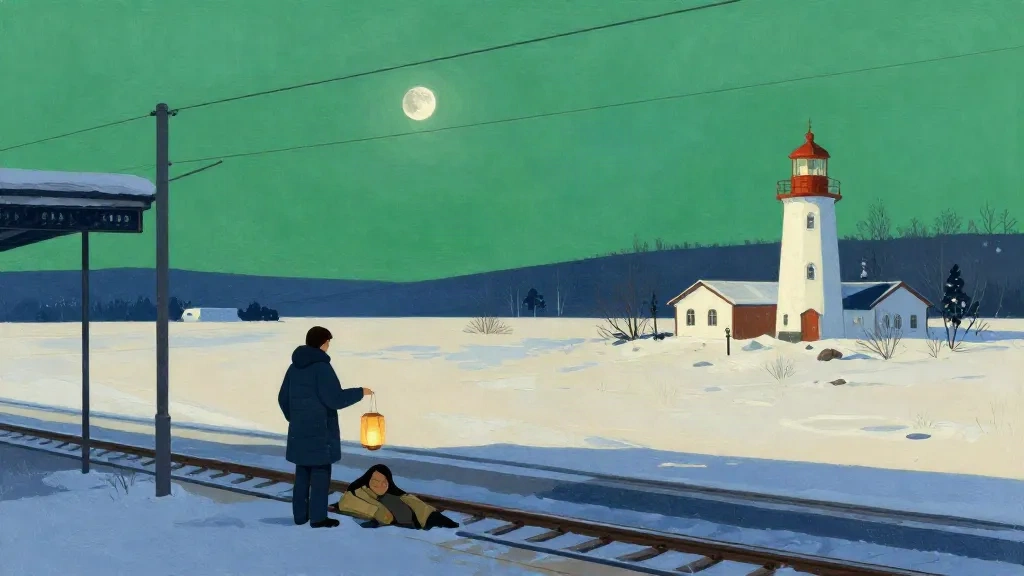
At the last hour of winter, the station glittered with salt. Frost had gathered along the rails in long white stitches, and beyond the glass, snow erased the city in cobalt shadow. The lamps burned low, each one surrounded by a halo of sea-glass green.
Maren kept the weather ledger beneath the station clock. She was a lighthouse keeper by appointment, though the lighthouse had been gone for three hundred years. Her duty was to catalogue skies that existed nowhere else: the amber rain of a drowned kingdom, the red dawn over a country asleep underground, the blue lightning that struck only inside open hands.
Each morning, passengers boarded for alternate seasons. They left with tickets punched in colors no ink could explain. The station master had posted the municipal ordinance beside the timetable: No impossible thing shall be admitted, performed, retained, or remembered.
Maren obeyed it with care. She wrote every impossible weather in her ledger, then rubbed the entries away before midnight. The ordinance had teeth. Once, a woman had stepped from a train smelling of hot grass and vanished from every photograph, receipt, and conversation. The city had called it correction, not tragedy.
A Sleeper With No Shadow
On the night the small moon appeared above the tracks, Maren found a passenger asleep beneath the timetable.
The moon was no larger than a coin, but it cast a pale green glow across the floor. Beside the sleeper lay a paper lantern, folded flat, its tiny wire handle tied with blue thread. The woman had no coat, no ticket, and no shadow. Snow blew through the gap beneath the station door, yet the hem of her dress never moved.
Maren recognized the lantern. She had seen it in three forgotten years, in the private weather of a village where every child carried a light to the shore. The village had been removed from the city map during a municipal tidying. Its season, its people, and its grief had been folded away.
The woman's lips moved. “You promised me the sea,” she said.
Maren had made no promise. Still, the words carried the weight of a bell beneath water. She opened her ledger and wrote: One sleeper. No origin. Destination: everywhere already lost.
The ink dried into a line of sea-glass green.
An Illegal Kind of Weather
At two in the morning, the station master arrived with two inspectors and a brass seal.
“The woman is an impossibility,” he said. “By ordinance, she must be returned to the last season that contains her.”
Maren folded the paper lantern into her coat. “She is a person.”
“A person can become a condition.”
He pointed to the windows. Outside, the snow had stopped. Each pane displayed a different sky: spring fields, summer storms, an autumn orchard burning beneath a copper moon. The forbidden seasons leaned against the station, pressing their hands to the glass.
Maren opened the weather ledger. She read aloud the entry for a rain that fell upward, then the entry for a wind that remembered every name spoken in grief. The inspectors shifted uneasily. The ordinance forbade impossible things, but it had not defined their sound.
When she spoke the sleeper's description, the station changed. The tiled floor became wet sand. A lighthouse beam swept through the walls, green and steady, though no sea could be seen.
“This is illegal,” the station master said.
“Yes,” Maren replied.
The Season That Owes Her a Name
They boarded the midnight service without a route. The conductor rang no bell. The rails sang beneath the wheels, and the small moon travelled beside the window, keeping pace.
Maren lit the paper lantern. Its flame cast no shadow, only a circle of sand-colored light around the sleeper's hand. The woman opened her eyes.
“What is your name?” Maren asked.
“I was Iven,” she said. “Then everyone began forgetting me together.”
Maren entered the name in the ledger. The page resisted. White seams split across it, and the station master's ordinance flared in red letters. Somewhere, doors were being locked in every city block. Somewhere, a thousand people were deciding they had never known Iven.
Maren tore out the page and held it above the lantern flame. The fire burned without consuming it.
“A lighthouse does not save the whole coast,” she said. “It saves the vessel nearest the light.”
She placed the page in Iven's palm. The woman spoke her name once. The train left the rails and crossed a dark field of winter stars.
At dawn, the station held no impossible passenger. The ordinance remained on the wall, freshly inked. But beneath it, in letters no clerk could erase, someone had written: Iven was here.
Maren opened her ledger to a new page. Above the lighthouse beam, the small moon dimmed. She drew its green reflection beside a paper lantern, then entered one last weather: clear skies, wherever she was remembered.





