 Netwrck
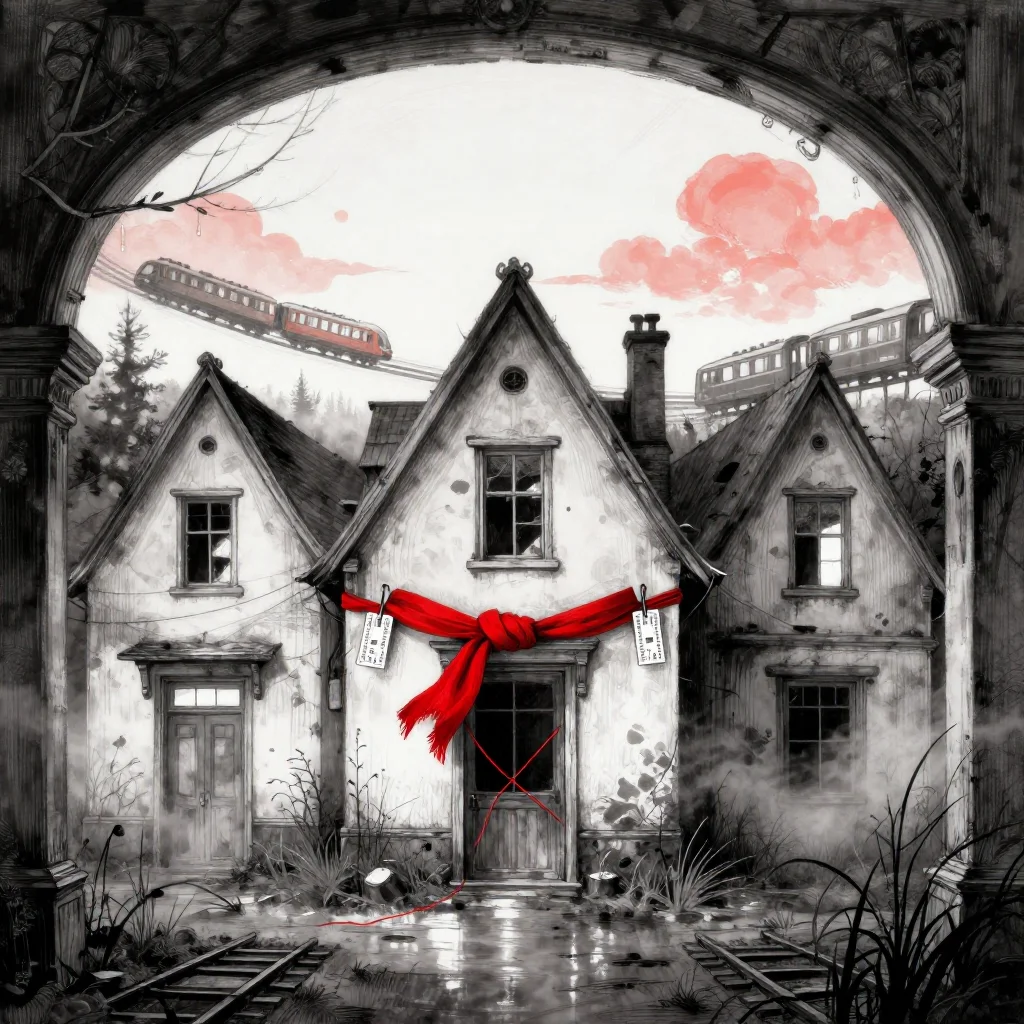
Gothic Fantasy.
The House With a Fever
By the time Mara Venn reached Morrow House, the windows had begun breathing frost.
She carried her black medicine case through the garden gate and a red wool scarf around her neck, though the afternoon was warm. The house stood at the end of a lane where no house should have stood for forty years: three gables, a sagging porch, and upstairs windows lit by a pale blue glow. A red thread ran from its weathervane to the hinges, then across the door and down into the grass.
“Homesick again,” said the stationmaster from behind her.
He was leaning against the abandoned cinema opposite, a man in a conductor’s coat with brass buttons gone green. His name was Orrin Vale, and he carried a timetable in one hand.
“The house is grieving,” Mara said.
“The house is delayed.”
He opened the timetable. Every page was blank except for a departure stamped in red.
Inside Morrow House, the fever was worse. A child’s bedroom had grown a hallway in the wrong place. In the kitchen, cups trembled on their hooks. The walls carried a low murmur, hundreds of people repeating unfinished sentences.
Mara set down her case. The house smelled of wet wool and railway smoke.
“Where is your brother?” she asked the woman sitting beside the cold stove.
Elian’s sister, Ada, looked up. Her face was thin with sleeplessness. “He leaves at dawn. He says he cannot bear the sound of this house remembering him.”
On the table lay a train ticket. It was unused, its date smudged by many fingers.
Future Films
That night, Mara climbed to the cinema projection room. Orrin waited beside the old projector, feeding it a reel with no label.
“Every ending is a scheduling error,” he said. “A door closes because nobody moved it in time.”
He switched on the machine. Light struck the abandoned screen, and Mara saw a future that almost happened: Ada at the station, waving through a train window; a red scarf caught on the door; a small house standing alone beneath a white-coral sky.
Another reel showed the same scene, but Ada remained at the kitchen table. The house stopped breathing. Her brother boarded the train without looking back.
“Which is true?” Mara asked.
“Both are scheduled,” Orrin said. “That is the trouble.”
He handed her a strip of film. The images were blank until she held it beneath the projector’s light. Then words appeared in wavering white: THE SPEAKER MUST BE HEARD BEFORE THE DEPARTURE.
Mara understood. The house was not only grieving. It was preserving every unsaid sentence, pressing them into its walls, waiting for a voice to return them.
Ada had refused to speak to her brother since the winter their mother died. Elian had filled the silence by leaving one room at a time. Now the house had swallowed his childhood, his quarrels, even the melody he used to hum while washing dishes.
“Can you alter the ending?” Mara asked.
Orrin watched the screen. “I can correct the timetable.”
The Unfinished Sentence
They found Elian beneath the cinema, packing his mother’s blue china into a crate. A red scarf lay across his shoulders. He wore no coat.
“I’m not afraid of the train,” he said. “I’m afraid that if I stay, she’ll hear me leave.”
Mara led him to the kitchen. The murmur in the walls sharpened. Ada stood before the stove, hands locked over her ears.
“You left without saying goodbye,” she said.
“You turned every goodbye into a punishment.”
“I wanted you to stay.”
“I wanted you to ask.”
For a moment, the house creaked. A red thread tightened along the floorboards and climbed the table leg.
Elian reached into his pocket and took out the unused ticket. He had carried it for three years.
“I bought this before the first fight,” he said. “I meant to give it to you. I thought if I kept a future in my pocket, I would have time to become brave.”
Ada took the ticket. The date on it was tomorrow’s, written in a hand neither recognized.
“That isn’t possible,” she said.
Orrin appeared in the doorway, holding the blank timetable. “Every ending is a scheduling error,” he said, “until someone speaks clearly.”
Ada looked at Elian. “I’m sorry I made the house carry it alone.”
Elian answered, “I’m sorry I asked it to.”
A Future That Held
The train arrived without a sound. Its windows were black mirrors, and the rails ran beneath the floor toward the house’s front door. Orrin punched a departure card. The red stamp bled across it.
Elian put on the scarf. Ada tied the unused ticket to its end.
“You’re still leaving,” she said.
“Yes,” he said. “But not before I’ve lived here again.”
He stepped into the carriage. Ada followed him to the threshold, then reached out and caught his hand. The house shuddered. Somewhere above them, every window cleared at once.
On the cinema screen, the future changed: the two of them returning together, red thread trailing from the door, their mother’s blue china rattling safely on a shelf.
Orrin watched the image and frowned. “That ending was not on my timetable.”
“Then you made another,” Mara said.
By morning, the lane held no frost. Morrow House had stopped breathing, but it still kept one window open. Red thread crossed the sill, thin as a pulse.
Whenever the house began to ache, Mara knew where to find the remedy: not silence, not a locked door, but the sound of someone saying the truth before the train arrived.





