 Netwrck
Mystery.
The Screen That Remembered
Mara Venn inherited the abandoned cinema with the recipes, the dented copper pans, and a key she could not explain. The Low Water Picture House stood at the end of Saint Orra Street, its roof shedding rain into a gutter that had forgotten how to reach the sea. The marquee still announced a season’s worth of films, though every letter had peeled away except one: TONIGHT.
Inside, the air smelled of dust, hot dust, and rain trapped beneath the seats. Mara had come to prove a family legend: that her grandmother, cooks before her, had once served a meal to a man who arrived from a future that never happened. According to the story, he had left behind a black umbrella and asked for one dish that could make the dead remember their names.
Mara set the umbrella beside the projection booth. Its silver spokes were intact. Its canopy was dry.
On the screen, a woman in a white apron stood in a kitchen flooded with amber light. She kneaded dough while a little girl watched from beneath the table.
“That is impossible,” Mara said.
The woman looked directly at her. “Not impossible,” she said. “Only postponed.”
The Dry River Beneath the Balcony
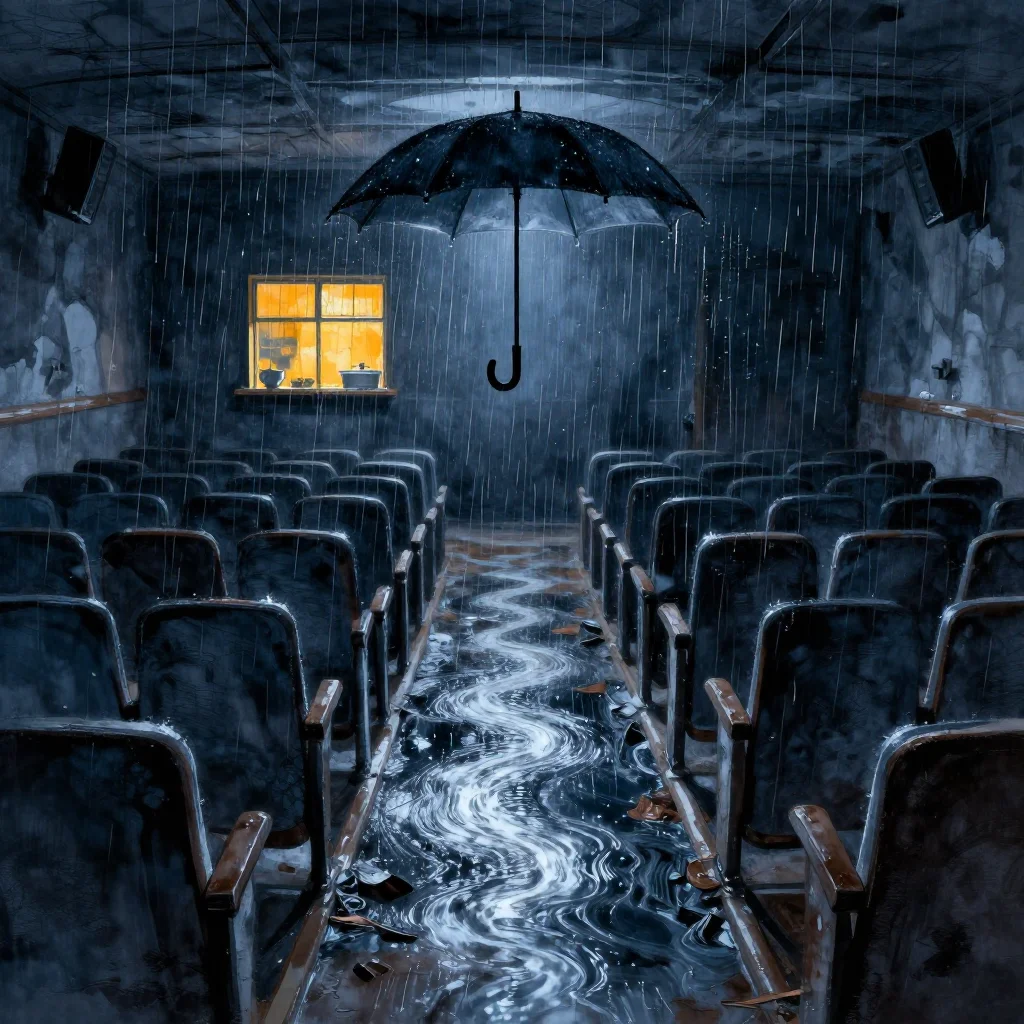
The cinema’s seats had been removed, leaving a shallow basin of cracked concrete beneath them. Rain entered through the broken roof and collected in the depressions, but the water always ran toward the center, as if pulled by a slope no one could see. In daylight it was a dry riverbed, silver with mineral dust. At night, when the projector awakened by itself, the basin shone like black water.
Mara found the first film at midnight. It showed a city where the river had returned. People stood on its banks, holding umbrellas against a rain that fell upward. A man crossed the bridge and removed his coat. He was her grandfather.
In the next film, her grandfather was older, standing in the same riverbed. He held a ticket in one hand and a black umbrella in the other. In another, he entered the cinema through a wall that had not yet been built. In every version, he looked back at the screen as though waiting for someone to tell him what to do.
Each film began without a title. Each ended with Mara’s family recipe written in handwriting she recognized as her own.
Behind the last row of seats, she found a narrow door painted the same ink blue as the night outside. No handle. No hinges. A brass plate bore the words:
WHAT WAS SPENT MAY NOT BE SPENT AGAIN.
Her father had told her the gate was a story meant to frighten children. He had said it without looking at her. He had already spent the cost, whatever that meant.
The Table Set for One More
Mara opened the kitchen behind the concession stand. Copper pipes ran through the walls, carrying a warm amber glow from a single window high above the sink. She gathered flour, bitter greens, salt, and a small jar of honey clouded by age. She had prepared the dish for customers who never arrived, because cooking for them had been easier than asking why they were gone.
She cooked the legend into a stew: roots softened in stock, green herbs bruised against the clay, grains of rice shining like wet stones. As the steam rose, the cinema changed. A door opened somewhere in the walls. Footsteps crossed the empty lobby.
They came one by one, taking places at a table that had not existed a moment before.
There was the woman from the first film, the upward rain, her fingers stained blue with ink. There was a boy carrying a lantern and a man whose face Mara knew from her grandmother’s photograph. They looked hungry, but not for food.
“You brought the recipe,” the woman said.
“I brought proof.”
“The recipe proves only that you remembered it.”
Mara laid the black umbrella on the table. The lantern boy reached for it, but stopped before his hand touched the handle. The man in the photograph studied Mara’s face.
“Your father paid at this gate,” he said.
Mara’s spoon struck the bowl. “With what?”
“The life he would have lived if he had stayed.”
The Cost That Cannot Return
Her father had left when she was eleven. He had promised to return before the next rain. The riverbed dried that year. On its stones, Mara had found a black umbrella folded beneath a slab of slate.
Now the booth door stood open. A staircase descended into the dry river, carrying a thread of rain-silver light toward the city below. The gate had opened. But on its threshold lay another umbrella, already open, holding a pool of darkness shaped like a hand.
“To pass, one person must leave something essential behind,” the lantern boy said. “Not a memory. Not a possession. A future.”
Mara looked at the faces around the table. They had all arrived through the gate. Each had surrendered the life that might have been.
“And if the cost was already paid?” she asked.
The woman in white turned her bowl over. A second meal waited beneath it, untouched and cooling.
“Then the gate opens once,” she said. “For the one who pays next.”
Mara understood. Her father had not escaped the cinema. He had become its toll.
She took the black umbrella and stepped onto the threshold. The dark pool rose to meet its handle.
“I am not paying for him,” she said. “I am asking him to keep his promise.”
She opened the umbrella. Beneath it, rain fell into the dry riverbed and made a silver channel. At the far end, a man turned. Behind him, a kitchen window burned amber.
“Mara,” her father said.
“You were supposed to come home.”
“I did.”
He touched the amber light. The screen went white.
When the picture returned, the table was empty. The stew had been eaten. The gate had closed. Only the black umbrella remained, its silver spokes bright beneath the single warm window.
Mara carried it home through the rain.





