 Netwrck
Fairy-Tale Fiction.
The Door That Could Not Be Walked Through
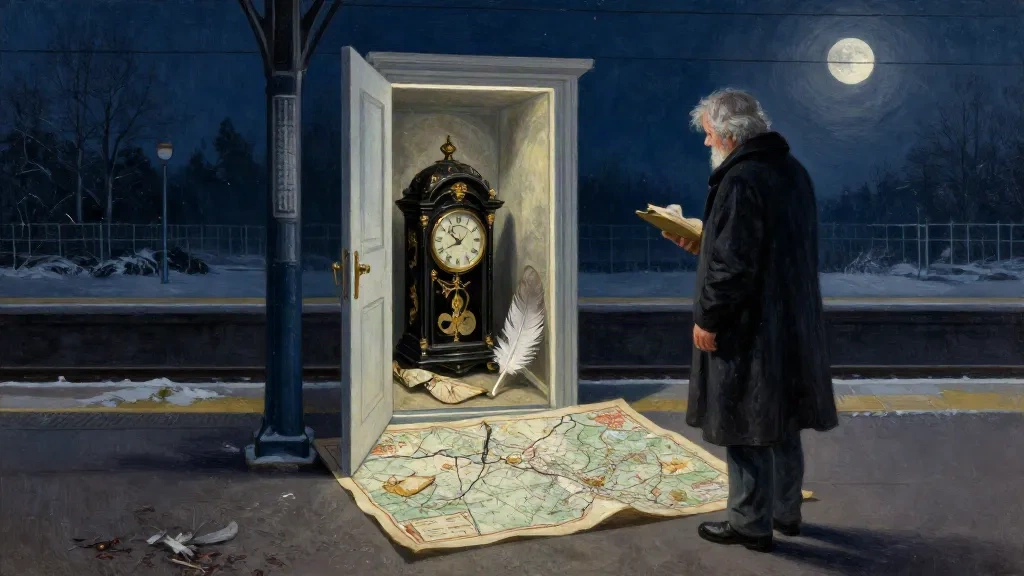
On the coldest night of the year, Mira Vale stood beneath the station clock while snow crowded the black lacquer windows. The platform ended in a blue lantern and a white field, though the rails continued past both.
She had spent forty years drawing coastlines, vanished villages, and the borders of kingdoms that no longer possessed governments. Retirement had left her hands steady and her maps unused. She had come to this station because its timetable promised passage into alternate seasons, and because she wanted one destination that could not disappoint her.
Mira unrolled a map of Saint Orra, a town erased by a reservoir thirty years ago. She searched for a blank space, found one between the old quarry and the drowned church, and drew a narrow door in blue ink.
The ink rose. The door appeared in the station wall, its brass handle cold enough to burn.
Behind it waited a room filled with lost things. A cracked cup. A red mitten. A child's shoe polished by a vanished foot. The room had no visible floor, only a pale depth.
“I want a place where they can rest,” Mira said.
The room answered with a thin wind.
The Market of What Must Be Believed
Beyond the door lay a market under a roofless winter sky. Stalls stood on iron tables, their wares arranged with care: a summer apple sweating in the frost, a brass key for a lock that had never existed, a paper boat carrying a sentence nobody had spoken.
At the final stall sat a woman wrapped in gray fur. She displayed a moth wing, pale as old parchment, and beside it rested a single white feather.
“You seek a sanctuary,” the woman said. “The station is full of lost things. None of them know how to remain.”
Mira pointed to the two objects. “What do they cost?”
“The feather costs a promise you can keep. The wing costs a truth you have hidden.”
Mira touched the moth wing. It trembled beneath her finger, almost alive. She remembered the night she signed the report that erased Saint Orra from the official records. She had known the town was still occupied. She had chosen the safer lie.
“The expensive things are always true,” the merchant said.
Mira drew the wing onto Saint Orra's map. The ink darkened, and a small voice cried from the room behind her.
Every stallholder turned toward her.
“The truth has been sold,” one whispered.
The white feather lifted itself from the table. It pointed toward the station clock.
What the Winter Refused to Forget
Mira ran. The market's lanes stretched and folded, turning her back toward the same black lacquer doors. She tore the map open. Names rose from the paper in silver: her village, her mother's house, a room where she had once confessed that she was afraid of silence.
She drew another door, this time onto the place she had tried to forget. The wall opened onto a train carriage filled with winter coats. Frost silvered every window. On the seats sat passengers whose faces had been rubbed away by time.
“Where do you want them to go?” asked the station voice.
Mira had wanted a place. A real place, with a roof and numbered shelves, a stationmaster, a warm lamp, a rule against opening the door after midnight. But a place required a name, and names were what the lost things no longer had.
She drew a small room on the map of a place that had vanished before she was born. She gave it a window, a stove, and a wide table. She gave it no walls, only a horizon.
The lost things arrived. The cup. The mitten. The shoe. They settled around the table like birds after a storm. The moth wing glowed above them, scattering gold dust through the air.
The white feather landed in Mira's palm.
“What is the price now?” she asked.
“Someone must remember them,” the station replied.
A Map That Kept the Door Open
Mira remembered the red mitten. She remembered the name painted inside: Elian. She remembered the crack in the cup and the first sip of winter rain from its rim. She remembered the shoe's owner, then remembered that his name was Thomas, though she had called him Father in the map's margin.
Each memory became a small light in the room.
When dawn reached the station, the market had vanished. The price had taken Mira's perfect certainty. She could no longer claim that the vanished places had been empty, or that every line on her maps had been true.
The station clock began again.
Somewhere beneath it, a door opened inward. Beyond it, lost things rested around a table while winter snow melted on the rails. The white feather guarded the threshold. The moth wing watched from the wall, a small gold constellation in the cold moonlight.
Mira folded her last map. The station had not given her a place of arrival.
It had given her a place that could continue.





