 Netwrck
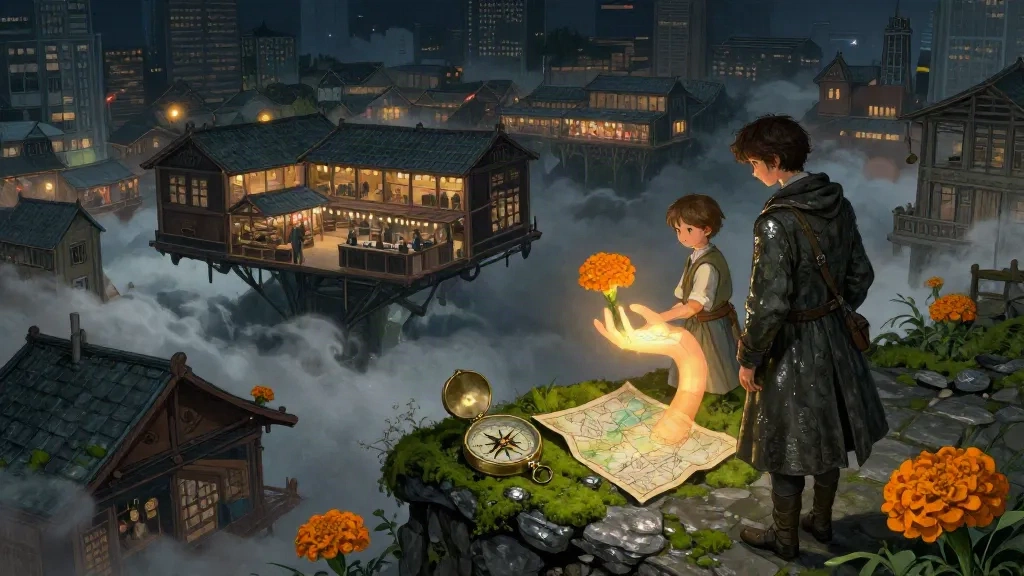
The Country on Her Hand
On the highest floor of Bellweather, where the stairways ended and the roofs began, the night market opened beneath a sky stitched from copper and cloud. There were no streets below the first floor. The city had been built upward for generations, its lowest rooms buried beneath cisterns, chimneys, and the accumulated thunder of a thousand market days.
Clara Venn, apprentice to the cartographer Elian Voss, carried his brass compass in one pocket and a folded map in the other. The compass had no needle, only a glass chamber set into its lid, and inside the chamber a dark green moss that had grown there from nothing and refused to grow anywhere else. The map showed streets that did not exist and blank spaces where whole buildings had been removed. Voss's rule was short, and he enforced it without ever lifting his voice.
Never draw what you have not walked. A map is an argument, not a picture.
Clara walked everywhere. She had been mapping the undersides of awnings since she was nine, and she had learned that a roof tells you what a building is ashamed of. The market smelled of hot iron, hot sugar, and the wet-flea smell of a place where objects were allowed to become other objects. Vendors sold bottled dusk in stoppered phials that glowed when you argued with them, salt flowers that bloomed once and were then worth nothing, and maps drawn on discarded memories, which faded in the hand and could not be copied, only spent.
Her mother had hummed the same song every night before leaving for the market. Seven notes. The sixth climbed. The seventh never arrived: her mouth had opened on a silence shaped exactly like a held breath, and then the door, and then the stairs going down and down.
Clara first noticed the country when she drew ink across a cut on her palm. The ink gathered instead of spreading. Beneath it a coastline appeared, crooked and confident, with a mountain range laid down like a spine and a river no wider than a hair. She wiped her hand with a cloth. The country remained. She washed it in the cistern basin; the borders shifted, sulking, and reformed slightly inland. When she wore a glove, the glove wore a country too, and at dinner it sat on her plate beside the bread, faintly green.
Voss saw it on the third day. He did not ask. He set down his pen, and for a long moment the only sound in the cartography room was the market's bell, which had no clapper and rang anyway at irregular intervals, out of boredom, he claimed.
“You will want to draw it,” he said at last.
“I will.”
“Don't. Not yet. A country you have only looked at will lie to you, and you will draw the lie, and then the lie will be the only version with witnesses.” He turned the compass so the moss faced her. “This was in my hand once. On the stair to the sixth floor, in the year of the long rain. I had a country and I lost it in nine days.” He said it the way a man reports a debt. “I do not know what your one is doing on your skin, Clara, but I know what it costs to keep looking at it, and I will not be the second person to let you find out on your own.”
That night she went looking for her mother's seal.
The Rival's Empty Name
She found it at a stall no wider than a doorway, hung with nothing at all — no cloth, no lantern, no goods — except a single folded map, pinned flat, face up, as if waiting to be recognized rather than sold.
The seller was a young man in a coat the color of wet stone. A marigold thread was tied twice around his wrist. He did not ask money. He said, “You found it,” and Clara said, “Found what?”, and he said, “The country. Most people never see it. Most people would be grateful not to.”
His own hand was turned up and open, and it bore a second country: larger, darker, laid in heavier lines, with a red city burning at its centre. He claimed the missing note was stored there, folded into the map of a country no instrument had ever agreed to measure. He wanted it for a reason he offered without being asked, the way people offer the worst version of themselves first.
His sister had been struck from the city's founding ledger. Not born late, not misspelled — struck, in the registrar's hand, in a column reserved for names that had never been entered. The city had never recorded her. Her name was the kind that gets you strange looks at the soup queue and your own name back from a clerk who has never heard of you. Only Rowan remembered her. He had been eleven. He had kept her in his mouth for nine years, and it had cost him everything that a name buys: tenancy, wages, a room, the right to be written an invitation.
Clara understood the temptation in a way that frightened her. A song with no ending is a door that cannot close. She wanted the seventh note because her mother had promised to return when it was found — a promise made lightly, in a doorway, by a woman who dealt in other people's endings.
Rowan reached for her folded map. Clara caught his wrist. His skin was cold and slightly damp, like stone in a cellar.
“Why should I trust you?”
“Because you won't,” he said, and something moved across his face that was not a smile. “Trust is another kind of country. Nobody walks into one and comes out the way they went in.”
They climbed to a roof above the market where the lanterns trembled in the updraft and Bellweather spread beneath them in tiers of glass, iron, and green copper, every window a small argument against the dark. Below, vendors called prices for bottled dusk and memory-maps and the last acceptable year of a particular kind of weather.
“What does playing it cost?” Clara asked.
Rowan looked at the burning city on his own hand for a while. “The note has to be played. Someone has to play it. The ledger opens for one song and closes for the next.”
“That isn't an answer.”
“No,” he said. “It's the door I can afford to open.”
The Stall of Unfinished Songs
The trail led down through the market's oldest reach, where the awnings were patched with older awnings and the sellers had stopped competing on price. An old woman traded in unfinished songs: a boy reciting nine bars of a lullaby and stopping with his mouth open; a widow holding a hummed aria in her throat, unwilling to spend it; a jar of a woman's laugh, corked, still faintly moving.
Clara's mother had been a customer. The old woman remembered her by what she had never finished.
“She bought a beginning,” she said. “Said she already had the rest.” Then she took a small clay flute from a drawer and pressed it into Clara's hands, cool as a spoon in a bowl of milk, and gave Rowan a black feather with no quill, only barbs, and told them both to be back before the second bell or not at all.
Behind her, on a table of unfinished things, lay a single red glove, folded flat, sized for a hand smaller than Clara's.
Where the Note Was Buried
At midnight the market thinned. Stalls folded their own tables. The bell that had no clapper rang once, and the copper sky above the roofs went the colour of a bruise.
Clara's palm opened like a door swinging on a hinge she had not known was there. The mountain range rose under her skin, and the country on her hand and the country on Rowan's hand met at the edges, red city to green coast, and the air between them took on the smell of wet chalk.
They went down into the country rather than across it. The red city was a bell: a chamber shaped like a bell, its walls fluted, its floor stone, its air full of wind that came from nowhere and went nowhere, smelling faintly of rain that had not started. Rowan walked as though he had been here before and been politely evicted. The seventh note lay on the floor a finger's length above the stones, visible and completely silent, the way a held word is visible.
Beside it knelt a boy made of folded paper, jointed at the knees with tape gone soft, holding Clara's mother's red glove in both hands. He had her mother's eyebrows. He had no mouth worth the name.
Clara knelt and the paper of his shoulder crumpled under her fingers, and she understood, with a clarity that felt like a blade slipped in under the ribs, that this was all that had come back. Not her mother. The shape her absence had worn in the world, folded flat, waiting to be addressed.
Rowan moved toward the note. Clara put the brass compass between them, and the moss in the glass chamber lit up green, throwing their shadows up the fluted walls, and the wind in the chamber stopped as though something had drawn its breath.
“You don't need it to remember her,” Clara said. “You need it to make the world admit she existed. Those are different and you know which one you came here for.”
“The world took her.”
“Then let the world hear what's left.”
“Left of what?” he said. “Clara. Look at what you're holding. There is nothing left of her. There is a glove and a paper boy and a song with a hole in it, and if you play this and the ledger opens, the ledger does not give people back. It gives records back. It gives paper. It gives a clerk saying yes, this was written, and it will not give you a hand to hold.” He said it fast, and he said it with a great deal of care, and Clara heard both.
She looked at his hand, at the burning red city, at the nine years of his mouth keeping a name alive.
“You knew the cost,” she said. “You knew it and you let me believe it was a song.”
“I knew you wouldn't play it unless you thought she was in it.”
“So you lied to a stranger and called it the only door.”
“I lied to the only person in this city who could open it,” he said. “If that makes me the villain of your evening, I have been worse and more efficient.”
And that, Clara thought, holding the clay flute, was the first entirely true thing he had said. She set it to her lips.
A Song With Two Doors
She played the first six notes. They came out of her badly, hoarse, in a stairwell of a chamber, but they came out. The paper boy lifted his head. The wind began again, moving toward the mouth of the bell. Rowan stood with his hand half raised and did not raise it, and she understood that he was not watching the note but watching her, waiting to see if she would stop.
Then she played the seventh.
It was not the note she had expected. She had spent nine years imagining it as a high clean sound that would finish the sentence her mother had started. It was not high. It sounded like a door opening in a wall you had lived your whole life behind, and then a voice, unhurried, saying her name the way a person says the name of a street they used to live on.
The note divided in the air.
One thread of it went down into the country on her hand and the blank coast along its western edge turned green, in patches, like frost leaving. The other thread crossed the floor to Rowan and did not stop at him; it went into the fluted wall, and the wall became paper-thin, and behind it she could see the founding ledger: a book the size of a door, its columns in a registrar's grey hand, its seventh page rewritten and rewritten until the vellum had gone furry.
His name came back first, letter by letter, the ink drying as it formed. Then his sister's, which had been struck, and which the ledger took some time deciding to accept, the way a locked gate takes time deciding it has been asked properly.
Rowan wept without shame, which Clara found harder to watch than cruelty would have been. He said his sister's name once, out loud, to test it, and then again, and then he laughed, once, horribly, at nothing.
The wind in the bell took the rest of the note. Clara felt it go out of her the way you'd feel a held breath finally released after nine years: not a taking, exactly. A setting down.
“Why didn't you take it all?” he asked, when he could speak. “There was enough for one name. There was enough for her.”
“There was enough for one name and one door,” Clara said, “and I know which one my mother left open for me.”
Then the paper boy unfolded. He came apart along his taped seams with a dry little rush, the way a bundle of letters comes apart when you drop it, and the red glove fell over and lay flat on the stone, empty, and stayed empty. Clara picked it up and it was paper, and cold, and nothing else. The chamber exhaled. The fluted wall with the ledger behind it thinned, went translucent, and was stone again.
She could not remember her mother's face.
She could remember the glove's smell of dye and dust, and the weight of it, and the shape of her mother's shoulders bending to a doorway, and she could remember six notes with a hole where the seventh had been, and when she reached for the face it was not a wall. It was a room with everything taken out of it. She had traded it. She had traded it in full, in good faith, for a name on a wall.
The Ledger Refuses
Rowan's name was restored to the ledger and the city declined, with great courtesy, to act on it.
This is what a restored name buys in Bellweather: a clerk who looks up instead of away, a landlord who must now admit he has been paid, a record that says a room was let to Rowan Ash in the ninth year of the copper rains. It does not buy a sister. She had been gone nine years, and there is no column in any ledger for the dead who were never entered, and the registrar explained this to Rowan across a counter for forty minutes with genuine regret, and then went home.
He took it better than Clara expected. That was the worst of it. He did not rage. He sat on the roof above the market with his restored name in his mouth, turning it over, and he said, “I knew. I knew and I wanted it anyway, and now I have it, and it's a word.”
“Yes,” Clara said.
“You could have taken the whole note. You could have had her back on paper and a clerk saying yes.”
“I could have,” Clara agreed, “and you would have spent the rest of your life resenting me for it, which is not the same as forgiving you.”
He laughed again, and this time it was nearly real. “Your master's rule. A map is an argument.”
“He has more of them.”
What Voss Had Not Said
In the morning the market was gone from the roof's floor — not emptied, not packed up, but unbuilt, its bolts still in the air, its awnings hanging from nothing, and by noon the whole reach had settled into ordinary roof and weather.
Voss did not ask what she had played. He asked what it had cost, and Clara told him, and he put down his pen for the second time in her life and did not pick it up for an hour.
“Then he lied to you,” he said finally. “And so did I, in a slower way. I have been drawing a map of a country I walked once and lost in nine days, and I have been drawing it in your hands instead of my own, because yours were young enough to hold it. I let you find the door because I could no longer open it. You should hate that more than you hate his.”
Clara sat with the red paper glove in her lap, which she had kept, though it was paper, and which weighed nothing, and which she would not throw away for eleven years.
“Did you find a door,” she said, “that let you keep her?”
Voss looked at his own hand, older and mapped with ink that would not wash out.
“I erased my name from the founding ledger,” he said. “On purpose. The ledger only opens for a name it holds. It took me two years to learn that, and a clerk's knife, and a very bad night of drinking. I went in. I came out. She did not.” He picked the pen back up. “Draw the awning you were on, Clara. You are letting it go to bad to feel it more honestly.”
The New Road
Two weeks later a road appeared on Clara's folded map, running north-south between two places that had always been divided by the river, joining Tanner's Stair to the chalk quarries in a single clean stroke of ink.
Elian Voss looked at it a long time before he said the thing that made it worse: not you drew this, but you drew this without drawing it.
Because it was true. Clara had put her palm flat on the map the night after the bell, the way a child presses a wound to see if it still hurts, and the blank country on her skin had answered, and the map had taken the impression the way vellum takes an embossing: a truth the world had agreed to, arrived at sideways, through her.
The road arrived in the world the same way. It arrived in three days, without scaffolding, without consultation, with the terrible cooperation of a city that has been wanting an excuse for years. Tanner's Stair lost forty houses. Not ruined — relocated, in the legal sense, which is a word with a hinge in the middle, and the hinge is where the cruelty lives. Their chimneys stayed. Their doors stayed, opening now onto a wall of dressed chalk, three hundred yards from where the door had been. A woman named Ivet Sarran lost her kitchen, her tap, her grandmother's table, and eleven years of rent, and was given a certificate and a footpath.
Clara went down to the Stair with a ledger of her own and a list of names, and did the only thing she could think of, which was to stand in a chalk cutting in the cold and write down every name correctly, in full, with their histories, and hand the pages to the registrar and ask for them to be bound and kept where the city could not quietly lose them.
“You are not responsible,” Ivet Sarran said, without much comfort in it, standing in the mud where her house had been.
“No,” Clara agreed. “But I am the reason there is a place to write them down, and the difference is not large enough to make me comfortable, so I'm going to do this anyway.”
It took four years. It was not enough. Two families went to the coast. One old man died of the winter in a room that faced the wrong way.
The Market's Last Stair
Rowan rented a room, which he could now afford to do on paper. He came to the cartography room twice a month for eleven years, bringing coffee and never staying past noon, and he drew.
He drew well. He drew the city as it was, which put him permanently at odds with Elian Voss, whose maps recorded what ought to exist, and the two of them argued about it for a decade in a manner that Clara's other apprentices found exhausting and that she found the closest thing to family the trade allows.
“You are going to have to say it eventually,” Rowan said once, in the fourteenth year, over coffee.
“Say what.”
“That the world pays in the currency you hand it, and you handed it a name and it gave you a road and gave Sarran a wall. That is the whole of the cartography trade, Clara, and you have been doing it since you were nine.”
She drew a line she had been holding wrong for a decade and corrected it, and did not look up.
“I played six notes of my mother's song every morning for a year,” she said. “I couldn't get the seventh. That's what I tell people when they ask why I gave the note away for a name on a wall.” She set the pen down. “It's true. It just isn't the reason.”
“The reason?”
“Because the note took her face and I could live in a world where the ledger was honest, and I thought if the ledger was honest then so was the city, and so was I.” She turned the paper glove over in her hands, a habit, a small stupid devotion that never once worked. “I was wrong about the city. I was only ever right about the ledger.”
He waited. Rowan had always been better at waiting than at lying, which is why she had eventually married him on a roof above a market that no longer existed, with a cartographer as witness and no guests.
“The reason is that a girl with no name has nobody to mourn her but one person,” she said. “That was his sister. I know what that costs. I have watched him pay it in instalments for nine years and I was not going to make him pay it again so that I could keep a face.”
“You are not kind,” he said.
“No,” Clara agreed. “But I am accurate, and there is a road on the map now, and forty houses went into the chalk, and the ledger says all of their names correctly, and that is the only thing I have that resembles an apology. I would have kept a face, Rowan. Faces are not evidence.”
Far below their feet, hidden beneath Bellweather's foundations, in a chamber shaped like a bell, where the ledger's oldest page is furred with rewriting, a final note sounded in the dark.
Nobody heard it. That is not the same as it did not happen.





