 Netwrck
Fairy-Tale Fiction.
The Country on Her Hand
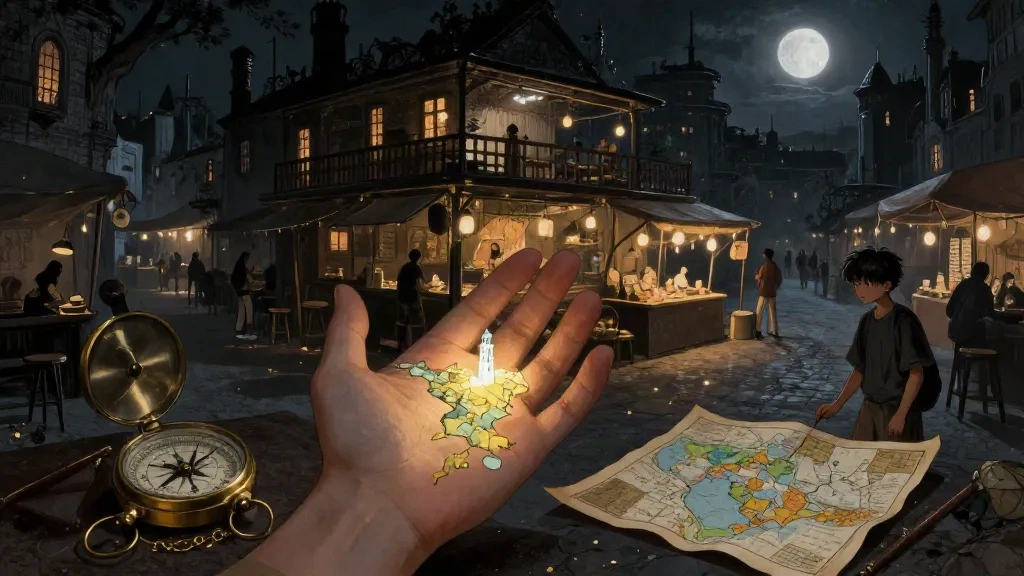
At midnight, the night market opened beneath the city, though the city had no second floor and no stairs below the first. It appeared in the black space under the old tollhouse: a row of lacquered carts, their wheels wrapped in straw, their lanterns burning without smoke. Vendors sold bottled thunder, salt from vanished seas, and small cold moons in wire cages.
There, seventeen-year-old Ilyra apprenticed to her uncle, the cartographer who mapped the places people could not reach. She carried his brass compass in one hand and a folded map in the other. The map was blank except for a gold line ending beneath its crease.
When a vendor spilled gold dust across the back of her hand, the dust sank into her skin. A border appeared. Then rivers, then tiny black mountains, then a silver coastline. Ilyra stared at the country forming there. At its center lay a white tower.
Her uncle had taught her to recognize a place by what it concealed. The country on her hand concealed a song.
She had known the melody since childhood. Her mother had hummed it while measuring flour, and the market children had answered it from beneath the floorboards. It was cheerful until the last measure, where the melody climbed toward a high, clear note. That note was missing. The song always ended with an ache like a door closing in another room.
The Rival Who Wanted Silence
Ilyra unfolded her map. The gold line had moved. It now pointed toward a stall selling black lacquer combs, where a boy named Oran was sharpening a knife.
Oran was her rival in the cartographers’ guild, though he never needed a map. He could hear lies in a person’s breathing. He had come to the market for a different reason.
“The final note belongs to my brother,” he said.
Ilyra tightened her grip on the compass. “Why?”
“Because it is the last thing he can hear.”
His brother had vanished three winters ago. Since then, Oran had been collecting lost sounds in glass tubes: confessions, farewells, the last words of dying birds. He said the note would restore a path through the sealed city. The path would lead to the place where the city had sent its unwanted children.
“You want to open the way,” Ilyra said.
“I want to bring him home.”
For one breath, their reasons fitted together. Then the compass needle spun north, east, south, and west, finally pointing at Ilyra’s own palm.
The country on her skin had begun to move.
Under the Black Lacquer
The market’s lanterns dimmed. Beneath the black-lacquered carts, the hidden country rose like a reflection in dark water. Ilyra saw streets winding through her own veins, saw houses balanced on her knuckles, saw the white tower glowing beneath her thumbnail.
Oran climbed down after her. He had brought his glass tube of lost sounds, along with the folded map.
“You brought the wrong map,” she said.
“It is your mother’s.”
He unfolded it. The blank paper filled with lines: the same country, the same silver coastline, the same tower. Her mother had drawn it from memory. In the margin, she had written one instruction in a hand Ilyra knew better than her own: Do not let the city hear you finish.
Ilyra pressed the map against the country on her hand. The two countries joined. A road opened, paved in black lacquer and powdered with gold.
They walked beneath the market in silence. The city’s sounds surrounded them: coins striking counters, beetles clicking in the dark, the endless scrape of a thousand carts. At last they reached the white tower.
Its door was closed. No handle. No keyhole. Only a narrow golden seam.
Oran raised his glass tube. Inside, one sound trembled: a boy laughing, then shouting her brother’s name.
“If the note is here,” he said, “then he may still be here.”
Ilyra placed her palm against the tower. The country lifted from her skin and became a map in the air. Every road led to the door. Every road ended at the same golden seam.
The Note That Opened Nothing
She sang the melody.
Her voice traveled through the tower, through the hidden streets, through the market above. The notes climbed higher. At the place where the final note should have been, she felt emptiness, cold as moonlight on stone.
Oran joined her. His harmony was rough but true. The lost sounds in his tube answered, layer after layer, until the empty space became crowded with voices.
Still, the note was absent.
Then Ilyra understood. The song had never been unfinished. Her mother had taken the final note and hidden it inside the city itself, inside the one thing the city could not bear to hear: a moment when it was allowed to stop.
She opened her mouth and sang no note. She simply listened.
For the first time, the market beneath the city listened too.
The black lacquer softened. Gold dust lifted from the ground and hung in the air. Cold moonlight entered every crack, not as a weapon but as a hand laid gently over a fevered brow.
Oran heard his brother laugh somewhere beyond the tower. The sound was far away, but it was no longer lost.
The golden seam opened without breaking. Inside was a room with no floor, only the night market spread below it, and above the room, the first-floor city asleep.
No brother waited there. No vanished city appeared.
Only a brass compass lay on a table, pointing toward the horizon.
Ilyra took it. The compass was warm. The folded map in Oran’s hands had changed: the country on her palm was now printed in gold, and its borders had opened.
At dawn, the market vanished. Ilyra returned to the cartographers’ hall with a new map, a missing note, and a rival who no longer competed with her.
Oran kept the glass tube. Whenever someone asked what the final note had been, he played the single sound inside it: a boy laughing in the dark.
Ilyra never sang the ending twice. Some doors, once opened, must remain open. And some maps are not made to show where you have been, but where the world has decided to let you go.





