 Netwrck
Fairy-Tale Fiction.
The Theatre of Unhappy Endings
At the edge of the city stood a theatre painted the black of a beetle’s wing. No one remembered who had built it, but everyone knew its rule: each night it performed the endings the world had discarded. A bride abandoned her husband at the altar. A king found the crown empty. A boy walked home with his mother’s shadow following him.
Ilan played the viola behind the scenes. He loved music because music refused to be persuaded by circumstances. In the orchestra pit, the winter wind leaked through the floorboards, carrying the smell of iron and snow.
One evening, a white feather drifted through the stage door. It was warm as a candle. After the performance, Ilan found a silver spoon on his music stand, polished until it reflected the black lacquer boxes above the stage.
Both objects returned the next morning, though the theatre had been sealed since dawn.
The Note of Truth
Ilan’s brother, Tomas, had vanished during the first snowfall. The city’s winter had lasted one generation now, refusing to thaw. Frost sealed the doors of homes, bridges, and hearts. Every morning, people declared that the winter would end, and every morning the sky answered with another silent fall.
“He went into the theatre,” a stagehand whispered. “Said he heard an ending that had not happened yet.”
Ilan searched the empty auditorium. He heard no truth in the stagehand’s warning, only fear dressed as fact. Then Tomas’s voice came from beneath the stage.
“I found the place where the winter is kept,” Tomas called. “It is inside a story.”
When Ilan replied, “I will come for you,” the theatre answered with a note he had never played. It rose through the floorboards, pure and cold as moonlight.
Truth had a sound. He understood then that the winter fed on discarded truths, the small admissions people made before witnesses: I was afraid. I wanted to leave. I knew I was wrong. Once spoken, those truths became loose endings, and the theatre collected them.
A Machine Against the Storyteller
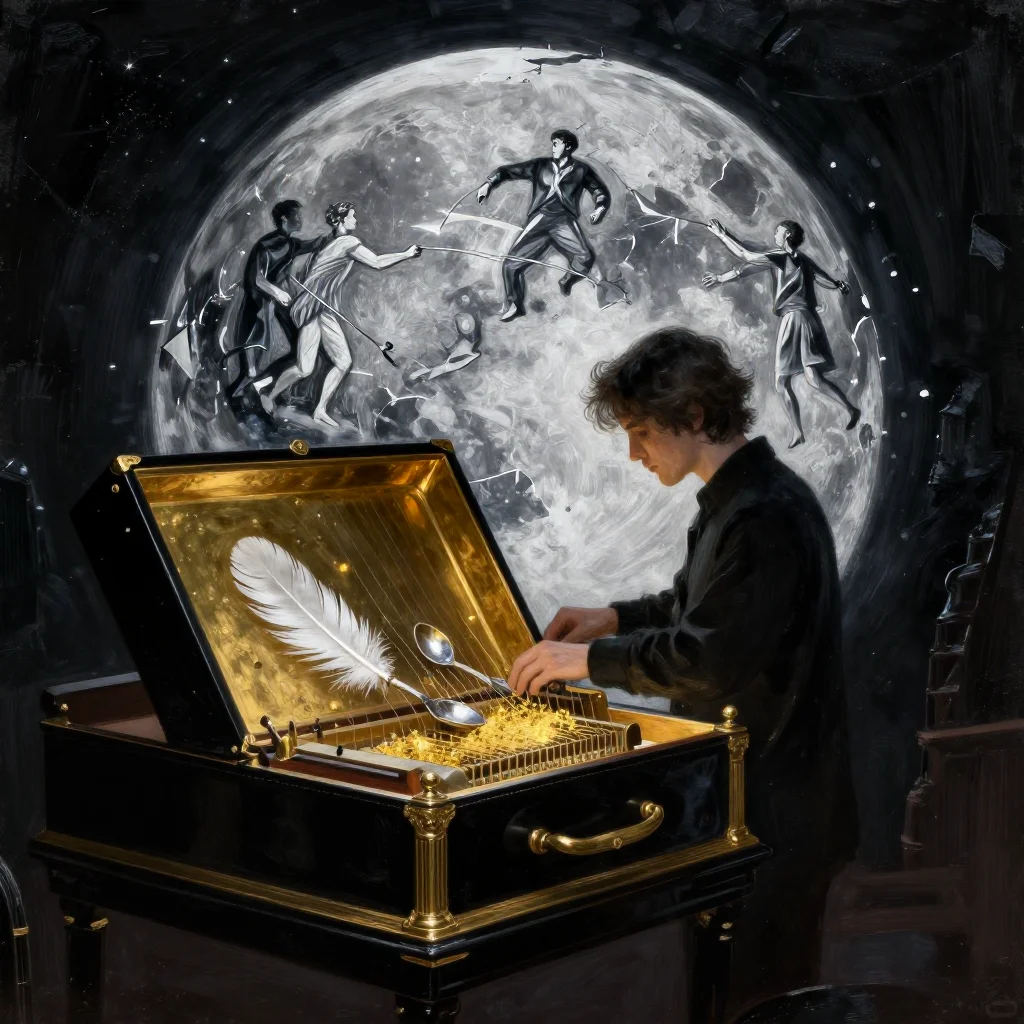
Ilan’s design was simple: a wooden chest with thirty-one brass strings, powered not by hands but by spoken truth. He wanted to build something that could survive the storyteller—to preserve a truth after the person who had lived it was gone.
He set the white feather between the strings and placed the silver spoon beneath the lid. The feather gave the machine its breath; the spoon gave it a measure of time. He tightened the screws until the chest sounded like a sealed winter.
On the third night, he entered the story.
The theatre became a forest of frozen actors. Their faces were masks of black lacquer, their costumes powdered with gold dust. At the center stood Tomas, young as he had been a generation earlier, trapped inside a globe of cold moonlight.
“The winter cannot end,” Tomas said. “Every ending it has eaten keeps it alive.”
Ilan opened his chest. He fed it every truth he had ever hidden: his fear that his brother had ceased to need him; his anger at the useless endings performed onstage; his secret wish to become famous and leave the city. Each confession struck a string.
The machine sang without a player.
What the Machine Could Not Keep
The globe cracked, but the winter did not leave. It moved into the music. Ilan understood, too late, that a truth preserved could also become a weapon. The machine began repeating his private doubts, amplifying them until the frozen forest shook.
Then Tomas spoke. “I stayed because I wanted to teach you to play without being watched.”
The note that answered was neither high nor low. It was the sound of a door opening in winter.
Ilan understood the flaw in his design. He had built a machine to survive the storyteller, but truth could survive only when someone remained present to hear it. The chest did not need to defeat the winter. It needed to give its ending back to the people.
He opened the lid.
The stored truths poured out as golden light, each one returning to its owner: apologies, admissions, promises abandoned and renewed. The theatre shook. On stage, actors spoke lines they had swallowed for decades. Mothers called children by their childhood names. Strangers confessed what they had hidden behind their smiles.
The winter broke not with warmth, but with breath. Tomas’s hand found Ilan’s.
At dawn, the theatre opened its doors. The city’s rooftops shone with clear, cold moonlight, and the snow had melted into silver runnels along the black lacquer walls.
Ilan kept the white feather and silver spoon on his music stand. The machine stayed in the theatre, repaired and useful, but he played every evening beside it. Some pieces were better when witnessed. Some truths were better when released.
And whenever the wind began again in winter, the theatre listened for the first true note.





