 Netwrck
Mythic Fiction.
The Country on Her Hand
Sera was drawing the contour of a dry river when the brass compass on her belt began to turn. Its needle did not settle on north. It swung under her wrist and held there, patient as a dog at a door, aimed at the station clock, where the second hand had stuck at 17:16 and stayed for eleven minutes a night for as long as anyone in Kalium could remember.
She had been apprenticed to Master Ilyan for two years, which meant most of what she knew about maps she had learned by copying coastlines and measuring shadows with a brass plumb line worn smooth on one end. The guild’s rule was a single line long: no map of a place you have not stood in. Ilyan taught it without emphasis, the way he taught everything, and then made her stand in the riverbed through the worst of August to earn it.
A map is a promise that someone will come back.
At dusk the station played its song on the invisible wires above platform three, a rising melody that gathered speed and then, every evening, stopped one bar short of its end. The missing note left a hollow in the air, the shape of a sound with nothing inside it. People waiting on the platform fell into conversation a little too eagerly. Sera had stopped hearing the gap six years ago. Her body had not.
Her mother had hummed the melody while mapping the western dunes, and in her last year had begun teaching it to Sera by drawing on the child’s arm with a stylus, tracing a coastline along the inside of the wrist. Carry a country, she said, and you will never be lost, and you will never have to own it. The last time she did this, Sera was nine and feverish and half asleep, and her mother had gotten only four bars in before turning away to cough into her scarf.
Sera kept the tin box. It held six folded sheets, her mother’s dune survey, unfinished at the western edge where the coast went on doing what coastlines do without a witness. On the night her mother died, the station song stopped short. Sera had pretended not to notice, because grief had made every repetition dangerous.
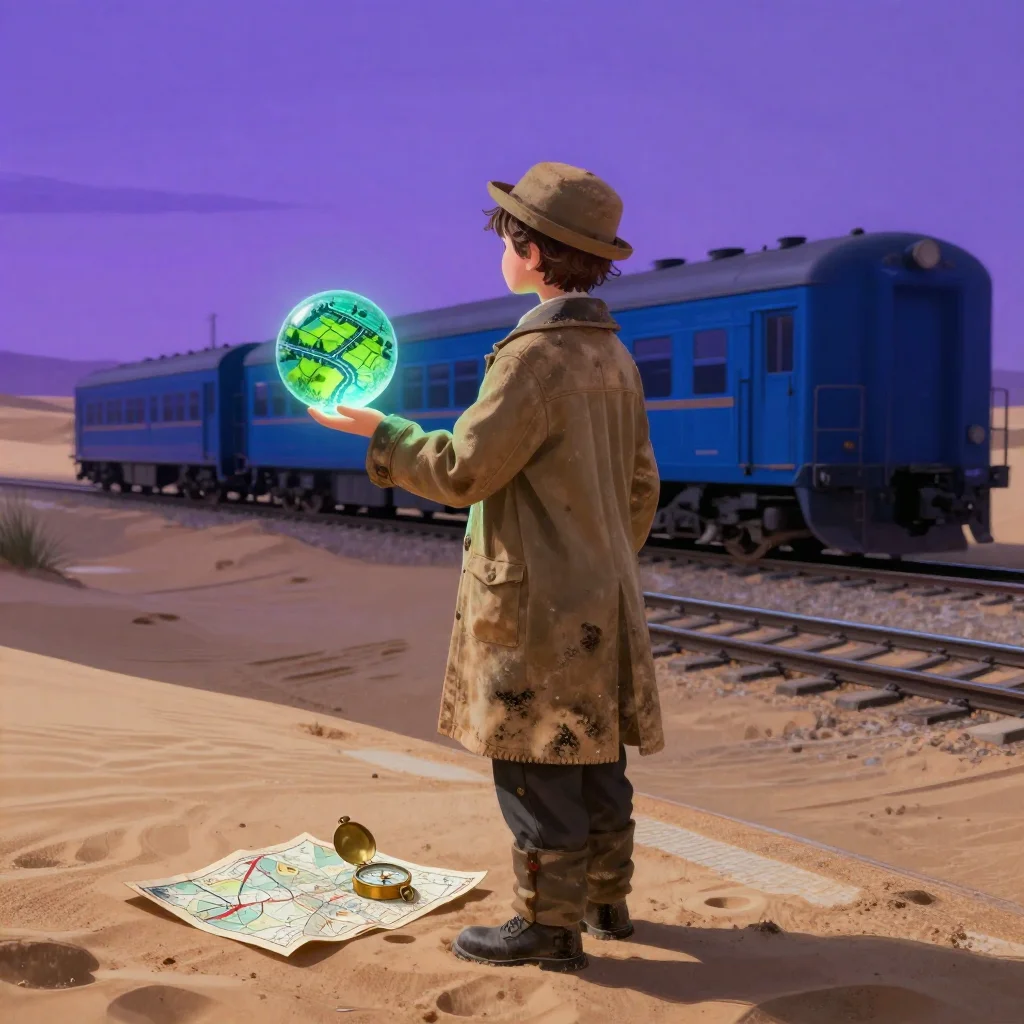
Now the compass would not quiet. When she turned her palm upward, a green shape lay across the lines there, no larger than her hand: hills, a silver river, three small settlements. The roads on it were moving, slowly, the way a sleeping hand’s fingers shift. She unfolded her sheet and laid the paper against the country. The paper warmed. On its blank western edge, ink came up out of the fibre by itself and made a coastline she had not drawn.
What the Train Would Carry
At 17:17 the train arrived without sound. Sera felt it in her teeth before she saw it, a low pressure travelling up through the rails. Its carriages were built of blue shadow, and the fields in its windows lay under a different sky, one with two moons in it and a harvest that came in the wrong order. A conductor stepped down carrying a lantern full of sand and bowed to her the way a man bows to something that has been expected for a long time.
“Your country has misplaced its name,” he said. “The song is tied to that name. Find the ending, and the train will take you where the name is buried.”
He tipped the lantern so the light fell through. The sand ran to the bottom and lay in the shape of a country with a bite taken out of its west side.
“How long does it wait?”
“Until 17:18. Then it goes once, and not again until the next hundred years.” He said it without weight, the way one reports a tide. “You have the length of a held breath. So does everyone else who wants on.”
He told her the price before she asked for it, because he had read that she would. A name could not be composed. It had to be found in the mouth of someone who remembered, or it would only be a sound, and a sound with nobody behind it took the land down with it when it went.
“You have known me for eleven seconds,” Sera said.
“I have known your mother for thirty years of her not finishing the fourth bar.” He set the lantern down on the platform, and the sand settled. “She is the reason the note is still missing rather than lost. A finished song is a closed door. An unfinished one is only an appointment.”
The Rival’s Empty Kingdom
She did not hear him arrive because he came out of the train. His coat was stitched with cobalt thread, and his compass was riveted to his wrist rather than hung at a belt, so that it could not be taken from him. Sera knew the coat before the face. Ilyan had kept Meren’s name in his mouth twice a year for two years and nowhere else, as though saying it occasionally were a form of restraint.
“You took my compass,” Meren said. “I took the lesson.”
He opened his palm. His hand was blank — not unmarked, blank, the way a page is blank after something has been lifted off it with a blade.
“The note belongs to a kingdom of mine,” he said. “A kingdom cut from every atlas in the world. Restore it, and the country on your hand will remember me as its ruler. It has been waiting nine years to be told who it belongs to.”
He showed her a folded map older than hers. Its borders had been excised, leaving roads converging on an empty square, and along one road a small train waited under a sun that had not yet risen. The cut edges were not torn. They were clean, and slightly blue.
“You want the same thing for a different reason,” Sera said.
“I want what was taken.”
“So do I.”
She thought of the tin box, of six sheets stopped at a western edge, of a country that had lost a name and had therefore become a handful of dust with rivers in it. Her song had been her mother’s. The last note had gone out of the world on the night her mother died, and Sera had let it go, because a girl who sang that melody to its end in that house would have finished dying as well.
“Your mother lost an ending,” Meren said. “Mine lost a country. You will decide which grief is larger at the tree.”
“I will decide it before that.”
Three Doors in the Cobalt Shadow
The conductor walked them into the station’s western wall, through a salt-stained door that had no handle, and down a narrow passage lit by blue lamps that gave off heat but no colour. Three arches waited at its end, and the air from each of them moved differently against her face.
The Arch That Smelled of Rain
Beyond it a green field under a grey sky, and eleven children standing in a line, singing. They had the note. Sera knew it in the first half-bar, in the way the air thickened ahead of the pitch. They sang it beautifully, and their voices were made of glass, and at the height of the melody they broke, and the pieces stayed standing in the shape of children. The grass grew over them. They began again.
One of them turned its head and looked at her and held out both arms, asking for it the way a singer holds out a hand for the next breath. Sera understood, with a clarity that stayed with her for years, that if the note were finished here it would be finished through them, and that they would not survive being whole.
The Arch That Smelled of Dust
A desert crossed by rails that ended at a buried city. Every map in the world lay there, folded around stones, edge to edge to the horizon, and where the wind got under them they lifted and settled with a sound like dry leaves. An unnamed place, the conductor had said. Look at what it becomes.
Sera found her mother’s sheets in the fourth row, folded around a grey stone, the western edge still blank. She got two fingers under the fold and pulled, and the stone did not move, and when she put her shoulder into it she felt the whole desert lean back, patient and enormous, and understood that she was not going to carry six sheets of her mother’s coast home in her coat pocket. She let go. The paper lay back down without fuss.
“So that is what it is worth,” she said.
“Dust that is proud of its rivers,” the conductor said.
The Arch That Was Silent
No air moved in it at all. A single black tree stood in a field of grey standing stones, its branches cut into the shape of musical staves, its bark so cold at a distance of ten paces that she felt it on her teeth. The country on her hand beat once against her palm, hard, like a second heart that had only just noticed it was there.
The Map That Cut the Borders
Meren took the compass off her belt. She let him, and that was the first honest mistake she made. The needle spun and settled toward the silent arch. His folded map opened itself on the air between them, the empty square filling with a red door drawn in wet ink.
“You cannot keep it,” he said. “The country is yours. The name is not.”
Under the tree the cold came up through her boots. Sera looked at the map properly for the first time instead of at its losses, and she saw that the excised borders had been cut with a guild instrument: a fine short blade, used for lifting a town off a sheet when a survey was disputed. She scraped the blue from the cut edge with her thumbnail. Under the dye there was a coastline, in a hand that had been taught in the same rooms she had been taught in.
“Ilyan taught you with that blade,” she said.
“Ilyan gave me the atlas. I was nineteen and they gave me the knife.” He did not raise his voice. “You have inherited a song that lost its name. I inherited a country that lost its king. Neither of us chose it, and both of us have spent our lives being the sort of person it made.”
Then she understood the shape of the evening, and it turned under her. He had not come to restore anything. Restoring a kingdom whose only living memory lived in his head would make the land servile to him, because the land had no other witness. He had needed a second witness. He had needed the girl with a country on her hand and a song with a hole in it, and the bite in the conductor’s sand was his border, and the train ran once a century, and it had stopped for him.
“You needed me to hold the memory once you let go of it,” she said. “So you weren’t going to break the compass. You were going to show it to me.”
Meren said nothing, which was an answer with a great deal of shame in it.
“I told you the price,” the conductor said. “I did not tell you the terms. Those are between you and the person who is holding the door.” He lifted the sand lantern again. “I have carried one passenger in a hundred years. It is not a matter of who I like.”
“Why her?”
“Because her mother did not finish the fourth bar,” he said. “An appointment that was never kept keeps a country in the world. Hers has been waiting on that platform for six years with a hand out. Yours has been waiting nine with a knife.”
The Note That Held the Rails
The missing sound was inside a black knot of branches, a hand’s width above the roots. Sera reached for it and the branch drew back, not quickly, the way a person pulls a hand from a flame they have decided to hold. Meren unfolded his map across the roots and the red door became real: a door in the air, painted red, with a brass handle worn bright on the side that opened inward.
“Sing your version,” he said. “A kingdom can survive a false ending. Mine has survived nine years of one. Put a name on the country in your hand and the note resolves, and my square becomes a door with a threshold, and a door with a threshold is a house, and a house is only a kingdom once someone is standing in it asking to be ruled.”
It was, she thought, the most honest thing she had ever heard him say. He was not lying. He was asking her to lie with him, and to be the mouth for it, and to be punished by it afterward, and he had gone about the request more courteously than anyone in the guild ever had.
Sera thought of her mother’s unfinished songs, of six sheets folded around a stone, of names said only by the old in the time before the last of them died. She thought of the glass children in the rain, of how a thing that cannot be made whole must not be made whole by being broken. She thought of Ilyan, who had taught her that standing in a place is the whole of the work, and who had never once said that staying in it was free.
She opened her mouth and sang the melody from the beginning. The station came back around her: the wires, the dust, the blue lamps, the second hand of the clock grinding forward through 17:17 and a half. The notes went out clean. The glass children sang their piece, and the maps lifted in the desert, and the conductor turned his lantern so the sand ran and showed them the bitten shape of a country that had been waiting nine years to be told the truth.
At the place where the last note should have been, Sera let the silence stand.
The silence answered.
It came up through the rails first, a low vibration she felt in the arch of her foot, then through her teeth, then through the country on her hand, where the hills lifted and the silver river found its old channel and the three settlements stood up straight like people who had been leaning in wind. Her sheet filled from the west inward: borders, rivers, a coastline finished at last, names in her mother’s spelling, a name she had never learned. Under the black tree the map burned at its empty square, and Meren’s blank hand filled too, a red door appearing at its center, small and painted and permanent.
He looked at it for a long time.
“That is not my kingdom,” he said.
“No.”
“Then what did I spend nine years restoring?”
“The door you cut,” Sera said. “Everything else came back. That part is yours.”
He closed his hand around it and the door did not shut. It stayed where it was, at the center of his palm, and he could not put it down and he could not give it away, and there was no one in the world but the two of them who would ever know what it was a door to.
The conductor raised the lantern. The blue-shadow train began its whistle, thin and downhill in pitch, and the clock moved to 17:18. Sera felt the last note move through her, not as a sound at all but as a bearing, a direction with a distance in it, the way a map is the only sentence that can hold all three. It pointed at the hand she had been taught all her life to trust.
“What is it?” the conductor asked.
“A place to put my hand down,” she said.
Then she took the note, and the country on her skin opened like a map under a sun that had not yet risen, and the train pulled out of Kalium without a sound and without heat, and Meren went with it. He had a red door in his hand and a country that had come back without him on it.
At the door of the carriage he said, “I will find someone who remembers it.”
“You will find someone who will tell you what you want,” Sera said. “That is what is left of them.”
“Then I will knock,” he said, and the blue lamps took the carriage, and the western arch closed over itself like water.
What the Country Needed Afterward
The clock went to 17:19, which the station had not done in a hundred and one years, and went back to 17:16 by morning, and nobody in Kalium ever established how. Sera walked out with an unfinished map in her hand and a country in her palm and the dull ringing of a completed bar still in her bones, and she understood within a mile that she had not recovered anything so much as taken on a maintenance.
She drew it up properly the next morning. The green country, the silver river, the three settlements, the coastline finished on her mother’s sheets at last — a single sheet, pinned flat, the tin box emptied of five of the six. She took it to Ilyan, who was standing in the doorway of the guild with his coat on and his seal in his hand, and who looked at the paper a long time before he said anything.
“The rule,” he said. “No map of a place you have not stood in.”
“I have stood in it,” said Sera. “I have stood in all of it. It took eleven minutes.”
He wrote in the margin of the sheet, in the guild hand, small and level: Surveyed by hand. Certified. Then he signed it with his own name and not the guild’s, which meant his name and not the guild’s was now attached to the only true map of a country that had come back, and which meant the guild would not print it, sell it, or admit to it, and that Ilyan would finish his life teaching apprentices who would be told that the world was fully drawn.
“That will cost you the school,” she said.
“It will cost me the school,” he agreed, and rolled the sheet, and gave it back to her, which was the last useful thing he ever did for anybody.
She named the western dunes that autumn. Not the survey station, not a saint, not the king’s third daughter: her mother’s name, said once, out loud, standing at the blank edge with a stylus in her fingers, and the coast came up out of the paper to meet it, and the six settlements that had been dust for thirty years were dust no longer. It was a claim. She had spent two years hearing that claim in Meren’s voice and she made it anyway, with her whole weight, and the thing she could not get past was that it did not feel like betrayal. It felt like a promise, made in a voice that was going to stop, to people who had not been born yet, that someone would come.
The country on her hand was real, which meant it was work. In dry months the green thinned and the silver river went to a braid of mud, and she learned that it drank from her: the hills drew down from the heat of her, and in the second week of a bad summer she could not get her fingers to close properly, and so she learned to water it at night, and then, when there was a week of it, to put her hand on the earth and let the ground take what it wanted. The three settlements stayed empty. She put a lamp in one window some nights. She was the entire foreign policy of a nation of one.
Six months later a map came by post to the guild, unaddressed, and the courier said it had been put into the box at Kalium by a man who would not give a name. New sheet, very good linework. A coastline nobody had drawn, with a red door sketched small in the corner, and no text. She had it framed behind the desk where apprentices copied, because the guild’s rules permitted any decoration in the workroom, and because she could not look at it and could not throw it away. Another came in the spring. Another in the year after.
And every evening after that, the wires above platform three carried the melody the whole way through, all the way to the end, faster than it had gone in her mother’s time, and the last note arrived exactly when it was supposed to, and it was not loud. People on the platform stopped talking a little to listen, which they had not done in six years.
Sera worked a day’s shift at the station most evenings, and when the song came to the bar that had been missing, she put her hand flat on the platform and the earth was warm through the stone, and the note arrived in her arm and nowhere else, and she understood at last that the appointment her mother had failed to keep in the fourth bar was not for her mother to keep. It had been for somebody to answer.
She was the only person alive who knew where the country was, and nobody was ever going to come, and she went on drawing it anyway, which was the harder version of the promise Ilyan had taught her, and the one he had never once managed to say out loud.





