 Netwrck
Romance.
The 2:17 from Elsewhere
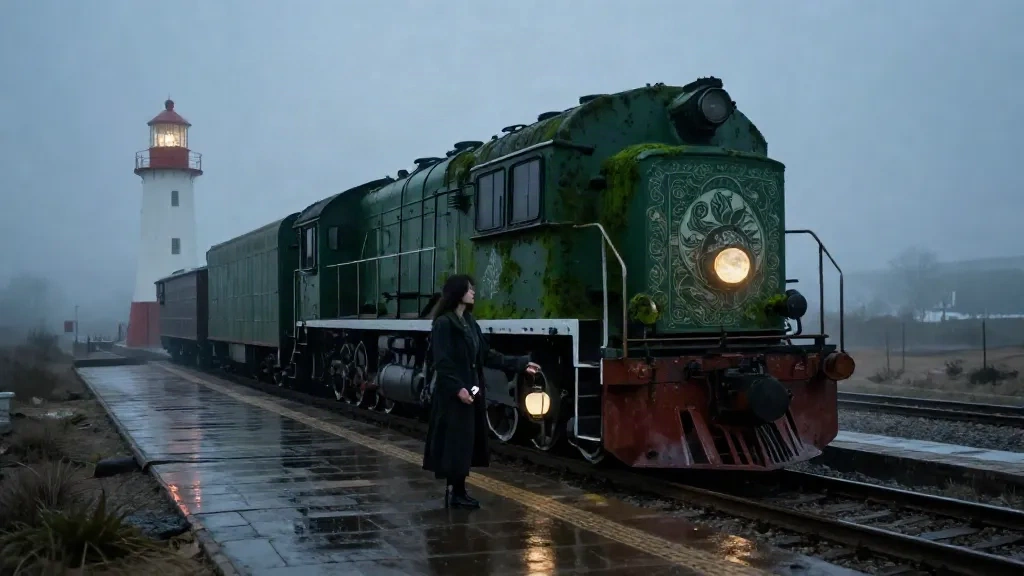
At 2:17 each morning, the railway station received a train that had not yet agreed to exist. Its carriages were green as deep moss, its windows filmed with rain, though the desert beyond Platform Nine had not seen rain in thirty years. The stationmaster, who had learned never to ask the driver his destination, would whistle once. Out would step the same passenger: Mara Venn, carrying a paper lantern with a small artificial moon inside it.
Leonie Vale kept the lighthouse beyond the salt flats, though it marked no shipping lane and no longer stood beside the sea. She catalogued weather from other worlds. Frost falling upward. Rain that remembered a drowned city. Thunder carrying the scent of lilacs.
On Mara’s third arrival, Leonie found her beneath the station clock, weeping into her sleeve.
“They are forgetting me,” Mara said.
Leonie checked the luminous register in her pocket. Beside Mara’s name, an unfamiliar seal pulsed: Collective Erasure, sunrise tomorrow.
“How many?”
“Everyone.”
Leonie took the lantern from her. Its tiny moon trembled like a trapped heartbeat. “Then we had better work fast.”
A Municipal Definition of Impossible
The town council had survived every century by writing sensible rules. Municipal Ordinance 12 defined an impossible event as any occurrence lacking a plausible cause, a licensed operator, and a completed insurance form.
Consequently, time-travelling trains were unauthorized machinery. Moons of forged ivory were counterfeit celestial bodies. Remembering a person erased by history constituted unlawful historical revision.
“You can’t simply love her into being,” said Registrar Odile, stamping FORM 12-B: LOVE WITHOUT DOCUMENTATION.
“Try explaining that to her,” Leonie replied.
Mara had slipped through the station doors. Each person she passed forgot her within seconds. The baker turned from the woman he was serving. A child laughed at the stranger holding his mother’s hand. At the tram stop, the conductor asked Mara to move along.
Leonie caught her beneath the marigold awning. “I need one true thing.”
“What?”
“Something neither of us invented.”
Mara lifted the lantern. “I remember the first night you showed me the small moon.”
Leonie’s own memory flickered. They had met only yesterday, in the lighthouse, beneath a meteor shower that smelled of wet stone. Yet the sentence opened a room inside her where two cups waited on the same table.
She understood then. The forgetting was not a flaw. It was how Mara had crossed so many centuries. She arrived as a person the world could not explain, so the world made her absent. Only one anchor could keep her particular: not history, not law, but the knowledge of being chosen.
Station Nine After Midnight
They went to the lighthouse because its signal was the only structure allowed to shine without a licence. Leonie opened the keeper’s ledger and wrote Mara’s name on every page. Wind tore the book. She copied it onto the walls. The harbor master copied it onto the tide board. The baker, suddenly remembering an empty shape beside his oven, wrote it in flour.
By midnight, Mara’s name had reached the tram shelters, the school notices, and the brass plate on Platform Nine. But the train was already waiting, its engine breathing frost into the dry air.
“You can stay as long as one of us remembers,” Leonie said.
“And you?”
Leonie looked through the station window. A flash of marigold marked the far platform. She remembered Mara laughing there. She remembered being lonely there. She remembered choosing.
“I’ll remember loudly,” she said.
When the Registrar demanded the names of everyone who had witnessed an impossible event, the town gave one answer.
What Love Can Outlast
At sunrise, the Ordinance tried to erase Mara again. Instead, every written name spoke her aloud at once. The station clock boomed. Doors opened across the desert. From the lighthouse came a steady green signal.
Mara stepped onto the arriving train but did not close the door.
Leonie climbed aboard.
“The keeper is required here,” said the conductor.
She held up the catalogue. “I have recorded a storm arriving from a century where this station is covered in moss. Weather without plausible cause. Licensed operator. Properly insured.”
He studied the stamp she had forged, then her face, then Mara’s hand closing around hers.
“Previous station?” he asked.
“Anywhere she can be remembered.”
The train departed before the Registrar could finish the form. Behind them, the town blurred into a flash of marigold, wet stone, and green light. Mara set the lantern between their palms.
Its small moon rose—not into the sky, but into the dark window—while Leonie began, in a clear voice, to list every weather they would weather together.





