 Netwrck
Fantasy.
The House With the Speaking Walls
On the evening the river turned violet, Mara Vale found a house weeping in its chimney.
She was the village nurse, though village children knew her better as the woman who listened to houses. She carried a black leather bag of bandages, herbs, needles, and small brass instruments. When a child had fever, she gave medicine. When a house had grief, she climbed inside with a lantern and listened.
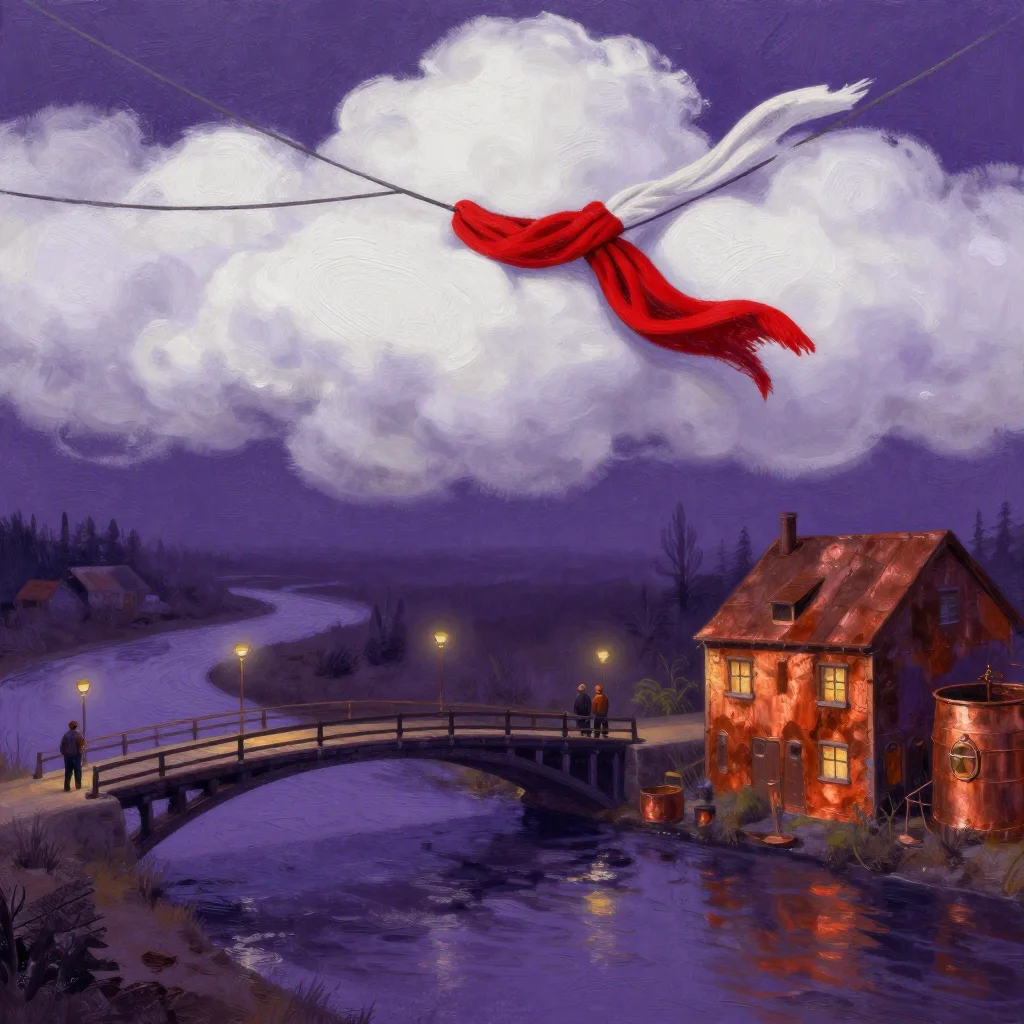
The weeping house stood beside Copper Bridge, its door painted the color of oxidized coins. Every plank in its walls had been cut from trees promised to the river, and every window faced the water. A red scarf hung from the banister, stiff with salt though the weather was dry.
“They are saying goodbye,” Mara told the house.
The house breathed through its fireplace. “They say they are coming back.”
Behind the wallboards, a woman and her brother argued in low voices. The woman, Lio, worked at the northern station. Her brother, Arun, repaired signal lamps. They had not spoken plainly for eleven years, since the night their father vanished during a flood and each blamed the other for failing to hold the bridge.
Mara entered the room where Arun sat. He held a train ticket between his fingers, its paper softened by repeated folding.
“He is leaving before dawn,” she said.
“He always leaves before dawn.”
“This time he means it.”
Arun looked toward the red scarf on the table. It had belonged to their mother. “Then why mend a house?”
“Because it is where the hurt is hiding.”
The Stationmaster's Impossible Ledger
Stationmaster Venn met Mara at the foot of the bridge, beneath three clouds bright as folded cotton.
He was writing in a ledger bound in green leather. Each line ended with a departure time, even for events that had not happened yet.
“You cannot move that train,” Mara said.
“I can postpone it.”
“The timetable says midnight.”
“The timetable believes every ending is a scheduling error.” He snapped the ledger shut. “A true departure requires permission.”
Mara looked across the river. The current carried a pale reflection of the station windows, though the water ran east and the windows faced west. The river was witnessing something.
“Lio's train leaves in three hours,” she said.
“Then we have three hours to correct the record.”
He offered her a train ticket, different from Arun's. The destination printed as BEFORE.
“This will take us to the conversation they have not had yet.”
“That is not a place.”
“Everything begins by refusing to be one.”
What the River Heard
They rode an empty maintenance cart along the river. The bridge lamps came on one by one, each casting a small copper ring on the water.
At the old tollhouse, Mara found the missing piece of Arun's history. The night their father vanished, Arun had pulled him from the current. Lio had seen him do it. But Lio was trapped beneath the collapsed footbridge, and Arun had cut the rope rather than let the river take them both. He kept the broken end tied beneath his shirt, where it had remained like a hidden accusation.
“He thought I left him to drown,” Arun said.
“I thought he chose the house over you,” Lio replied.
She had found the red scarf caught on the bridge rail. She kept it because Arun had once promised their mother he would wear it through winter. The promise had outlasted the storm, the father, and their ability to speak.
Venn opened his ledger. The river's testimony rose in the air as silver writing: You saw. You held. You did not let go.
Arun placed his ticket on the page. Lio placed the red scarf beside it.
The midnight train began to ring.
The Promise That Moved
They reached the station as the engine waited beneath a violet sky. Lio put her hand on the carriage door. Arun took the scarf and tied it around his wrist.
“I am still angry,” he said.
“I know.”
“I may be angry tomorrow.”
“I know that too.”
Mara watched the ticket in Venn's hand. The word BEFORE faded from it. A new destination appeared: HERE.
Venn stamped the page. The train's wheels moved, but the station remained fixed. Across the river, the bridge lights held steady.
Lio stepped down. Arun followed.
At dawn, the houses along Copper Bridge stood quiet. The town had not erased the old wound, only given it a door wide enough for two people to enter.
Later, Mara would return the red scarf to them. They would keep it between their chairs, where neither could say it was an apology and neither could say it wasn't.
Under the bridge, the river moved on.
It kept every promise it had witnessed. It also kept the names of those learning how to speak again.





