 Netwrck
Historical Fantasy.
The Cinema Without an Audience
Mara Venn had spent nine years nursing houses that suffered from lowness of spirits. She entered by the back door, laid a palm against the plaster, and listened for the settling of old beams. A prosperous farmhouse sounded like a man clearing his throat before a wager. A widow’s cottage creaked with the same sigh each winter. But the cinema had stopped breathing three years ago, when its owners nailed the doors and fled the town after the final audience vanished mid-film.
It was still open when the red scarf appeared beneath the projection-room door.
Mara recognized the wool: one skein, dyed with madder, trailing fire across the dusty road. She followed it into the abandoned auditorium, where reflected candlelight moved along the walls though no candle burned. The screen illuminated.
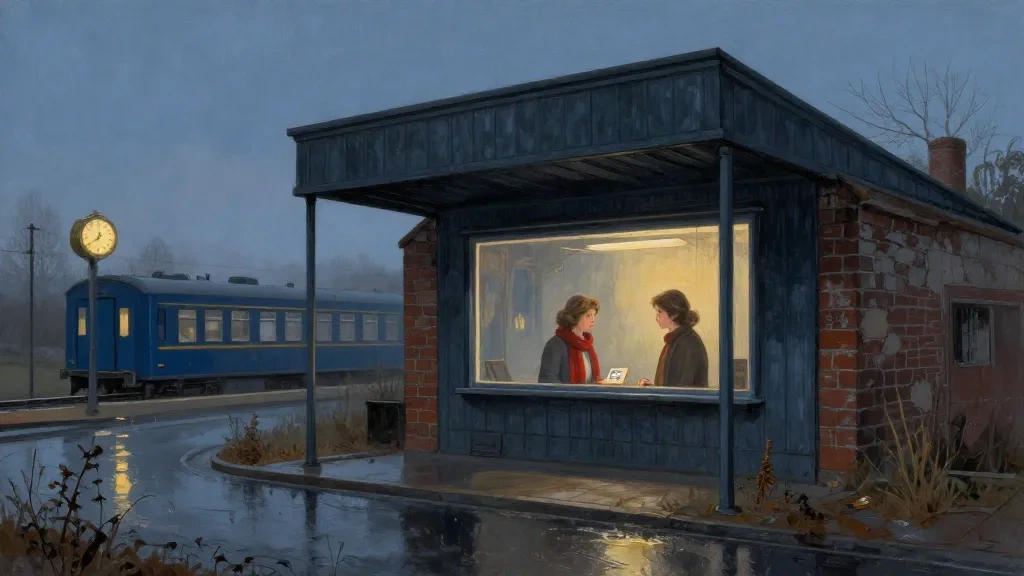
A railway platform appeared beneath the flicker. Steam pressed against the glass. A young woman in a red scarf held a paper ticket while an older woman stood beyond the barrier, both mouths moving without sound. The older woman turned away. The younger boarded. The carriage roof closed over her like a sealed box.
Then a brass clock struck midnight, and the scene reset.
Mara’s own sister’s voice came from the darkness. “I leave before dawn.”
Mrs. Bell Watches the Timetable
The stationmaster, Mrs. Bell, waited beside the ticket booth as though the cinema’s strange light were an expected hazard. She was broad-shouldered, tobacco-brown, and never without a timetable folded into her apron.
“Schedule error,” she said when Mara asked what she had seen. “A mother declines to say farewell, a daughter boards, both spend the night miserable. Surely a clerk misplaced one line.”
She produced a fresh train ticket. It bore a departure time already four hours past.
“If I revise the minute,” she said, “perhaps the scarf stays on the platform.”
So they did. They pinned the ticket beneath the ticket window, struck the booth bell, and waited. The film showed Mara’s sister taking one step toward the carriage. The stationmaster cheered. The sister stopped. The older woman had vanished.
On the ticket, a thin line of soot appeared.
Mrs. Bell said, “Endings are caused by poor coordination.”
Mara pressed the red scarf into her hands. “This is not a timetable. It is my sister’s.”
For the first time, the stationmaster looked less certain than the screen.
The Future That Almost Happened
They changed the carriage number. They delayed the announcement. They put Mrs. Bell’s ticket in the coal stove, though the stationmaster protested until the paper curled blue.
Each alteration produced another future. In one, the sisters embraced beside the engine while their mother watched from an upstairs window. In another, the mother boarded and the daughter remained, lonely but safe. In the third, neither sister appeared; a boy in a red scarf carried the ticket toward a village burning under a steel-blue sky.
“Stop,” Mara said. “Those are not choices. They are possibilities we frightened ourselves with.”
Mrs. Bell folded her timetable. The paper trembled in her hands.
“I have watched departures for forty years,” she said. “I learned every destination except the one taken by the people we fail to answer.”
The projector warmed. Its beam cut through tobacco dust and reflected candlelight. On the screen, Mara saw the truth beneath the images: no station, no train, no sister. Only two people standing in the cinema’s old lobby, one holding a scarf, the other holding a ticket they had refused to accept.
A Farewell Before Morning
Mara climbed to the projection room and lowered the lamp. The auditorium darkened until the screen became a pale window.
“You are making a mistake,” her sister said from behind her. “I am not leaving you.”
“You are leaving tomorrow.”
Mara descended. In the flickering light, her sister appeared in the third row, younger than Mara remembered, her red scarf bright as a coal. Between them stood Mrs. Bell, holding the ticket.
“I thought ending a journey meant losing the journey,” the stationmaster said.
Mara took the ticket. “It means somebody must answer.”
Her sister said, “I do not forgive the years of silence.”
“I did not ask for forgiveness.”
“I do not know whether I can stay.”
“I know.”
Mara tied the scarf around the ticket and placed it between them. The paper caught reflected candlelight, red wool bright against steel blue.
Outside, the first bell sounded toward dawn. The film flickered, softened, and went black. The stationmaster’s timetable lay forgotten on the floor.
Years later, travelers claimed the cinema showed only futures that nearly happened. That was true enough. Mara never told them the ending she had chosen: not a repaired past, nor a future guaranteed. A conversation, spoken before the train arrived, with no guarantee anyone would remain.





