 Netwrck
Speculative Fiction.
Borrowed Ground
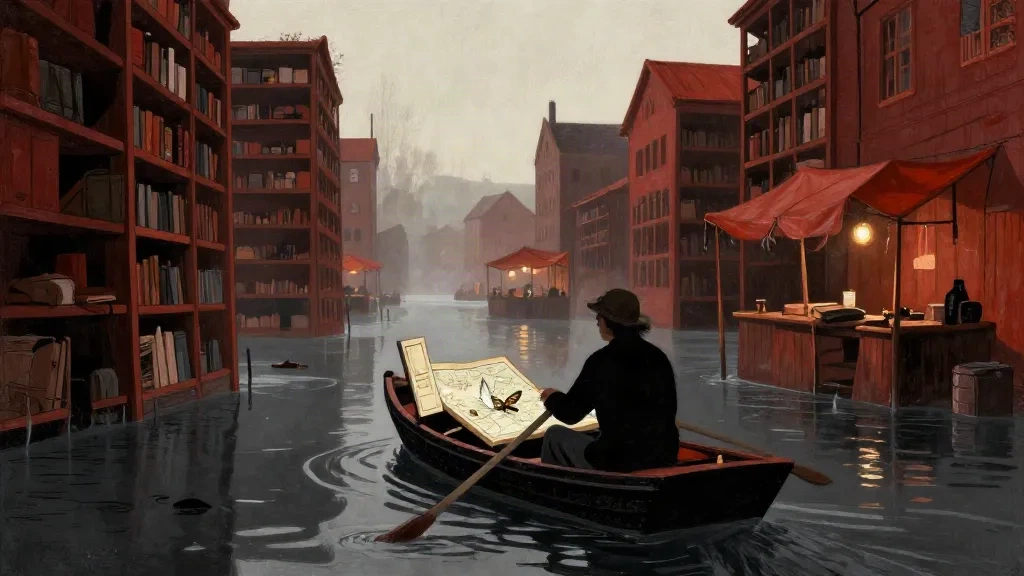
At low tide, the archive surfaced.
Water slid from the stone shelves in slow sheets, uncovering ledgers swollen to the size of boats. Librarians rowed between the stacks, their oars dipping through reflections of vanished floors. They called the upper galleries the ribs, the drowned reading room the belly, and the place where the ceiling had cracked the crown.
Mara Venn waited in the lowest boat, beside the old survey table. She had been a cartographer for forty-one years. Now she kept one tool: a silver pencil sharpened to the width of a needle.
She could draw doors only on maps of places that no longer existed. The trick was not invention. A vanished village was already an absence, and absence had edges. She could enter a missing coast, a burned monastery, a house swallowed by a reservoir, and leave behind a narrow rectangle of paper where a person might once have passed.
Her desired place had no official name. It needed a shore where lost things could rest: names without owners, keys without doors, letters that had arrived after everyone they loved was gone. She had drawn a hundred provisional maps, but each one collapsed when morning light touched it.
The Market of Facts
On the third flood, a market surfaced beside the archive.
Its stalls stood on rafts of black timber. Brass lamps burned beneath tarpaulins, and the vendors called their prices in winters, wounds, and remembered voices.
The expensive things were always true.
A child’s red mitten, offered for a winter, refused every lie. A marriage ribbon could be purchased only for the truth of its torn knot. Mara saw a man trade away his shadow and walk home upright, brightly exposed.
She had one true thing to sell: the final map she had made as an active cartographer. It showed the valley before the reservoir, including a house where her daughter had once laughed in a yellow kitchen.
The map dealer named Orren lifted it without looking. “That will buy a door,” he said.
“I’m not selling my daughter.”
“Then sell the house. It is already gone.”
On the stall lay a moth wing, pale and powdered, almost transparent. Beside it rested a white feather. The vendor had promised that anyone who bought both would be able to tell a true loss from a counterfeit one. The price was Mara’s map.
She placed the map beneath the wing and feather. The paper began to drink the lamplight.
What the Water Kept
That night the archive tilted.
Shelves leaned together like old friends. A rowboat carrying six librarians struck a submerged pillar. One of them vanished beneath a falling catalogue, and the market rang like a struck bell.
Mara saw the lost emerge in the shelves: a soldier’s spare button, a bride’s misplaced veil, the red mitten’s owner, a dog bark heard once in a town now underwater. They drifted toward her boat, unable to distinguish the living from the dead.
The silver pencil warmed in her hand.
She drew on the market ledger instead of paper. There she made a coast where no coast remained, a marsh with a patient moon, and a house whose rooms had been rearranged by every century. At its threshold she drew a door.
It was not a door to anywhere that existed. It was a door to everything that had lost its way.
Orren shouted that the ledger was not a map. The vendors called the drawing a cheat. The always-true objects on their stalls began to flicker, their certainties losing confidence.
Mara stepped through her own door.
The Place Between Places
Beyond it, the water was warm.
Shelves rose in a valley of grey silt, but the books floated safely above the flood. Lost things rested on broad stone steps: unclaimed names in glass jars, keys curled inside shells, letters tied to reeds. None were waiting to be found. They were allowed to remain lost.
The moth wing fluttered beside Mara. The white feather drifted after it.
Then footsteps came through the water.
The drowned librarians rowed in, followed by Orren and the market crowd. They had followed the door because, for once, none of them could afford certainty. The map of Mara’s daughter lay folded in her coat. Its yellow kitchen was gone, but the map kept the place where love had been made, not as a claim, but as a landmark.
At dawn the water withdrew.
The archive returned to the world, dry and ordinary, its lowest shelves filled with pale winter light. There was no market on the stones, no silver door, and no proof that lost things had found a shore.
Only Mara’s ledger remained open on the survey table. Between the marks of old roads, someone had drawn a small white feather beside a moth wing, and beneath them a door with no hinges.
She did not open it. Rest, at last, did not need a way in.





