 Netwrck
Weird Fiction.
The Door That Would Not Open
Every morning, Orso Bell repaired the hinges of doors no one could name.
They stood in the basement of the abandoned Grand Meridian Cinema, where the air tasted of hot dust and old popcorn. He worked by saffron light from a portable lantern, wrapping each joint in oiled cloth before fitting it back into place. The doors stood in a row along the wall: oak, steel, glass reinforced with brass wire, one made entirely of salt cakes bound in copper.
Orso was a blacksmith before the town forgot how to make hinges. His shoulders bowed from the work, and his hands were blackened in the permanent creases of palms. He valued the doors less for what they enclosed than for the way they resisted him. A hinge was a promise between two surfaces: meet now, stay joined.
Above him, the cinema occasionally shook with applause from an empty auditorium.
On the velvet seats, films showed futures that had almost happened. A pale woman became mayor after the river froze. A factory was dismantled brick by brick and turned into orchards. Every film ended at midnight, when the countdown burned through its final number and the screen filled with smoke-grey air.
One Film Without an Ending
On the third morning, Orso heard the projector running before he reached the projection room.
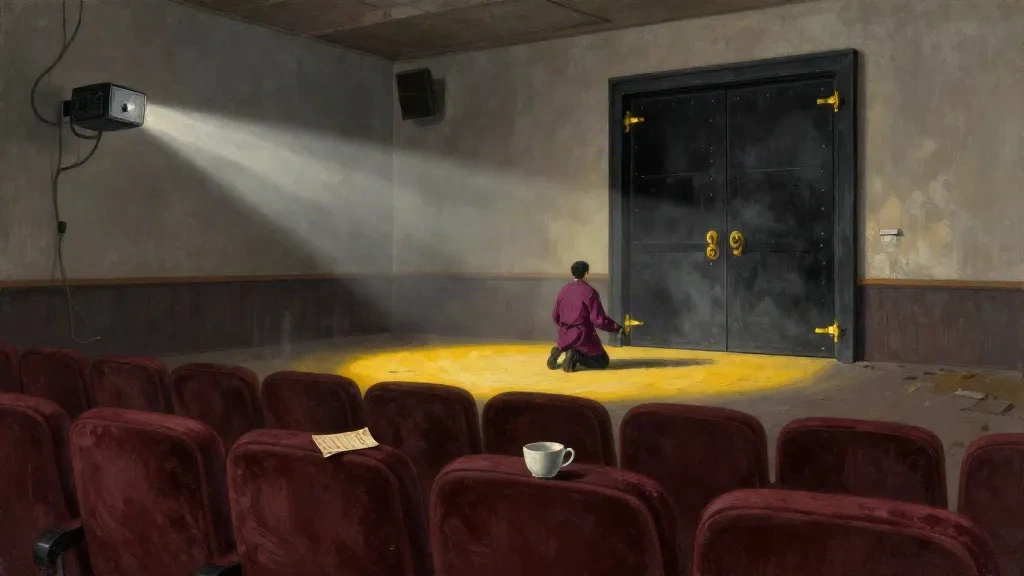
He climbed the stairs between rows of seats, carrying a ticket found beneath his bench. It was cream-colored and damp, printed with a departure from Vey Station, though the year on its face had been scratched away. In the last row sat a man wearing a plum velvet coat, eating from an empty teacup.
“You have come to make a decision,” the man said.
Orso set down his hammer. “The hinge is the decision.”
The man smiled without showing his teeth. On the screen, the city appeared beneath a saffron dawn. A procession crossed the square carrying a bell fashioned from a fallen star. Children ran ahead of it. Windows flashed violet in sequence across the hills.
The film repeated.
It ended in the same instant every time: the raised bell, the final bird, the woman on the balcony turning toward someone just outside the frame. Then smoke. Then the procession again.
Orso had seen thousands of versions of the future in the Grand Meridian, but never one refused to conclude. The man told him the cinema’s owner, Councillor Merrow, had purchased all the ticket stubs from that day. The theatre survived by charging for the promise of an ending, but the missing final scene had become dangerous. People were beginning to leave jobs they loved, forgive enemies they hated, and travel toward accidents that had not happened yet.
“Merrow keeps the mystery closed,” Orso said.
“Merrow profits from the door remaining shut.”
The Price of Knowing
Orso found the projection booth locked from within. Merrow stood inside beside the machine, feeding a blank reel through its brass jaws.
“You were not meant to see that future,” Merrow said.
“Then name it.”
“It earned its ending.”
“That is not an answer.”
Merrow’s plum coat darkened with sweat. “If you know how a future ends, you begin forcing it. The people in it become furniture. Their choices are cut away to preserve the spectacle.”
On the screen, the bell again began to rise. The woman turned toward the empty frame. This time a faint shadow moved at its edge.
Orso understood. The cinema had not preserved the future; it had preserved its suspense. Every viewer supplied a possible ending from their own life. Merrow kept the missing image beyond the screen because ambiguity was the only product still worth selling.
He raised his hammer. Merrow flinched.
“You cannot repair the projector by threatening me.”
“No.”
Orso struck the lock. The booth door opened with a sound like a distant train changing track.
He found a narrow service passage behind the machine. Its walls were lined with black levers, each labeled with a date and a consequence. One read: OPEN THE RIVER. Another: KEEP THE FIRE. A third had been torn nearly in half, leaving only the words ORSO, BELL, 04:17.
He pressed it. The hidden panel swung inward.
A Future Still in Motion
Beyond the passage waited the auditorium’s last unclaimed seat. On its arm rested the empty teacup. A second ticket lay beneath it, the departure still blank.
The film played above him.
The woman looked toward the edge of the frame. This time Orso entered it.
She was younger than he had expected, with a burn scar along her jaw. In her hands she carried the ticket he had carried for years. Beyond her stood a workshop full of blackened tools. No crowd waited there. No camera followed them.
“What do you want?” she asked.
Orso had prepared a thousand answers during his years of repairing doors, yet he found only the plainest.
“I want an ending nobody has earned.”
She glanced toward the empty theatre. “That is dangerous.”
“A chosen future is.”
She tore the ticket into two pieces. One half slipped through the screen. The other remained in her hand.
Orso woke beneath the cinema, his hammer still closed in his fingers. Dawn had entered through the broken roof, saffron across the plum dust. The projector had stopped. In the empty teacup lay a single brass screw, bright as a small sun.
He carried it to the doors. He would repair the hinges in order, from the strongest to the weakest, and leave the last one open.
Some endings, he decided, should arrive carrying their own tools.





