 Netwrck
Mythic Fiction.
The Municipal Weather Below
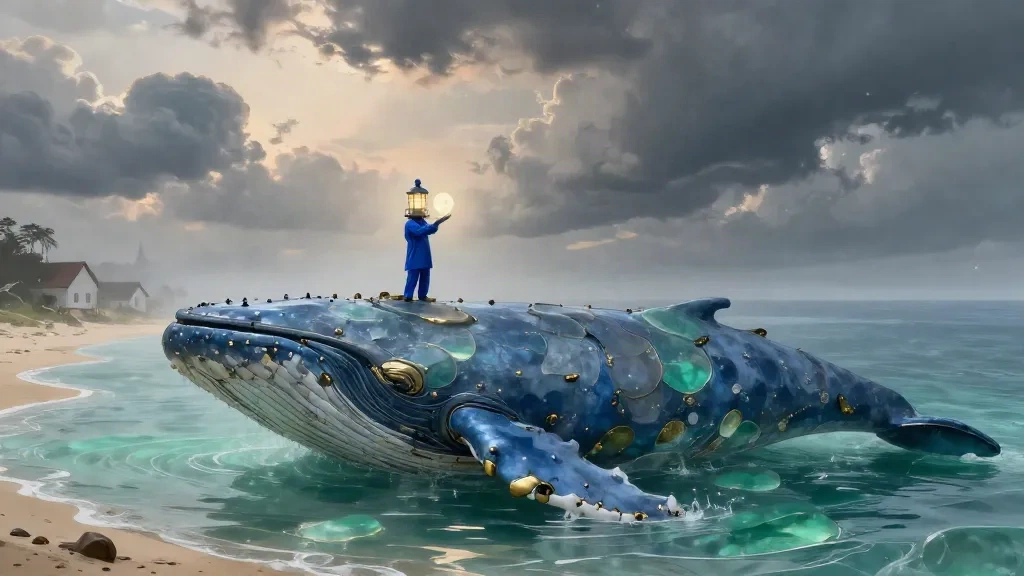
Ilyra Senn kept the lighthouse at the base of Pellu’s spine, where the great whale’s plated ribs came up out of the water like reefs that had changed their minds about sinking. The city of Pellu lived inside the dreaming whale. Its streets were the spaces between ribs, its weather was the animal’s breath, and its harbor was the long slow throat in which ships were quietly digested into legend.
Every dawn the whale counted itself. The count moved through the streets like a cold front, entering kitchens and net-lofts and painted houses, and whatever the arithmetic could not place, the city forgot before noon. Not violently. A census does not hate. It simply declines to include.
Ilyra entered the weather of other worlds into a sea-glass ledger: thunder flattened into blue salt, green lightning, sand that fell upward, winds that still remembered mountains drowned under other seas. The ledger was the whale’s mouth. Her handwriting was the only speech it permitted.
Beside it rested her smallest instrument, a moon no wider than a thumbnail. It had fallen through Olme’s sky in the year the Olme tides went wrong — a slow pear-shaped thing with a lopsided sea on its face, cold enough to fog silver. Ilyra had caught it in a net of sailcloth, four years ago, already the most valuable unregistered object in the municipality. Beside it hung a battered paper lantern holding Ilyra’s private flame, the only thing in Pellu she had made herself.
That morning, the harbor census had lost Pellu again.
What the Count Could Not Place
The fishermen on the Corbel mole remembered a red scarf and nothing behind it. Her brother remembered a song she hummed at the night ferry, and every verse of it ended one word early, the syllable cut clean off as though a hand had come down mid-line. The painted house at the end of Corbel Street had sanded her reflection out of its window and hung a new panel of sky.
Ilyra found the girl beneath the eastern stair, folded into a raincoat three sizes beyond her, knees drawn up, bare feet dry and clean. Dry, in a raincoat, in a city that rained two days out of five. Pellu had been keeping herself out of the weather as if weather were the thing that ate people.
“Don’t let the bell ring,” the girl whispered.
The bell above them was the count’s voice. It never struck. It gathered itself, hour by hour, into a single held note, and released it at noon, and in that released note the whale announced what it held. Anything the arithmetic had failed to place, the ordinance called debris, and debris was returned to its proper weather.
“Seven years old,” Pellu said, answering a question Ilyra had not asked. “The clerk said I was seven. I’m not sure that’s right, but I didn’t correct her.”
Above the stair, the whale’s municipal clock began to assemble itself for noon. Ilyra felt it in her teeth: that hour had a texture like a held breath.
The Ledger and the Seal
In the tower office the air was warm and tasted of kelp, iron, and old paper. Ilyra opened the codex to the current table and read Ordinance Twelve aloud, because reading it aloud was the only way it had ever listened.
Every impossible thing within the municipal body of the living whale must be registered before existence. Unregistered phenomena shall be returned to their proper weather.
Pellu had no birth in this world. Her memories arrived in fragments from drowned cities, a woman’s kitchen she had never seen, the smell of a pear she had not eaten. Her name appeared nowhere in the register of the living. By the letter of the law she was ballast: something the whale had swallowed and would one day cough back out.
Ilyra went to her own page instead, which she did less often than a keeper should. Seven lines down, in her own careful hand, an entry read: SENN, ILYRA. Born Pellu. Keeper, lighthouse, spine-base. Persistent. The last three letters were the color of weak tea. Four years ago they had been black.
She had been erasing for a while. Once a year at the census she woke with a new gap in herself — a mother’s face gone featureless, the taste of a thing she had loved, the address of a house she had rented. The whale was forgetting its keeper too, patiently, the way a shoreline forgets a nail.
So this was not only mercy. Ilyra understood the shape of her own stake, and did not pretend otherwise. If Pellu stayed, the count had to be wrong in a particular way, and it might be wrong in a particular way about her.
There was a knock of brass on brass. Sisk Vane came in without knocking, carrying the day’s tally in a lacquered case and a smell of cold wax. She was the city’s under-tally: the hand that actually wrote, while the whale supplied the will.
“There is a lawful instrument available,” Sisk said, setting the case down. “Register the child as a phenomenon. Seventeen-year southwesterly, intermittent, person-shaped, harbor-local. She is entered. She is counted. She is not returned, because phenomena are not returned, they are merely — located.”
“And she is not a person.”
“She is a person,” Sisk said, and for the first time something in her face moved. “She will be a person the way a kept instrument is a bell. It will ring. It will not know it is ringing.” She opened the case; the ledger-page inside was already filled, the description written out, everything but the name. “Also, Keeper, you should know that I have a daughter. She was debris in the year of the red tide. I wrote her in as a southwesterly.” She closed the case. “It is a working solution. I will not pretend it is a kind one.”
“You won’t need to pretend of me,” Ilyra said. “But I won’t do it.”
Sisk left the case on the desk anyway, the way people leave weapons where a person can see they are being offered a choice.
A Forecast Against the Clock
Ilyra opened the weather ledger to the page of a city and wrote in it, in the clerk’s formal black: PELLU. Local. Persistent. Seven years old.
The ink dried and took the shape of a small red scarf lying still on the page.
The clerk’s seal came down of its own accord, hot as a hand, and stamped the entry ILLEGAL. Then, beneath it, stamping twice, as if unable to leave the matter resting: PROOF REQUIRED.
The trap was elegant, the way all good traps in Pellu were elegant. To prove a person belonged to the whale, you had to prove the whale had loved them. A fact of birth proved nothing; a fact of love was a weather event, and weather events were precisely what Ilyra’s ledger could summon to testify.
She asked the city for witnesses and was given a room full of absences.
Old Havik remembered lending Pellu a cup. The cup, when brought, remembered holding water, and could offer no further testimony. A baker remembered the flour she had sent to his oven each winter for seven years, though every sack he had received bore a different merchant’s mark, and he had baked bread from flour he had bought, and sold the bread, and cannot say now to whom. A woman on Corbel Street remembered that someone had once stood in her doorway and made her feel, briefly and completely, that her life was not a wasted arrangement. She could not describe the doorway, the year, or the person. She could not describe anything except the feeling, which stayed in the room like heat in a stove banked for the night.
At ten minutes to noon the whale began to breathe. Water climbed the lighthouse stair in a green-black lip, tasting of salt and iron. Every glass instrument in the tower began to hum at a slightly different pitch. The bell above them swung once, twice, and did not strike; the swinging made the silence move, which is a different and worse sound.
Pellu’s face thinned in the draft. Not faded — thinned, like paper worn by handling, and through it Ilyra could see the stair, and through the stair the sea.
“I keep forgetting to be frightened,” the girl said. “Is that a symptom?”
“It’s a record,” Ilyra said. “Something has been writing on you for years.”
Then she opened the paper lantern.
The flame was no longer yellow. It burned cobalt, the exact color the sea took in the half-minute before it forgot the moon. The thumbnail moon on the desk brightened until every pane in the tower threw a blue shadow, and the shadows all pointed inland, toward the sleeping bulk of the whale’s spine.
“Forecasts require witnesses,” Ilyra said.
She carried Pellu up to the whale’s beacon and spoke into the revolving light, and the city began, unwillingly, to remember.
Out of the water came a child’s footprint appearing beside a flooded drain, filling with rain, keeping its shape. An old woman’s promise to save the last coal for winter. A boy’s laughter under the observatory stairs, and the specific stair, and the specific boy. A cup that had held water for a girl who was seven for several years running. Seven quiet mornings stolen out of the calendar and never once missed by anyone, which was, Ilyra thought, the most damning item in the entire inventory.
None of it made Pellu whole. A child’s footprint is not a child. A promise is not a woman. But the fragments would not settle, and would not lie down, and would not be returned to any weather at all, because a forecast is not a history. A forecast is a claim about what is coming.
The bell gathered itself higher. Below them the whale’s ribs creaked like a hull in a hard swell, and somewhere under the streets the count reached the number it had reached the day before and found it did not fit.
The Ordinance of Passing Weather
Noon struck.
The bell did not ring. It exhaled. The sound went out of the tower and through the ribs and into the water, and the ordinance opened behind the lantern like a mouth of dark glass, and inside it Ilyra saw the whale’s inventory leaving all at once: drowned constellations turning like slow flakes, upside-down rain going up out of the gutters, the blue hush between one star and the next, a winter, a road, a name with the wrong number of syllables in it. Thousands of things, going home.
Pellu rose toward the opening, weightless, calm, and not fighting at all — the calm of someone who has been leaving for seven years and has finally stopped objecting.
Ilyra caught her wrist. The contact was cold and gave her the sensation of holding a wet rope. The municipal seal slammed the ledger shut on the desk below, and the judgment went off across every page at once like a dropped shutter, so that the whole book reported the same single finding: UNREGISTERED. RETURN.
There was one clause left, buried in the same article, an old sentence from the first census when the whale was still new and the clerks were frightened of it. A phenomenon might be returned to its proper weather only if another impossible thing entered the body in exchange. Not a person. Not a thing the person loved. Something the law could not classify at all.
Sisk was in the doorway, breathing hard, her case in her hands. “Don’t,” she said. “Keeper, whatever you are reaching for, I have countersigned forty returns. I know what they do. It isn’t a door. It’s a mouth with manners.”
Ilyra took the thumbnail moon from the ledger and held it beneath the paper lantern, and the little thing from Olme was very light, and very cold, and it had a lopsided sea on its face, and the tide in Olme had been wrong for four years because of it. She thought about that. She thought about it the way a person thinks about a debt they have never once stopped counting.
“Record this,” she told the whale. “An unregistered moon has entered my custody.”
She fed the moon to the flame. It took the fire the way water takes a dry cloth, all at once, and the cobalt blazed up through the tower, through the lens, through the whale’s ribs, and the whale’s vast sleeping body dreamed awake.
Its light showed everything Pellu had ever carried. A winter with no stars in it. A road that ended inside her own voice. Seven stolen mornings. The brothers and the flour and the cup and the whole long accumulation of a life lived entirely inside a city’s forgetting, none of it registered, all of it real, all of it hers, all of it now standing in the open light of the whale’s own body where the inventory could see it. The ordinance could not return Pellu without returning every one of those things with her. Municipal law, at last, had been beaten by the contents of its own ledger.
Sisk sat down on the stair in her good coat and put her face in her hands, and after a moment said, with terrible practicality, “Then we had better start writing very fast.”
What the Morning Kept
Pellu fell into Ilyra’s arms, and at first nothing came back but the scarf: wet, red, bright as a strip of sunset torn off the day.
Then the count gave her up in pieces, in the order the arithmetic happened to release her. Houses lifted painted figures down off their window frames and hung them back, and every one of them was a different age and none of them was the right one. Fishermen lifted their eyes and found they had opinions. Her brother came up Corbel Street at a dead run with his mouth open on the last verse of her song, and got all the way to the final word, and the word was her name, and he said it out loud in a voice Ilyra had not heard from him in seven years of dinners he no longer remembered having.
“Pellu,” he said. “That’s — that’s you. That’s your name. How do I know that’s your name?”
“It’s my name,” she said, and looked at Ilyra, and did not say the second thing, which was but nothing else is.
By evening she sat under the lantern eating salt bread and insisting, gently and absolutely, that she remembered nothing. Not drowned cities, not the woman’s kitchen, not the pear. Seven years had left her without a single room in it. She had been returned to a city that knew her name and nothing else, and she had decided — Ilyra could see her deciding, watch the decision go through her like light through water — to accept that, because it was cheaper than the alternative, and because Ilyra’s bread was warm, and because the girl had no one else to be.
Ilyra put the extinguished little moon in her palm. It felt heavier than any stone in the tower, heavier than the bell, heavier than the ledger. A moon that had not been fed had been a curiosity. A moon that had been fed and had died was a debt with a face on it.
Outside, the whale breathed beneath the sea-glass evening, and its shadow passed cobalt across the harbor, and did not pass back.
The Ordinance remained sealed. At midnight a message appeared in the ledger in the whale’s own flat unpunctuated hand, and the whale is not a liar, only a witness, which is the same thing until noon:
PROPER WEATHER RESTORED. MUNICIPAL MEMORY: ONE LOST PERSON RECOVERED. NO FURTHER IMPOSSIBILITIES OBSERVED.
Ilyra read it twice. It was true in the way a report is true. It said nothing about the moon now burned into the lantern. It said nothing about the tides of Olme, which would arrive wrong at the turn of this year with nothing left in Pellu to correct them. It said nothing about a weather keeper whose entry in the register was thinning toward the color of weak tea.
And it said nothing about the whale, which was awake now, in the way a house is awake when a stranger has come into it in the night, and which would want, in a day or a year, to count itself again.
The Debt on the Last Page
Sisk came before dawn with the case, and the tone had changed; she was a clerk again, which meant she was frightened on paper.
“You understand what you’ve made,” she said. “The whale has nothing in the register for what you gave it. We returned one child and consumed one moon and the account balances to zero because nothing was entered. The next count will not find a discrepancy, Keeper. It will find a blank. Blanks are worse than debts. A debt is a thing with a shape, and a shape can be argued with.”
“Then give it a shape.”
“I can. I have done it before.” Sisk set down a clean page and the brass seal, and Ilyra saw her own entry there in the weak-tea ink, Senn, Ilyra, Persistent, and the last letters almost gone, almost the color of the sea at the hour before it forgets the moon. “Sign the count, Keeper. Swear the morning as complete. There are seven witnesses on the stair and I will countersign with my own hand, which I have never done, and which will cost me a daughter I have already filed as a southwesterly. Let the whale have its silence. Let it sleep.”
And that was the whole of it, laid out honestly: the lie was small, the sleeping was real, the cost was hers and Sisk’s and the city’s, and the whale would stop dreaming if she wrote a sentence that was false in exactly one direction. Nothing would be returned. Nothing would be counted. The forgetting would go on, and Pellu would be inside it, and the only question was whether Ilyra was the kind of keeper who wrote the sentence.
She thought about her mother’s face, gone featureless between one census and the next, and the way she had mourned a woman who was still standing in the kitchen asking what she wanted for supper. She thought about a girl who had spent seven years keeping herself out of the weather. She thought about a pear-shaped moon with a lopsided sea on its face, going to be found missing by people who had never once been forgotten, and would come looking with a great deal more anger than a child would.
Then Ilyra took the pen and wrote a false sentence, and the whale sealed it, and the sea went quiet outside.
Afterward she went back down to the eastern stair, where the light of her private lantern found the girl awake in the too-large raincoat, dry feet, knees drawn up, waiting to be told what the morning had decided about her.
“Will I stay?” Pellu asked.
On the beacon glass above them, dawn began assembling itself out of the ordinary materials of a harbor: gulls, fog, the bell not ringing, a painted door at the end of Corbel Street, the light on the water thinning toward the color of a coin.
Ilyra watched the first true light catch the paper lantern, and the little moon dark between their hands, and understood that she had traded one unaccountable thing for another and would be asked, eventually, by someone with a seal, to account for both.
“Yes,” she said. “Some things are worth keeping in the record.”
Then, before she could think better of it, she went up to the office and opened the ledger to her own thinning page, and beneath her name, in ink that came out of the nib already warm, she wrote one more line, and closed the book, and did not read it back:
INSTRUMENT OUTSTANDING. ONE (1), NON-MUNICIPAL. HOLDER DECLARES. HOLDER REQUESTED.





