 Netwrck
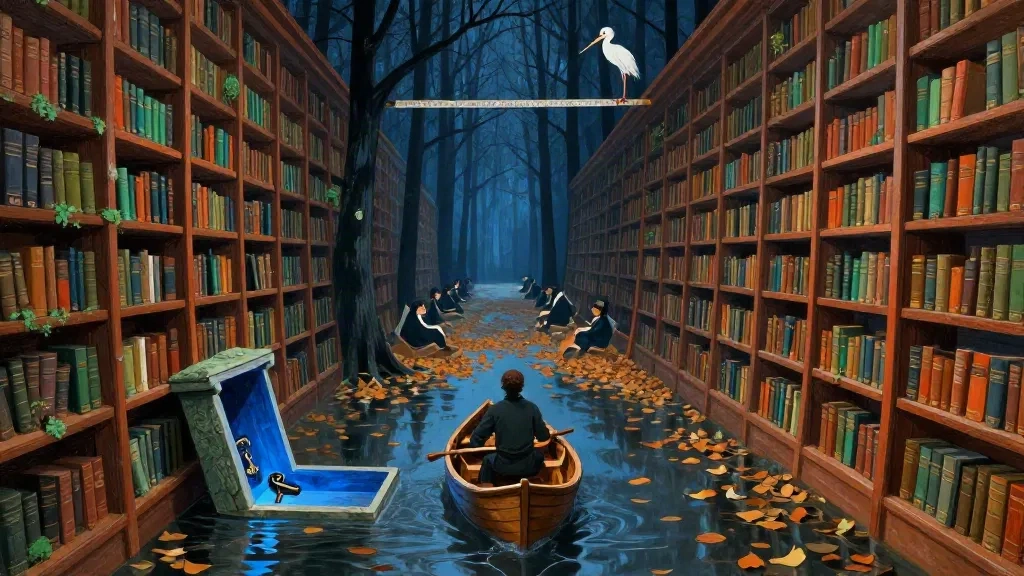
Surrealism.
The Forest That Missed Tomorrow
By the time Mara Venn reached the drowned archive, the evacuation was complete. The forest had been lifted from its century and stored beneath row 594, each tree leaving behind an outline of absence among the oaks. The rangers had been assigned to guard what could no longer be harmed, though the squirrels still stripped bark from those pale silhouettes and the owls still argued over branches that were not there.
Her skiff struck a shelf of submerged folios. Water entered the pages, but the letters held together, bright as fish scales. Above her, librarians rowed between towering stacks, their oars dipping in deliberate silence.
Mara carried two objects. The first was a brass key given to her by the municipal archivist. The second was a small moon, no larger than her palm, recovered from an upstairs telescope that had stopped turning toward the stars.
She kept the moon wrapped in her coat. It produced a pale blue storm-light that trembled whenever anyone spoke a lie.
The Route of the Missing Man
The brass key opened a narrow locker beneath the librarian’s desk. Inside lay a waxed chart covered in the handwriting of Tomas Vale, the ranger who had vanished four years earlier. He had begun navigating the archive to the Evacuation Orchard, a place where lost centuries were stored. Each night he marked his route with a small stamped star. Then his boat, notebook, and name vanished, leaving only the brass key on the wardroom floor.
Mara’s order was simple: recover the notebook, identify the defect, return before curfew.
At that afternoon, however, the archive lowered its blue shutters. Across every flooded aisle rang the single note of a chronometer.
A marsh stork descended upon the central desk. It was not hostile. It disliked loose timing, vague distances, and people who arrived before their reflections. The curator called it the Curfew Keeper.
“Your passage ends at the sixth bell,” it announced, folding its measuring wings. “No vessel may remain between shelves after the blue interval.”
Mara looked at the key. Tomas’s final mark lay far beyond the permitted waterline. To reach it, she would have to cross row 594 without dipping her oar during the changing light. One careless stroke would return her boat three days backward.
A Borrowed Hour
She poled beneath a shelf of atlases. Lost coastlines slid across her shoulders. In an oak-built hollow, she found Tomas’s name carved into a plank and, beside it, a sentence: The forest ends where the key is refused.
The brass key had grown warm. The moon in her coat glowed through the cloth, and the stork called down the time from the roof.
Mara lifted the moon into the blue light. It cast a tiny round shadow on the lock. The key refused that shadow by one degree.
So she rowed three degrees east. Time loosened around her. The six bells sounded, then continued backward: five, four, three. The stork dropped onto her bow and fixed one bright eye upon her.
“Your vessel is occupied,” it said.
Mara understood. The journey could not be finished while Tomas remained a missing passenger. She placed the key against the moon’s shadow, not in the lock, and spoke the name he had left uncalled.
The moon chimed like a small brass bell.
The Destination Was a Return
Water divided. Beneath it appeared a road of dry leaves, leading from the archive to the empty grove where the forest had once stood. Tomas waited at its far end with an oar across his knees. Four years had not touched him. The trees had returned one by one behind him, older than themselves, their leaves burning orange with the light of autumns no living person had seen.
He stepped into the boat without surprise.
“The orchard was never a destination,” he said. “It was a crossing.”
Together they pushed away. Behind them, the librarian-oars dipped and rose in perfect measures. The keeper measured the crossing with rigid wings, satisfied when each wake formed a straight line.
At the bank, Mara returned the brass key to Tomas. He refused it.
Then she understood. The journey was his, but the route became visible only when another boat carried it forward.
She kept the key. Tomas returned to the forest. Behind him, the trees rustled in seasons that had been waiting to arrive.
That night, the curator asked why the small moon still shone in her pocket.
Mara turned it toward the blue shutters.
“Because the journey isn’t over,” she said. “Only the part someone else began.”





