 Netwrck
Mystery.
The market above the drowned forest
Mara Vell had been born in the year the forest was removed from time. The trees were still there, black-barked and enormous, standing inside bell-glass domes the government had raised from the north after the first evacuations. But nothing crossed their branches any more. Birds stopped. The deer walked and walked through the same blue fern and never came out the other side. Official documents called it an evacuation. Her mother, who had been a hydrologist and then was nothing, called it a wound.
Mara had grown up on the water, in the drowned quarter where the streets of the old town were still visible under nine feet of black water, and where the floating market drifted overhead like a second city hung upside down and lit from the inside. She had inherited her father's ranger's coat, stiff with silver rain, and the unfinished map folded against her ribs in its oilcloth sleeve. Each dusk she rowed the perimeter skiff out to the seal line and checked the locks that the wardens reset, and each dusk she looked at the domes and did not row closer.
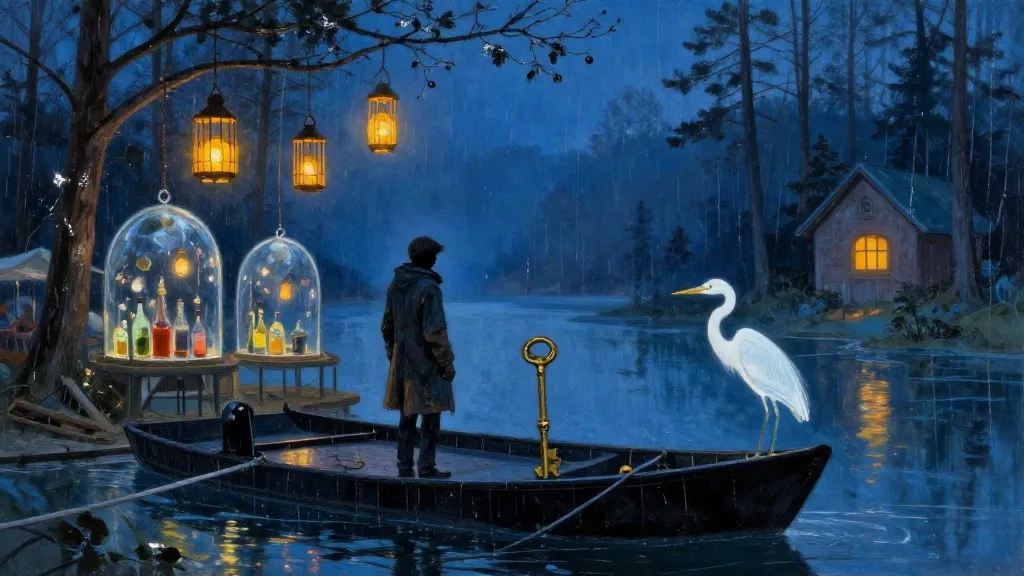
The market traded what people had lost and could not bear to bury. A childhood dog in a paper cage, still yapping at the bars. A soldier's last breath, sold by the ounce, drawn up through a reed. A wedding quarrel preserved in two green bottles that clinked against each other whenever the two people who had thrown them were in the same mood.
Mara bought none of it. She had learned that the market is patient in the way water is patient. It keeps.
That night the ninth-bell curfew came early, and among the stalls she found a lantern burning beneath an empty awning. No vendor. No coin tray. The flame stood as steady as a held breath. Beside it, on the wet planking, lay a small brass key and a note in her father's handwriting.
She did not touch either for a while. She looked up into the dark maze of the market, at the shopkeepers who were all suddenly very interested in their own stock, and she understood that something had been set down here for her, and that it had been set down by someone who knew she would come.
Curfew at the ninth bell
The note said only: Take the west passage. Finish what I started.
No signature. No explanation. She turned the paper over. Nothing. The key was warm as a living thing, and heavier than a thing that small had any right to be, and when she held it up to the lantern flame it threw a second shadow that did not match her hand.
The market's lanterns trembled in the water below, all of them at once, the way bait trembles. The curfew creature was passing.
It lived inside a white heron with a seam of silver around its right eye, and it had never once attacked anyone. Mara's mother had told her that its cruelty was exactitude. It did not punish you for breaking the law. It punished you for breaking it slightly.
The heron stood on a floating toll gate that drifted where the west passage met the water, its wings folded, its head on a slow tilt that Mara had learned to read the way you read a man holding a door.
"The forest is closed at the ninth bell," it said.
"It is always closed."
"That is not the same."
It lowered its head. Silver rain slid off the beak and went into the water and did not splash. "The evacuated forest leaves at the ninth bell. Anyone carrying an unfinished route must surrender it. A map, a memory, a debt. I do not care which shape it arrives in."
Mara thought of her father going into the trees eleven years ago with a lamp and a roll of oilcloth, thinking he was only mapping them. She had spent nine years being angry at him, which was easier than the other thing, which was that he had been frightened and had not said so and she had let him go up the ramp without a single good argument.
"I carry the key," she said.
The creature tilted its head the other way. "Then you carry the only passage. Understand what that means before you open it. A door that has one key is not a door. It is a debt with a handle."
"My father sent it."
"Your father is not the one who has been waiting."
And that was the last thing it said to her, and afterwards it opened its beak very slightly, the way a man does when he has decided not to repeat himself, and the toll gate swung wide.
The route beneath the roots
At the eighth bell, the forest opened a seam between two black trunks, no wider than a body, and Mara went through sideways with her father's coat caught on the bark and left behind. She did not go back for it. The coat was a thing for a world with weather in it, and she was moving into a place where the last weather had been dusk, nine years ago, and had never finished arriving.
Inside, time had stopped at dusk. A boy crouched beside a stream, forever drinking from it. A woman held a lantern, forever lifting it toward a door she never reached. A man counted coins into another man's hand, forever, and neither of them ever looked bored. They were not people. They were memories caught in the moment the evacuation began, still repeating the last available moment they owned, the way a fly keeps walking up a window.
Mara had grown up hearing her mother's version of this place. Everything the forest took, it kept as a room, her mother had said, tapping the flooded map on the table. Nobody goes in and comes out changed. They come out finished.
She followed the silver threads that ran between the frozen figures, the ones that pulled taut when she moved and slackened when she stopped, the way the market's strings pull when someone touches a thing that belongs to someone else. At the center stood a house with no walls. On its porch rested a second small moon, pale as a pearl, and the key in her pocket turned in her hand, physically turning, like a compass needle, and pointed at it.
Her father's map showed no house. She spread it on the porch rail, and the paper drank what little light there was, and the ink lifted and swam, and the route he'd drawn was still going, still unfinished, still running off the edge of the oilcloth into a line that had been the forest's edge and was now the world.
"He is not here," Mara said.
"He is still arriving," the moon said. It had a voice like a coin set down on wood. "Nine years is a short time to be nine years late."
"I have waited for him."
"Yes," said the moon. "I know where you put that. Everyone puts it there. It is the heaviest thing in the forest and it does not weigh anything at all."
She struck the key against the moon. It sang, a single clear note, and the locked door at the far end of the forest unfolded like a paper thing, the way a map unfolds when you finally admit you have been reading it upside down.
Beyond it stood a ferry made of black wood, its lantern burning warm amber, its hull sitting low and patient on water that had no name left.
Her father sat inside, holding the oar. He looked nine years younger, or she looked eleven years older, and neither of them moved, because neither of them was sure who was going to say it.
"You took your time," he said.
And Mara, who had rehearsed fourteen versions of this sentence for eleven years, discovered that the true one was very small. "You never finished the map."
"No," he said. "You were supposed to."
The accounting of the lost
He explained it badly, at first, the way he explained everything: as if it were weather or tide, a condition to be reported rather than a decision to be judged. The forest had not been evacuated in a night. It had been slowed, in layers, by the same ministry that sold the memory stalls upstairs, and the slowing had to be fed. Every hour that the district stayed in one moment cost something, and the something had to come from somewhere, and the wardens had chosen the only honest currency they had: people who came looking. His name had been the first on the list, and his had been a route, and a route is only ever a way for somebody else.
"You were the toll," Mara said. "You paid with yourself."
"I paid with a delay. Six days, the first time. The bell could not sound before someone arrived who could hear it. It goes very quiet, otherwise."
"Nine years."
"Eleven, from the inside."
"And you could not have told me."
"Time had stopped. There was no road out of here except the one you were standing on." He turned the oar over in his hands. "I wrote you every night for a year. I put it in the market. I watched the stalls get built over it. Then I watched you come every dusk and not look at the ground, and I decided that was the last piece of proof I owed you."
It was a beautiful sentence. It was also, Mara understood, a hiding place, because a man who says he is protecting you from a thing is also protecting himself from being asked to be the reason for it. She looked at his hands on the oar and they were the hands of a man who had been holding still for a decade, and she thought about her mother's face at the table, the way she had said he was frightened and then had never said it again, and how a child learns very quickly that a household can survive on one true sentence a year if everyone agrees which one.
"You should have told me anyway," she said. "You should have trusted me with the danger instead of with the waiting."
"Yes," he said. He did not soften it. He had, she realized, learned that from her.
The ninth bell began, and the forest leaned.
Every memory in it turned toward the door, the way the market turned toward a good lantern: the boy with the stream, the woman with her lantern, the two men with their coins, and behind them, further off, the shapes she could not see, the dog, the soldier, the quarrel in the bottles. The curfew bird came down out of the dark and folded its wings on the threshold, and laid one silver feather across the boards. It did not look at Mara. It looked at the door, with the patience of an instrument that has been asked to do exactly one thing.
"The route admits one," it said. "The one who started it, or the one who carries its key. Those are the terms. They are old terms; I did not write them, and I would not have written them so."
Mara understood what she was being told, and understood also, immediately and with a clarity that felt like a blade between the ribs, that this was the shape her father's whole life had been bent into. He had found the way out. He had simply decided that a way out for one was not a way out, and that the forest was not to be emptied by whoever happened to be standing in it at the end. He had taken the job not because he escaped but because he would not leave until every lost thing boarded.
And he had needed her. That was the part he had not said. He had waited for a person, not a person in particular, and for a long time he had not been sure she would ever come, and now she was here with his key in her pocket and every reason in the world to go home.
"You gave me the map," she said.
"I gave you a reason to find it. The map was only so you would believe me."
"You could have told me."
"Time had stopped."
"That is not the same."
Her father looked at her for a long moment, and for the first time he looked nine years older, and the expression on his face was one she had never seen on him before and did not know, then, to be the one she was going to see for the rest of her life. "No," he said. "It isn't."
The breaking of the small moon
There was only one way to fill a ferry. The moon on the porch was not a light. It was a lantern with a hole in the side, and everything the forest held was behind that hole, and it was small because it had been rationed for eleven years by a ministry and a market and a bird with a seam of silver around its eye.
Mara put her thumb under the key and twisted it, and the small moon cracked from the pearl through the heart of it, and light came out of it sideways, cold at first, then warming fast, the way water warms.
It went through the house with no walls and through the trees that had been standing in one dusk for a decade and through the bell-glass domes and out into the market above, where every stall-lantern flared once and every shadow in every alley stood up straight and looked at itself, and then the light went into the water.
Each memory found its owner. The boy's dog came bounding out of a distant city square, wet, furious, entirely real, and did not stop running until it reached the boy's hands, and the boy, who had been drinking from the same stream for eleven years, finally looked up. The woman's laughter went back into her daughter's throat somewhere on the west side and the daughter laughed at nothing, in a kitchen, in the middle of washing dishes, and put her hand flat on the sink. The soldier breathed once, deeply, and was let go. Two bottles stopped clinking. A hundred small things went home.
The market, above, became very quiet, and then very loud, and then began to close stalls that had never closed in ninety years.
On the ferry, the light pooled in the hull and filled it the way water fills a thing that was made to hold it.
Her father gripped the oar. He did not thank her. He had gone the color of a man who has just been handed something he cannot put down and must row a long way with.
"Take the key," he said.
"I know what it opens."
"I know you do. I have known since the market. I am telling you because I would like to be told a thing before I am able to ask for it."
Mara looked at the black water, at the ninth bell still hanging unfinished in the air, at the silver feather on the boards that was already going grey at the tip.
"Ask me after we land," she said. "Ask me in a room with a window."
Her father almost smiled. "There will be time. That is the last thing they took."
She set the key against the surface of the river, and the river unlocked. It did not open like a door. It came apart along a seam that had been there the whole time, a long black hinge of water, and through it came the drowned streets of the old town, and the lamps of the market, and the low cold ordinary sky of a morning that had, in fact, already begun eleven years ago without anybody.
One warm amber window
At the final stroke the curfew bird watched them pass. It stood very still on its floating gate, and when the ferry slipped by the threshold it bowed its head, once, with the exactness of a man who has been promised something and intends to collect it. It did not speak. It had, Mara thought, gotten precisely what it was owed, and being a creature of exactitude, it would not be one coin more or one coin less.
They came up through the seam under the black water of the drowned quarter, and the forest went back to being a forest, which is to say it went back to being ordinary, which is to say the domes stood there with nothing inside them worth guarding, and the wardens would fill out the forms, and the forms would say no further anomalies, and someone in the ministry would be promoted.
Her father stepped off onto the old street and put his hand flat on a wall that used to be a shopfront, and he was nine years older, and he was going to have to be looked at, and explained, and probably disbelieved. Mara thought about the sentence he had written and never sent, and about the market stall that had been built over it, and about how much of her childhood had been spent waiting for a person who was, the whole time, writing.
"I will want to know things," he said. "About the years. In order. All of them."
"Yes."
"Before the market," he said. "Before anything we say on the street."
Mara looked up at the black water, and the last of the light from the small moon's broken half was still going up through it, thin as a thread, and she could see, in it, the shape of the forest for a moment, and the boy at the stream, and the ferry with its lantern burning warm amber, and one window in all that ordinary dark.
She did not know whether her father had vanished or simply learned to arrive. That was the shape of the question and she understood now that it had never been a real question, only a way of holding still in a doorway.
She took the brass key, and unlocked the river, and rowed.
Below, one warm amber window opened in the black forest, and it was not a door for going out. It was a door for coming back, which is the harder direction, and the one that requires somebody still out there to open it.





