 Netwrck
Mythic Fiction.
The Cinema That Remembered Tomorrow
After forty years, Mara Venn could no longer tell a coastline from a memory. She kept the atlases in a narrow room above a shuttered bakery, where the windows faced the sea-glass green roofs of the old harbor. Every map she had drawn was accurate once. Then the places vanished: a village lifted into cloud, a river renamed before it reached the sea, a railway station abandoned at the moment its last train arrived.
Her hands had begun to shake, but they still remembered the old craft. She drew coastlines without rulers. She inked roads that no longer existed. And, in a margin she had once dismissed as foolishness, she drew doors.
One morning, the door she had sketched on the map of Bellweather Wharf opened beneath her feet.
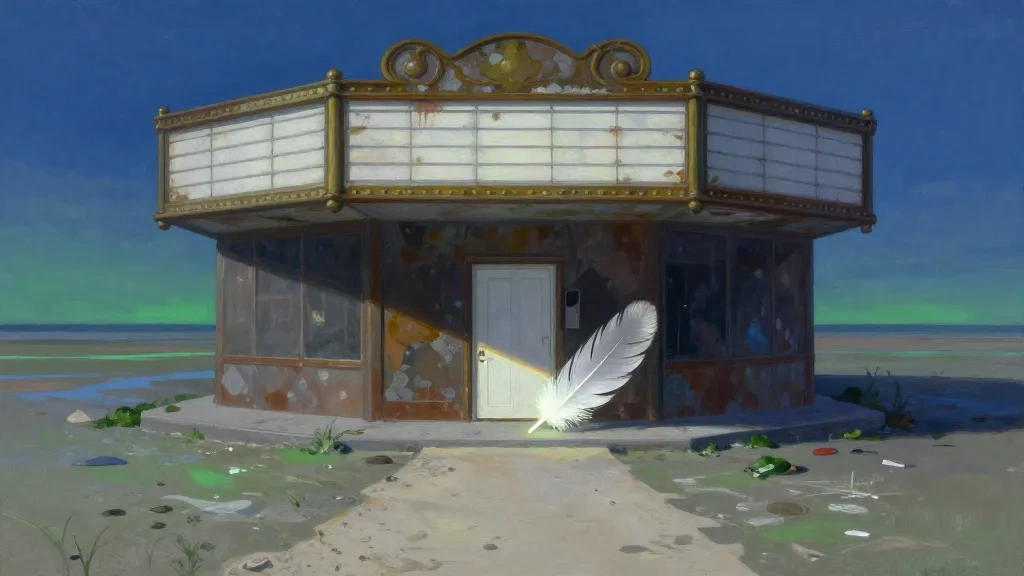
Beyond it waited a building with a curved roof and a black marquee: THE FUTURE ALMOST HAPPENED. Its doors were open. Sand whispered across the lobby, though the windows showed cobalt shadow and a rainless afternoon.
What the Machine Remembered
Inside, the seats were furred with dust. A projector stood at the back, its lamp warm. On the screen, a woman in a red scarf crossed a bridge while floodlights burned behind her. The woman stopped. The bridge swung open. Below it waited a room full of children, each holding a paper kite.
Mara recognized the year from the date at the bottom of the frame. It was the year she had refused to leave Bellweather.
“You came for the door,” said a ticket taker behind the counter. His uniform was almost white, its edges worn to transparency. “The cinema has one more showing.”
“I need a place where lost things can rest,” Mara said.
The tiller struck three times. “Rest is expensive here.”
On the other side of the lobby, between the exit doors and a cracked drinking fountain, a market had opened. Stalls crowded the corridor, their goods displayed beneath green glass lamps. A brass tooth in a velvet box. A name tied to a ribbon. A key whose bow was a crescent moon. A jar of blue seawater.
Everything had a price written in small white letters. Beside the tooth: TRUTH. Beside the name: TRUTH. Beside the jar: TRUTH.
“The expensive things are always true,” Mara said.
“The cheapest are lies,” the tiller replied. “You may have either. Not both.”
The Child with the Moth
At the final stall sat a girl of perhaps nine, wrapped in a sailor’s coat too large for her. She had one hand over her eyes. In the other she held a torn map.
On the table before her lay a moth wing, pale as old paper, and beside it a single white feather.
“I lost the sea called Mallow,” the girl said. “Not the water. The name. My mother used it to call me home.”
Mara knew the map. She had drawn it decades ago, though she had never visited its blue border. Across its empty interior, a small black door had been inked in a child’s hand.
The stallkeeper named Fen wore spectacles made of split shells. “One lost thing,” he said. “You can buy it, or you can give one away. The market accepts exchange.”
“What would she pay?”
“You have brought a door.”
Mara looked at the girl. “I cannot buy your name.”
“You can borrow it.”
On the screen, the woman in the red scarf lifted the child’s kite. The cinema lights failed. A market bell rang once in the dark.
The girl uncovered her eyes. Her irises were the color of deep sea.
The Map With No Country
At midnight, Fen drew a door on the girl’s map. Mara filled the rest of it from memory: Bellweather’s cliffs, the path behind the bakery, the room above it where her empty atlases had gathered dust. She drew a shelter on the cliff’s edge, with a low roof, a dry hearth, and a window facing the water.
“This is not the sea called Mallow,” Fen said.
“No.”
“Then the trade fails.”
“It does not.”
Mara placed the moth wing and white feather inside the black door. The feather became a sail. The wing became a lantern. The door opened onto a little house above a silver beach, and a wind rose from nowhere, carrying the scent of salt, kelp, and rain.
Across the beach, a woman in a red scarf began to walk toward home.
When the film ended, the market had vanished. In its place stood a brick wall, warm in the projector’s glow, with a small brass plaque: THE CINEMA REMAINS OPEN.
Mara took the girl’s hand. The girl held the torn map against her chest.
“You gave up the door,” the tiller said.
Mara looked at the black rectangle, now only ink on paper. Her own home had disappeared from the map, but the shelter remained. It had a window. A hearth. A place for lost things to rest.
Outside, cobalt shadow lifted from the harbor. Somewhere beyond the roofs, a child called home.
Every door Mara had ever drawn opened inward.





