 Netwrck
Adventure.
The Cook of the Dry River
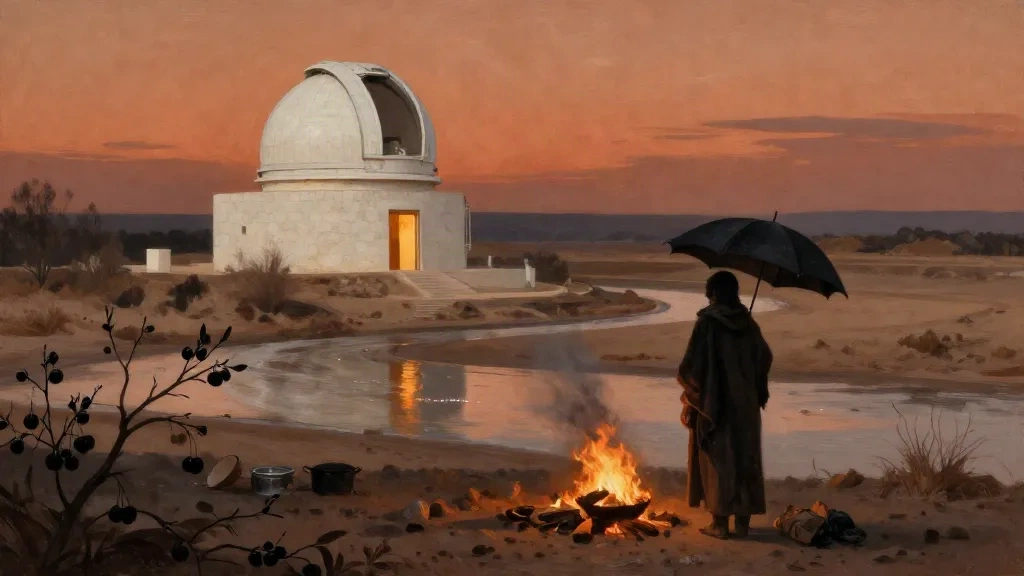
By dusk, the black umbrella above Mara’s cooking fire had become a second moon. It belonged to no one. It leaned against the observatory wall, furled tight, its silver ribs flashing whenever the copper horizon brightened.
The observatory stood where the riverbed narrowed into a pale stone scar. Six hundred years earlier, water had carried silver sand toward the southern dunes. Now the stars hung above reeds that cracked like biscuit, and Mara carried her knife from kitchen to fire as if crossing a country-sized dining room.
Her grandmother had left her one forbidden recipe, written on the back of a star chart. Cook for the absent. They will come hungry. Beneath it was a family legend: the oldest observatory gate opened only for a meal prepared from an unbroken chain of family names.
Mara had spent seven years testing the claim. She had served soups to nobody, bread to the wind, and once a whole wedding feast to an empty courtyard. The dead never appeared, but the recipes kept her hands steady. She wanted proof. She wanted to know whether her grandmother had lied kindly or preserved a truth too dangerous to speak plainly.
Guests at an Empty Table
At midnight, Mara peeled a black cherry and placed its red flesh beside three grains of salt. The observatory clock stopped. Doors opened inward, though there were no doors on that side of the building.
People entered from the riverbed.
A fisherman in wet wool carried a lantern shaped like a fish. A child from the old railway station held a blue cup in both hands. A woman Mara did not recognize set a blue bowl on the table and whispered, “Your grandmother served me this.”
One by one, they took their old places. The fisherman requested smoked onion. The child asked for honey cakes. The woman wanted broth clear enough to reveal the bottom of the spoon.
Mara obeyed. Each dish was exact, yet she had never learned where her grandmother had learned it. When she tasted the broth, salt and grief rose on her tongue together.
Then a man arrived carrying a black umbrella, though the night remained dry. He sat opposite her and placed his hands on the table.
“You know what the gate wants,” he said.
“A name.”
“A first taste.”
Mara understood. The gate’s price was not a name written in a ledger, but the person who prepared the meal. Once admitted, the cook would have to give up remembering what food tasted like. The next gate could not take that sacrifice again.
The Cost Before Her
“Who paid before?” she asked.
The man looked toward the black umbrella. Mara’s grandmother had carried it during the drought, according to the stories. She had crossed the riverbed to reach the observatory, cooked one meal beneath the stars, and entered a gate that never opened.
Mara had believed the stories were empty because the gate remained sealed.
“She paid,” the man said, “and the gate opened for her. It has been waiting for someone else to finish the meal.”
“Then you brought me here to steal her work.”
“I brought you where the stars could hear her.”
Mara looked at the assembled guests. They were not spirits, she realized, but memories given appetite. Her family had fed them across generations, always adding a little of itself to the recipe. The black cherry, the pale salt, the broth—each dish carried the names of those who had survived the desert.
The constellation overhead turned. A thin line of light descended toward the riverbed, marking the gate.
Its lock was shaped like an empty plate.
Mara understood the final requirement. The family chain had to end with a dish no one remembered. Her grandmother had begun it. Mara had inherited it. To prove the legend, she would have to cook away the origin.
A Table Without a Center
She emptied the cooking pot into the sand and gathered the guests’ names from their stories. The fisherman had been saved by dried reeds. The child had waited beneath a railway clock. The woman had carried a bowl through a city that no longer existed.
Mara made one dish from all of them: black cherries crushed into broth, pale stones boiled until they softened, copper dust sprinkled over the surface. The guests ate. Even the man with the umbrella lowered his hands.
The gate did not ask for Mara’s memory. It did not open.
“The chain is incomplete,” he said.
Mara looked at the black umbrella.
Her grandmother had not carried it to shelter herself. She had carried it to shelter the gate while the river ran. The umbrella was the family’s first recipe: shade, water, patience. It had protected the people who came before Mara.
So she opened it.
Under its black canopy, the stars reflected in the dry riverbed. The pale stones glowed. Copper light ran along the horizon and struck the empty plate. The gate opened inward, revealing a room full of tables, every table covered with the same clear broth.
No one approached. The guests turned toward the desert, carrying Mara’s dish with them.
She remained beside the fire, tasting salt, smoke, and cherry on her tongue. The legend was true, but the sacrifice had not been hers to make. Her grandmother had already paid it, not once but in every meal she passed down.
At first light, Mara packed the black umbrella beneath her arm. The observatory kept its empty table. Beyond the pale stones, the copper horizon narrowed to a point, bright as a kitchen lamp seen from far away.
Mara walked home. For the first time, she did not need to prove she remembered.
Some doors open because someone before you was willing to arrive hungry.





