 Netwrck
Folk Horror.
The Observatory at Zero
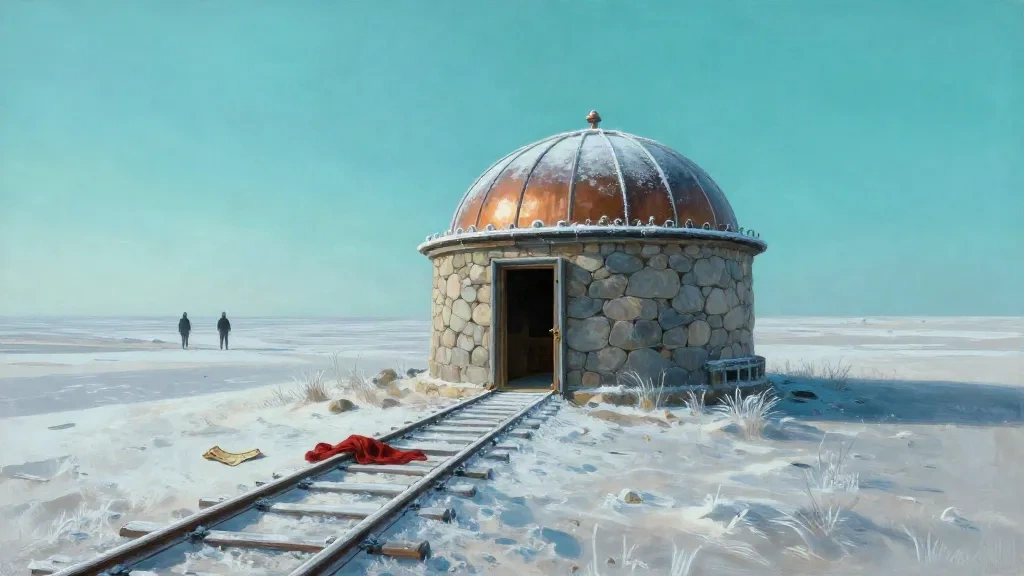
The observatory stood beyond the village, where the dunes had been cut into long, patient shelves. Its copper dome was green with frost even in August. Every night, its lens followed a star called Vesper-7, which sent messages downward in a pale cyan script.
People said the messages were written by the homes themselves. When a message arrived, a house developed a cough behind its walls. Its doors began locking from the inside. Rooms grew restless, repeating old arguments beneath the floorboards.
Mara Vale was the village nurse. She treated fevers, splints, and the special sickness of people who had become homesick for places they had never left. More than once, she had entered a house and found its residents standing in separate rooms, unable to agree on whose door led to the kitchen.
Her own mother lived in one such house at the edge of the dunes. Mara carried a red scarf in her bag, though her mother had never liked red. On the final visit, the old woman had pressed a train ticket into her palm.
“You always came to mend things,” her mother whispered. “Come before the last speaker leaves.”
The Stationmaster's Correction
Stationmaster Ilyan kept the timetable nailed beside the observatory road. He was a thin man with iron-gray whiskers and an ink stain across one thumb. He believed endings were scheduling errors.
“A road does not die because a house falls down,” he said. “It is misplaced.”
He had spent years rewriting the departures of people who had vanished into the desert. Their names remained in his ledger, but beside each one he drew a small red circle and wrote: return pending.
When Mara showed him the ticket, he examined the date, tore the page in half, and gave one half back.
“Your mother has not left,” he said. “The station has simply misplaced the announcement.”
That night, the observatory received a message. Frost spread across the lens, spelling the house's address in letters the color of iron. Inside, Mara heard two voices arguing through the walls. One was her mother's. The other belonged to Mara's younger sister, Ada, who had left the village years before and never returned.
The stationmaster placed the ticket halves on the timetable. “If one speaker leaves, the relationship becomes a single line,” he said. “But a line can be repaired. We need only correct its destination.”
A House With Two Doors
Mara entered the house at dawn. The air smelled of cold metal and dry snow. Frost gathered around the doorframes, and beneath the floorboards something enormous shifted its weight.
Ada stood in the far room, translucent, wearing a coat of pale dust. Her face was almost unchanged. Mara remembered the morning Ada had left: the red scarf caught on the thorn bush, the ticket in her hand, the argument that had become a locked door.
“You said I was homesick,” Ada said. “I was homesick for the version of you who stayed.”
Mara reached for the red scarf. It was not in her bag. It was wrapped around Ada's neck.
Her mother appeared in the doorway. “I kept it,” she said. “You needed something to return with.”
The house shuddered. Frost sealed the windows. From outside came the stationmaster's whistle, though the timetable showed no train until nightfall.
Mara placed the two halves of the ticket together. They did not form a complete ticket. Between them remained a strip of blank paper, wide enough for one address.
She wrote the house's address, then crossed out her own name.
The stationmaster's voice rose from the road. “That is not a valid destination.”
“It is the only one that belongs to both of them,” Mara answered.
The Soft Cyan Morning
At the last possible moment, Mara opened the front door. Beyond it lay the desert under a cyan dawn that did not belong to the sun. The stationmaster stood beside the rails, his iron-gray whiskers bright with frost.
Ada stepped onto the threshold. Her feet remained inside the house, but her body shone with the soft blue light of Vesper-7.
“You cannot keep everyone,” Mara said.
Her mother placed one hand on Mara's shoulder. “No,” she replied. “But you can stop making a bridge where a door is needed.”
Mara pulled the red scarf from Ada's neck and tied it around the door handle. The house recognized it. The walls exhaled. Frost withdrew from the rooms, leaving only salt-white stains where the windows had been.
The train arrived without sound. Its windows were filled with cyan light. The stationmaster hurriedly altered the timetable, then stopped.
On the platform, two figures appeared. Mara's mother took Ada's hand. They did not enter the train. They walked together toward the observatory, leaving frost-bright footprints in the sand.
Mara kept the blank strip of the ticket. By morning, the station had become a small station, then a shed, then only two posts beside the road. The village remembered the trains, but no longer needed them.
She returned to the observatory at sunset. Vesper-7 was sending a new message, bright and steady as a heart.
This time, it gave directions home.





