 Netwrck
Historical Fantasy.
The Train Before Morning
At four minutes past three, the brass clock in Bellhack Station agreed with the stars and disagreed with the calendar. Mara Venn stood beneath the platform awning in her gardener’s boots, waiting for a train that had not yet been built. Its headlamp swept the tobacco-brown hills. Its wheels struck rails ending in a white glare.
“Platform nine,” the conductor said when Mara boarded. “Last stop before whatever comes next.”
She had been municipal gardener of Bellhack for eleven years. Her title covered irrigation ditches, date palms, shade trees, and the neglected courtyards reclaimed after the mining boom. But her private work was stranger. In each courtyard she planted a story: my grandmother hiding beneath a salt cart during the Ash Emirate; my brother building a boat without nails; two sisters who divided one blanket and somehow kept warm through a killing frost. People passing remembered their own lives, or lives they wished to have had.
That was why she had come on the train from tomorrow. The station records said her family story had been lost. Mara carried the only surviving piece: a brass key stamped with a crescent moon.
In her coat pocket, the key touched a slip of paper listing twelve names. Every name belonged to a stranger. She intended to plant the story among them, let it grow, and use its roots to shelter whoever came after.
A Machine Doubted by Everyone
Track nine descended into a buried maintenance chamber. Mara found the machine there: a black iron cabinet with a keyboard of glass keys, a funnel where its chimney should have been, and a handle shaped like the railings of the old pleasure gardens.
A brass plaque offered three instructions. Speak the desired shelter. Provide the seed story. Leave believing nothing.
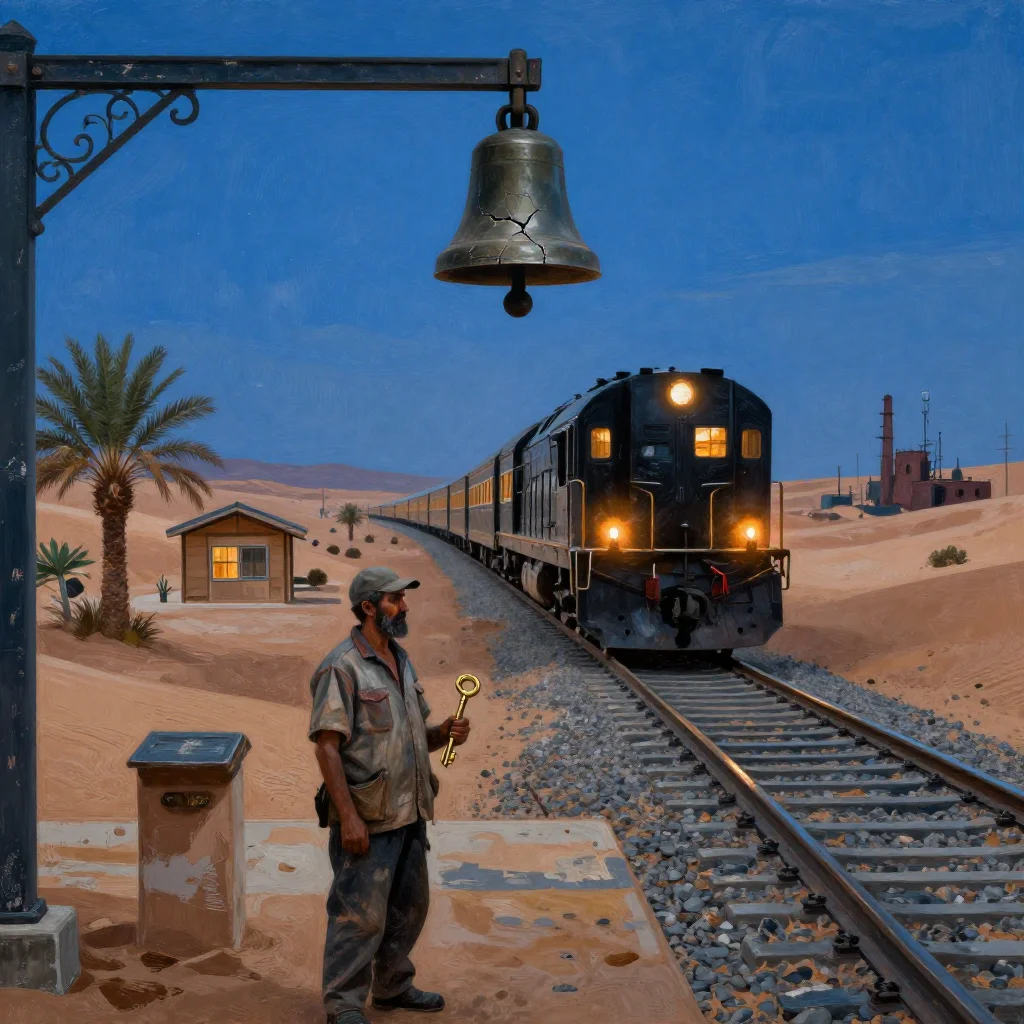
The first time Mara tried, she put her key in the lock. The machine coughed blue sparks. Above them, a cracked station bell began to ring, though its clapper had been missing for thirty years.
“Enter the facts of your flight,” the machine requested.
Mara placed one hand over the key. During the siege, her grandmother had escaped Bellhack on a maintenance train. A stationmaster hid her among the sacks of lamp oil. At the border, the soldiers asked the family’s name. Her grandmother offered the name of a dead saint instead. The lie became a door, and the train passed through.
“Enter the facts,” Mara repeated.
“Facts do not shelter. Belief does.”
“Belief cannot stop a desert.”
“Then you misunderstand the instrument.”
“Enter the story without believing,” the machine said. “Enter the story without doubting.”
Mara tried again. Nothing happened.
At dawn she found seven railway porters waiting outside the chamber. They had heard the bell and come to help. She sent them away. That night she invited her neighbor, the water engineer. The machine stalled at the first spoken sentence. When the engineer called it nonsense, the glass keys dimmed.
By the third attempt, every mechanic, guard, porter, and ticket clerk in Bellhack was whispering about the machine. Some believed it divine. Some believed it fraudulent. The believers watched it with delight. The doubters watched it with suspicion. Either way, someone was watching.
Rooms Made from Doubt
On the seventh night, Mara boarded the same impossible train. The conductor recognized her.
“You returned before the work is done.”
“The machine requires disbelief.”
“All machines do, in one form or another.”
At the border Mara saw soldiers stopping families beneath a red sun. Among them stood her grandmother, young and furious, with a key hidden in her mouth. Before Mara understood the scene, the machine projected a room into the desert.
Plaster walls trembled. Beds appeared. Water flowed into an earthenware jug. The room had no roof, only a lattice of blue shadow. Mara stepped inside and knew every plank beneath her feet: the floorboards of her childhood home, soaked through by a summer flood.
Beyond the lattice, more rooms formed. Some held stairs. Some held lamps. Some were only chairs for the exhausted.
Then the machinery began to disassemble them.
“You believed,” the machine said.
Mara looked through the wall. At the station, a boy carried her brass key. The cracked bell swung above the crowd. Mara was proud. The boy was amazed. The porters were certain. Every eye fixed on the miracle.
“No,” she said.
The shelter trembled.
“You built it from what they believe,” the machine continued. “Stories fed by admiration decay. Stories fed by doubt take root.”
Mara turned to the soldiers at the border. In her grandmother’s memory, the dead saint had begun to speak. Not because anyone believed her. Because doubt was the only silence the enemy could not command.
Mara gave the story no ending. She took the key from the boy’s hand and said, loudly, that it was probably a piece of scrap. The porters groaned. The engineer denounced her. The conductor shrugged. One by one, they looked away.
Under their averted eyes, the courtyard settled.
The Roof No One Saw
By sunrise, a garden occupied the space beyond the platform. Twelve narrow rooms circled a courtyard planted with date palms. Their walls were woven from old bricks, empty rail ties, and scraps of oilcloth. Each room had a well, a sleeping mat, and a latch that worked with the station’s missing bell clapper.
Mara’s brass key opened the first door. The bell, newly whole, sounded once over Bellhack.
No train arrived then. A woman named Sera did, carrying a suitcase and three children who had slept in freight yards for a week. Behind her came an old man, then a pair of railway cooks. The courtyard received them without asking who they were.
Mara planted no story that day. She watered the palms instead.
Years later, travelers claimed the shelter was a rumor and a refuge at once. Its walls shifted when suspicion met them, but never when kindness did. Old porters denied having helped build it. Children said the garden grew better after visitors stopped praising it.
Whenever the cracked bell sounded, Mara checked the key. It remained warm from no fire at all. The station’s records continued to show the trains arriving from years no calendar owned.
She kept her family’s ending incomplete. Somewhere beyond tomorrow, a dead saint still spoke when soldiers watched. Somewhere in the courtyard, strangers slept beneath a roof that existed only while no one believed it could.





