 Netwrck
Mystery.
The Platform Beneath Winter
At 4:17 each morning, Mara Vale climbed into the lighthouse and opened the sky. Winter had sealed the harbor with hail, but beyond the salt glass, autumn sailed over a green sea and summer walked openly through orchards still buried in snow. She copied each foreign weather onto a narrow ledger: pressure, wind, thunder, the temperature of falling rain.
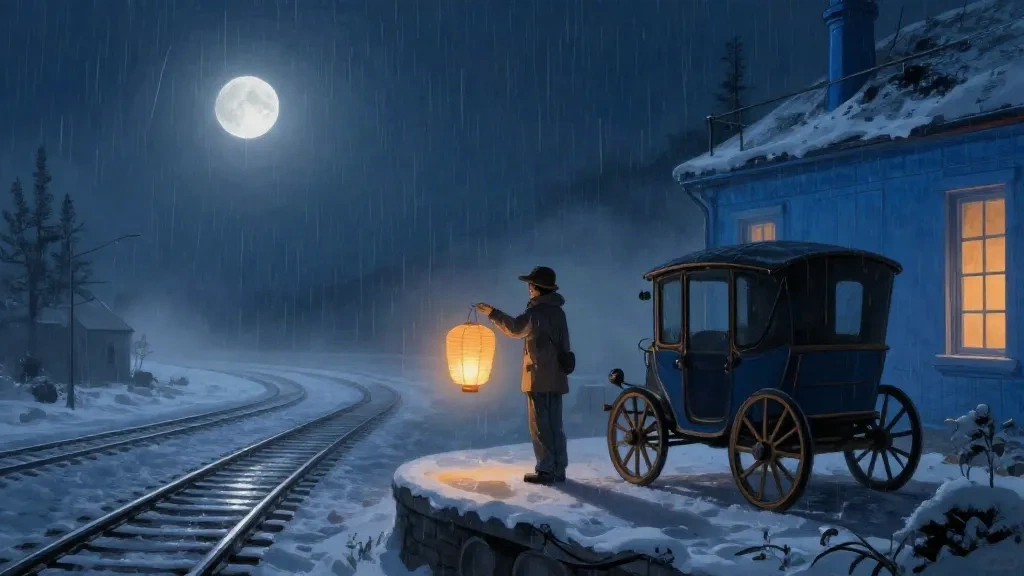
That morning, one departure board read WINTER UNDER FOOT, SPRING AHEAD. The small moon hanging above the platform shed rain-silver light onto the tracks. A paper lantern swung from its hook, though no breeze entered the station.
At the ticket window sat Ilyan Rook, stationmaster and keeper of the municipal code. His spectacles reflected the amber window of the signal cabin.
Passengers may board only where a season can lawfully be entered,
Ilyan said.
“Nonsense,” Mara replied. She had catalogued seventeen kinds of impossible weather, including rain that remembered falling upward.
“New ordinance.” He tapped his ledger. “No impossible thing shall occur without a licensed cause.”
Mara saw a blue-ink notice pasted beneath the timetable. Its signature shone faintly: a moon stamped over a municipal seal.
The Man With No Arrival
The lantern was waiting for someone, but the platform belonged to a passenger called Ansel Vale, who had stepped out of a summer carriage two nights earlier. He was the lighthouse keeper’s brother: gray-bearded, smelling of salt and orange peel, carrying her little moon in his coat pocket.
Now passengers remembered him as a tall stranger, then as a fare already paid, then as nothing at all. By dawn, even Mara’s ledger held only a blank page where his arrival should have been.
“Why save one man when winter has taken half the city?” Ilyan asked.
“Because half a city is not my brother.”
She descended beneath the platform. Frost glazed abandoned signs: BEECH STREET CLOSED, LIGHTHOUSE MAYOR, TUESDAY. Each notice named a thing that had vanished because no person could remember causing it. A forgetful city, Mara thought, and beneath it someone selling licenses to causation.
Under the third rail she found Ansel’s paper lantern. Its wick had never burned. Written inside the paper was her childhood warning: RETURN BEFORE I FORGET YOUR NAME.
She had sent that lantern into a November storm when they were children. Now it led her toward the alternate seasons.
Licensing a Small Impossible
At platform seven, summer arrived without a train. Warm wind rolled through the station, carrying orchard dust and the hot metallic smell of a lightning flash frozen in midair. Ansel stood behind the refreshment stall. A brass plaque on his coat read SUMMER CAUSE, UNPAID.
“The city is making itself forget,” he said. “No one notices when the impossible has an explanation.”
“Why do you remember?”
“Your lantern remembers.”
Ilyan stepped from the shadows with the ordinance open. “Retrieve the passenger and you will erase another season. This station may lose autumn entirely.”
Mara understood the trap. The law did not merely punish impossible things. It made forgetting the cheapest legal effect. Every unexplained change vanished from public memory, leaving the city materially intact and emotionally untouched.
She opened her weather ledger. “What is a season?”
“A licensed alteration of prevailing conditions.”
“And a person?”
“A persistent witness.”
Mara entered the small moon. It gave no heat, no tide, only a thin silver circle against the platform roof. Then she entered the paper lantern: evidence of departure, promise of return, an object remembered by two childhood hands.
“Exhibit A,” she said, showing the moon. “A navigator’s record.”
She placed the lantern beside Ansel’s blank license.
Cause: someone came back to be recognized.
Ilyan frowned. “That is not an event.”
“It is the only one you cannot classify.”
One Amber Window
By law, the keeper of a winter station could close one platform for an unregistered traveler when necessary to prevent structural danger. Mara declared the hazard a person: a summer passenger standing in winter air, causing persistent weather.
Ilyan stamped the page. The moon brightened. The lantern lifted.
Summer tore like wet paper. Ansel seized the signal rope, and the amber cabin window blazed across the station. Mara shouted his name into the rain. Once, no answer. Again, every syllable.
The ordinance tried to remove each sound. The small moon held the silence, the paper lantern carried the light, and Mara kept speaking until the city remembered.
On platform three, a woman opened her umbrella and frowned. “Ansel Vale,” she said. “You missed the November fair.”
He looked at Mara and smiled.
Outside, autumn returned in a single breath: wet leaves against the harbor, a warm west wind, the year's first difficult rain. The station remained in winter. One amber window burned above the tracks.
Mara entered beneath her brother’s name: CAUSE CONFIRMED.





