 Netwrck
Historical Fantasy.
The House That Kept Coughing
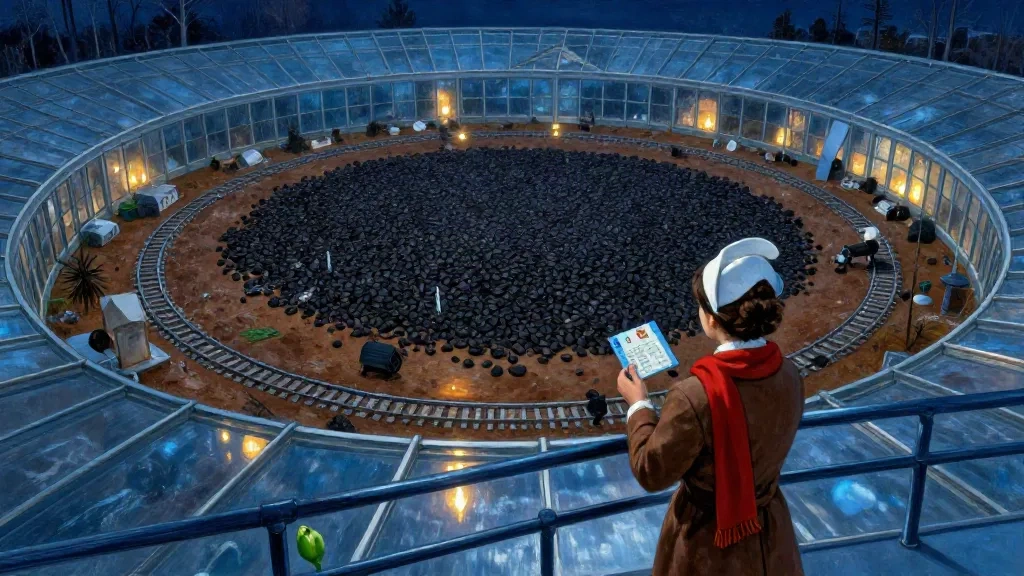
On Seedlight, the oldest greenhouse turned around the silent seed like a bracelet around a black stone. Its steel-blue ribs arched overhead, stained by frost and age. Beneath the glass, tobacco-brown soil held trees that had not grown for three hundred years: oaks with sealed leaves, ash trees with roots clenched around vanished rivers, birches whose bark remembered the axe.
Nurse Elian Vey lived among the tending galleries, where each house was joined to the seed by a silver root. When a family quarreled, the root loosened. When someone left, the walls drew inward. The houses grew sick with borrowed grief, and Elian carried a medicine case of iron needles, red thread, and small brass bells.
The Vale house began coughing on the ninth day of rain.
Its kitchen shutters rattled. Three grown children argued over a table where their father had carved the measurements of their hands. Their mother sat with her back to the oven, pretending not to hear. On the mantel, a red scarf lay folded beside an unused train ticket.
“The west platform closes at moonrise,” Elian said.
The eldest daughter, Mara, looked up. “Then it closes.”
“You said you would never speak to your brother again.”
“I was younger.”
“You are twenty-six.”
The house coughed again. A pane near the floor frosted over, though the greenhouse was warm. Elian laid her palm against it. Behind the glass she saw a memory: a boy in a red scarf waiting at a platform, a woman holding out a ticket, both mouths moving without sound.
“He is leaving at dawn,” Mara said.
Elian looked at the father. “And you?”
He stared into his tea. “I have already left.”
The Stationmaster’s Ledger
Stationmaster Orin Venn met her beside the maglev platform, where the greenhouse track curved toward the transfer ring. He was a narrow man in a brown uniform, carrying a ledger thicker than a paving stone.
“Homesickness is a scheduling error,” he said.
“The Vale house is ill.”
“Then revise the schedule.”
He opened the ledger. Every departure in the station was listed: a daughter to the outer hydroponics, a mechanic to the shipyards, a bride to the northern farms. Beside each name he had written a cause.
“People call it fate,” Orin said. “I call it poor administration.”
“Can you bring them back?”
“Not bring. Recalculate.”
He offered her a ticket. It was pale blue, stamped with a departing constellation, and warm as if recently withdrawn from a printer.
“The last carriage waits beneath the eastern arcade,” he said. “It will arrive before the west platform closes. I can delay the departure by six minutes.”
“Six minutes is not a reconciliation.”
“It is a beginning.”
Elian took the ticket. On its back, in a cramped hand, someone had written: SPEAK BEFORE THE DOOR CLOSES.
Six Minutes in the Roots
The eastern arcade smelled of wet iron and cedar. Beneath it, the old carriage waited with its lamps burning low. Elian descended alone, carrying the red scarf and the ticket.
She found the Vale family in the root chamber. The children stood on either side of their father. Mara held one end of the scarf, Tom the other. The mother stood by the silver root, her hands pressed flat against its bark.
“The stationmaster says the carriage can wait six minutes,” Elian told them.
Tom’s face hardened. “I don’t want a carriage.”
“No one asked what you want.”
“You think six minutes can undo ten years.”
“No. I think six minutes can make room for the truth.”
She stitched the red thread through the root where the old forest had broken. Candlelight from the carriage lamps fell in fragments across the chamber, steel blue and amber. The root trembled. A green leaf opened on a branch that had been dead since the first century.
Tom spoke first. “I went because she asked me to stay.”
Mara’s grip tightened. “I asked you to stay until the house stopped being angry.”
“I thought you meant forever.”
“I meant tonight.”
Elian held the ticket between them. “Forever is a bad timetable.”
At dawn, the carriage door closed with the sound of a distant bell. The west platform remained open. No one boarded. The stationmaster watched from above, his ledger shut for the first time in forty years.
What Stayed
By evening, the Vale house had stopped coughing. Its shutters stood straight. In the kitchen, the family argued again, but the walls no longer tightened. They argued about supper, the missing spoon, who had moved the red scarf onto the hook.
Elian left the blue ticket beneath the lamp. The stationmaster came at night, carrying a pencil but no corrections.
“I believed every ending was an error,” he said.
“Some are.”
“And some?”
“A door. A breath. A person deciding to remain.”
He looked toward the greenhouse, where reflected candlelight trembled over the steel ribs and the sleeping seed. Then he wrote a new line in the ledger, not a departure, but an arrival.
Elian returned to her medicine case. The red scarf was warm in her hand. Somewhere beneath the floor, a dead tree put out one pale bud.





