 Netwrck
Weird Fiction.
The House with a Cold Mouth
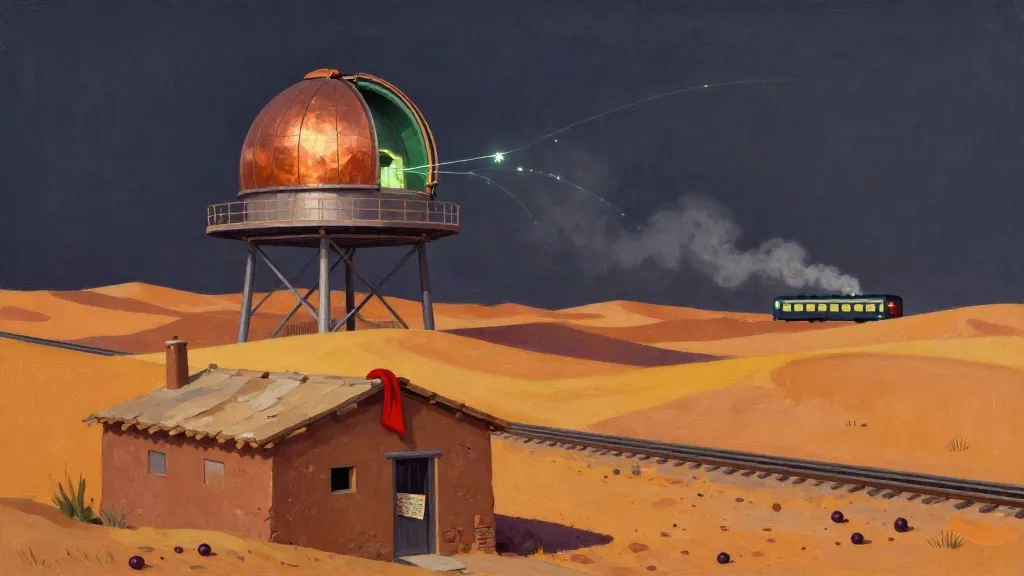
In the saffron dusk of Veyr, the observatory stood on nine iron legs above the dunes, its copper dome turning toward a sky that had begun sending messages in pale green. Each message arrived as a line of light, a pressure behind the eyes, a word spoken in sleep.
Ilya was the village nurse, though her patients rarely admitted to illness. She treated homesick houses: shutters that would not close against the wind, kitchens that burned every meal, bedrooms that kept producing the smell of a childhood. A house became homesick when its people had stopped answering one another.
The patient this evening was a narrow adobe house at the edge of the railway quarter. It had a red scarf hanging from its chimney and a train ticket nailed beneath the door. When Ilya touched the wall, it shiveried.
“He leaves before midnight,” she said.
“Then the house is right to be frightened,” said the stationmaster from the doorway. He was a broad man in a plum-colored coat, carrying a lantern even though the stars were bright. “Every ending is a scheduling error. People are not obliged to depart merely because a timetable says so.”
Messages for the Living
Inside, the rooms had arranged themselves like an argument. Spoons pointed toward the ceiling. Chairs faced the walls. A bowl of dry dates sat untouched on the table, each fruit marked with a tiny bite.
The absent speaker was Nima, the house’s owner. He had left his sister Sereh on the platform two nights before, carrying the same red scarf Ilya had seen on the chimney. Their quarrel had begun over their mother’s last observatory key, then widened to include every year they had failed to visit her.
They had promised to speak when Nima returned. The star message arriving that evening said only: What is already gone cannot be assigned a seat.
Ilya treated the house by opening every drawer. Beneath the floorboards she found letters addressed in both their hands, most never sent. One said, I do not know how to come back without becoming a stranger. Another said, I know. Come anyway.
The stationmaster read them over her shoulder. “A practical defect,” he declared. “The return carriage was delayed by a sandstorm. If I amend the schedule, the relationship need not be lost.”
“You cannot amend a person.”
“Watch.”
The Platform of Useful Fictions
They carried the house’s letters to the station. It moved easily on its iron sills, leaving tracks in the dust. At the platform, the village gathered beneath smoke-grey air that swallowed the horizon. The night train waited with its windows sealed and its wheels warm.
“Call him,” said the stationmaster. “Call him by the old name. Tell him the carriage has been delayed.”
Ilya climbed onto the platform and used the station’s brass telephone, a relic from before the desert trains changed their names. Nima answered on the seventh ring.
“I cannot come back before I leave,” he said.
“Neither can she,” said Ilya.
Silence. Then Sereh took the receiver. The house creaked around them, its red scarf lifting as if touched by a wind from another season.
They spoke for less than a minute. No one mentioned their mother. Nima said the observatory had recorded a new star message in her handwriting. Sereh said the house had been ill because it was keeping both their silences. He said he had been afraid she would ask him to prove he was sorry. She said she had been afraid he would.
Then Sereh asked, “Will you meet me between trains?”
The stationmaster seized the timetable and began rearranging the hours. The midnight departure became 1:12. The 1:12 became dawn. The platform clock spun backward with every alteration, but the train did not move.
“Listen,” Ilya told him. “The ending is not the departure. It is what we make the departure mean.”
A Message Without a Sky
At the observatory, the green message strengthened. A new line formed across the dome, bright enough to turn the saffron walls white. Ilya read it on the brass plate:
Two houses may share one wall and still leave each other outside.
Nima and Sereh returned to the adobe house together. They did not reconcile. They argued about the key, the scarf, the years, and the train ticket beneath the door. The house listened, trembling whenever either voice softened.
The stationmaster found them at sunrise with a red scarf wrapped around his lantern and a ticket marked for a carriage that no longer ran. “I have corrected the timetable,” he said. “Neither of you has to leave.”
Nima picked up the ticket. “This was never about leaving.”
Sereh opened the kitchen door. Smoke-grey air entered, carrying the scent of rain that would not reach Veyr for another year. She set two bowls on the table. The spoons turned upward, then slowly faced each other.
At noon, the observatory received a final message. It was not green. It burned saffron yellow, then deep plum, and resolved into a line so small that only the house could see it:
Begin again in the room you are standing in.
The house exhaled. Its walls loosened. The red scarf stayed.
And beneath the door, the train ticket slowly changed its destination from Veyr to Here.





