 Netwrck
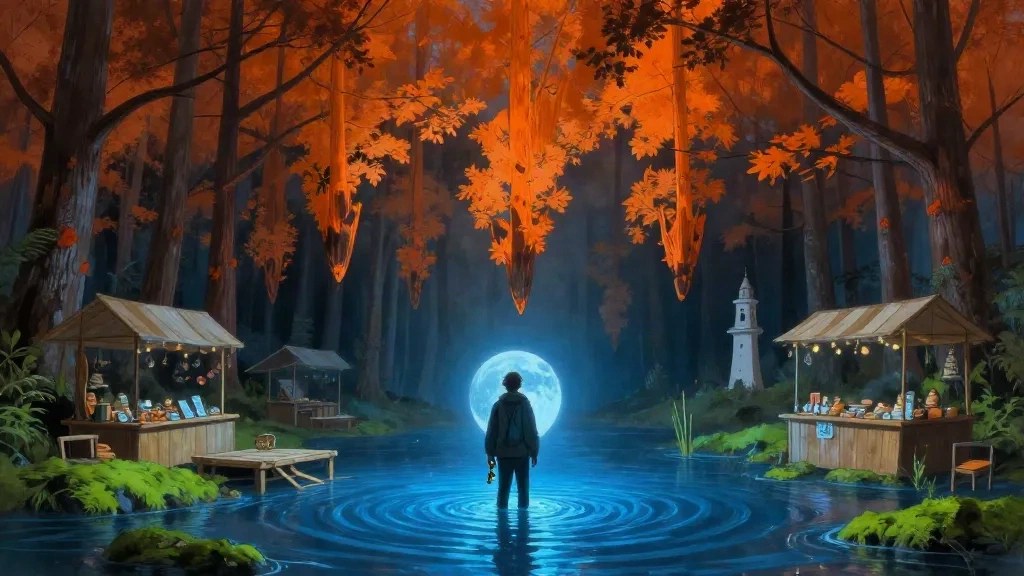
Surrealism.
The Forest That Had Been Put Outside
By morning, Lichen Reach had no yesterday.
Its trees stood in burnt orange light, their roots wrapped around one another like sleeping animals. Between them ran a blue storm-light that had no weather. The ranger, Iven, stood at the boundary with his hand on a brass key and watched the forest refuse to be remembered.
Everyone evacuated from time had gone. Grandmothers left their kitchens in the middle of boiling. Children abandoned half-built forts. A blacksmith had left his hammer glowing on an anvil, waiting for a hand that would never return.
His work was to keep the forest safe from returning hours. Nothing born inside it should be allowed to rejoin the world.
At the market’s edge, a brass key lay on a stall beside a cracked bowl. Iven recognized it immediately. It was smaller than his palm, warm as bread, and cut from metal the color of old honey.
Under the key was a note:
Take the moon across the market. Find the blue ford. Do not let the bell count twice.
No signature. No name.
But the handwriting belonged to Mara, the guide who had vanished from the forest nine years earlier.
A Market of Borrowed Rooms
The floating market began at the boundary and ended nowhere. Platforms of blue wood hung above a silver void, tethered by chains thin as spider silk. Stalls displayed memories that had lost their owners: a child’s shoe filled with birdsong, a winter morning folded into a jar, a quarrel preserved in a glass cup.
Everything had a price. Most sellers accepted only memories.
Iven had none to spare, so he kept his hand over the brass key and walked past the stalls. A woman offered him the sound of his mother laughing. A boy offered the smell of rain on a childhood road. He refused them all.
At the center of the market floated a small moon.
Not the moon in the sky. This one was a fruit-sized sphere of blue-white light, rolling from stall to stall on an invisible track. A rope of shadow followed it.
“You are late,” said a tall creature standing beside the moon.
Its body was made of measuring reeds. Its face was a smooth stone with two narrow apertures where eyes should be. It held a silver clepsydra.
“Curfew begins when the moon reaches the third bell,” it said. “After that, the market closes its paths. A lost memory is a dangerous tenant. It may forget the forest and begin forgetting the people who once lived there.”
“I need to reach the blue ford.”
“You need to reach it before the moon crosses the third bell.”
“Why should I trust you?”
“You should not trust me. You may trust the schedule.”
The creature turned the clepsydra. Sand fell upward.
The Bell That Counted Twice
They moved through the market as the moon rolled ahead of them.
Every stall tried to make Iven stop. A room called his childhood name. A memory of Mara touched his sleeve, then withdrew. The forest appeared below the platforms, upside down and burning gently beneath a blue sky.
He kept walking with the brass key clenched in his fist.
At the first bridge, a tollkeeper raised one hand.
“One memory,” the tollkeeper said.
Iven stared at the key. Mara had carried this, he realized. The journey had not merely been left unfinished. It had been left to him.
He placed the key on the tollkeeper’s palm.
“This is hers,” he said.
“Then it is not yours to spend.”
“It is not a memory.”
The tollkeeper opened his hand. The key had become a small, bright door.
Iven stepped through.
He emerged on the far side of the bridge with the moon still rolling ahead. The creature’s clepsydra was empty.
“Curfew,” the creature called.
The market folded shut around them.
The Blue Ford
The forest began returning in pieces.
A door appeared inside a tree. A child’s voice called from a hollow branch. Beneath Iven’s feet, the ground remembered being ground.
He ran.
The brass key had grown warm against his palm. The small moon waited above the blue ford, casting a circle of storm-light across the water.
On the opposite bank stood Mara.
Not alive. Not gone. A memory precise enough to hold the shape of a person who had refused to be forgotten.
“I started the journey,” she said.
“I know.”
“I was carrying the moon to the forest.”
Iven looked down. The moon was between them, small and impossible.
“Curious,” Mara said. “You have brought it back.”
Behind him, the measuring-creature raised its clepsydra. Across the market, the first bell began to ring.
Iven understood then. The creature was not guarding the forest from him. It was keeping him from taking the moon where the past could no longer reach.
He stepped into the blue ford.
Water rose to his knees, his chest, his throat. The moon touched the surface and sank.
The bell rang a second time.
Mara’s face softened.
“You came all this way to finish a stranger’s errand,” she said.
“I came to finish yours.”
The moon rose beneath the water, carrying the forest with it. Trees, stones, doors, and birds ascended into the storm-light. For one instant, Lichen Reach existed in both directions at once.
Then the water closed over Mara’s memory.
At dawn, the market was gone. The forest had returned to its proper place, though no one could agree on what year it belonged to.
Iven kept the brass key. It no longer opened anything. Still, every morning he carried it into the trees and waited for the small blue moon to appear between their branches.
He never told anyone that the moon was not a warning.
It was the light Mara left behind when she went home.





