 Netwrck
Romance.
The Clockmaker of Wet Stone
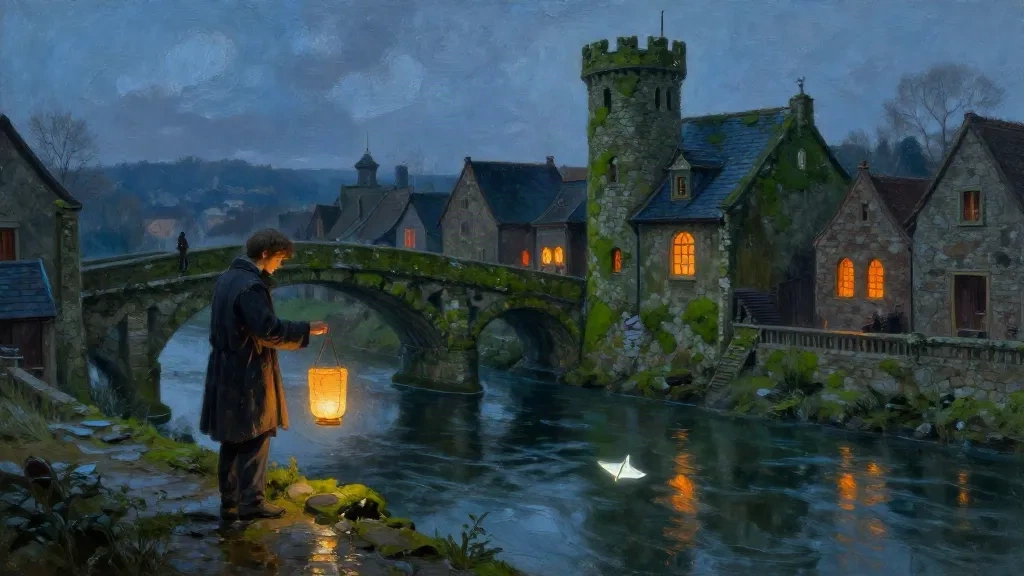
Elian made clocks for seasons rather than hours. He shaped their brass cases from river reeds, filled their narrow chambers with thawing rain, and wound them only at the turn of spring, harvest, frost, and thaw. His shop stood beneath Moss Bridge, where every promise crossed in green weather and every lie waited beneath the wet stone.
Customers brought him broken promises in all forms: a ring that had grown too small, a letter softened by tears, a key returned after the door had forgotten its house. Elian placed them inside paper lanterns and listened for the right season.
On the morning the river changed color, he heard his own name in the choir behind the bridge.
The voices were memories. Some were his mother's, stern and smelling faintly of rosemary. Some belonged to customers who had left town without paying. Others had no names at all. They argued through the reeds, each claiming a different version of what had happened.
Elian held a pale lantern beneath his counter. Inside it, a moth wing lay folded on a scrap of velvet. The wing was iridescent, blue at the edges, and it had belonged to Mara, the woman who had vanished six winters ago.
He had promised to return it to her. He had promised to return everything.
The River's Conflicting Testimony
The choir told him the wing was a gift Mara had meant for him. Then it told him she had torn it from a moth and bound it into the lantern to escape. A third memory insisted there had never been a Mara, only a promise someone else had mistaken for love.
Elian carried the lantern to the river. The water ran black beneath the bridge, carrying leaves and scraps of names. When he lifted the lantern, the choir swelled. His mother's voice warned him that some things return changed. A stranger's voice laughed and said that love was only a clock wound by the hand that feared losing it.
Across the water stood the old kiln where Mara had taught him to hear seasons in metal. Her face appeared in the window, young and solemn, then aged, then young again. Elian stepped onto the bridge.
Every promise in town creaked beneath his boots.
He remembered the night Mara left. She had placed the wing in his palm and asked him to keep it until she returned. He had promised without asking when she would return. That omission had been enough to bind him.
The river rose, wet stone shining. The wing beat once inside the lantern.
What the Lantern Remembered
Elian opened the lantern. Cold air spilled out, carrying the scent of marigolds from Mara's garden. The wing lifted, but the choir fought for it. Memory tore at memory: her laughter, her silence, her last angry words, the kiss she had given him beneath a sky the color of moss.
He understood then that the choir did not want the wing restored. It wanted the promise preserved, because promises gave their voices a place to live.
Elian placed his own hand over the lantern. He did not command the wing to fly. He spoke plainly, as he had once spoken to a stubborn season clock.
She made this. I return it. What she meant by it is not mine to decide.
The wing rose in a flash of marigold gold. It struck the river once, and the water rang like a bell. Every bridge in the town answered. The chorus broke into separate notes, then fell silent.
Mara's face returned in the kiln window. This time it did not change.
A Promise Returned
She looked at him for a long moment. Then she lifted one hand, showing the pale scar across her palm where the moth had brushed her.
She had kept the wing because making it had been the last promise she could complete. She had gone north, not to leave him, but to find a winter so cold it could not take her work from her. Returning had been impossible. The river had mistaken her departure for abandonment.
Elian wanted to accuse the town. He wanted to ask why its bridges had made him wait, why its river had kept her voice, why the choir had let him believe the worst. But the watchmaker understood now that a promise was not a lock. It was a thing maintained by both hands.
He released the moth wing toward the kiln window. It passed through Mara's reflected hand and vanished into the winter beyond.
The lantern collapsed inward. Elian made it flat, warm, and empty.
On the bridge, the water ran clear for the first time in six years. Mara stepped onto the wet stone, solid at last, while the town listened to the river keep its witness.





