 Netwrck
Romance.
The Clockmaker of Thaw
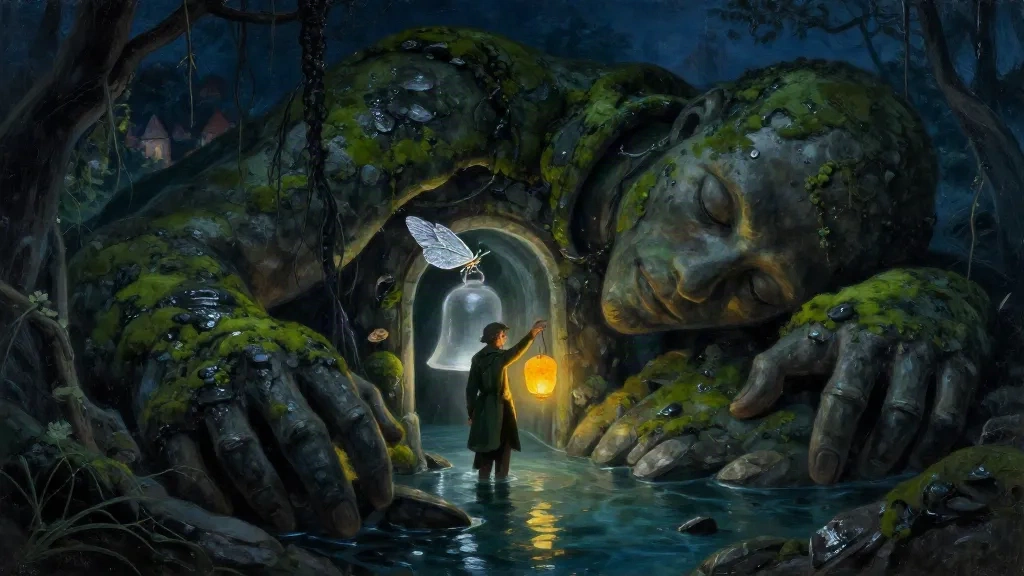
Mara Venn repaired clocks for seasons rather than hours. In the village built inside the ribs of a sleeping giant, her workshop leaned against one warm bone wall, its windows clouded with sap and rain. On the bench lay a copper dial marked First Frost, a silver one for the long blue dusk, and a glass case holding the village's restless midsummer.
Her own clock had stopped three winters ago. She had never found the missing spring.
That morning, beneath the last of the market smoke, someone left a paper lantern on her step. It was small enough to close around one hand, its folds mottled moss green, its ribs blackened as if by a fire no one remembered. A marigold glow shone through the paper.
Inside lay a single moth wing.
The wing was silver at the edges, scaled like frost, and marked with a droplet of blue. Mara knew its species. She had seen its twin pinned beneath the workbench of Elian Sore, the bell caster who had loved her without ever asking her to stay.
Elian had disappeared the night the giant turned in its sleep. The ribs cracked. Three houses fell. The river entered the village by a new channel, carrying away everything the old maps named.
By dusk, Mara carried the lantern up through the settlement. Children followed it. Grown men stood aside. The annual hinge creaked overhead, and the whole village seemed to breathe with it.
The Choir Under the Bone
At the old kiln, beneath the lowest rib, a choir gathered to decide the lantern's fate. Their voices were not sung. They surfaced from the stone: a woman's exhausted sigh, a child's complaint, an old man's laughter, the dry scrape of a chair.
They were memories.
“Return it to Elian,” said the sigh. “He made it to guide her home.”
“Burn it,” said the child. “The giant dislikes bright things.”
“Keep it,” whispered the laughter. “Some warmth is worth hoarding.”
“Forget the maker,” murmured the chair. “The maker is not the one who lost anything.”
The voices rose until the lantern trembled. The moth wing lifted itself against the glass, trembling too.
Mara held fast. The wing was the hinge. She had seen Elian work for three nights, scoring paper with a needle, pasting it with beetle glue, setting the marigold pane in the center. He had told her, For a thing that remembers where it belongs.
He had meant the lantern. Perhaps he had meant her.
The choir attacked her doubts. One voice showed Mara Elian leaving with another woman's hand in his. Another remembered him laughing at the market, whole and careless, before she had loved him. A third described his last command: let the lantern go if he did not return.
“You are returning it to satisfy yourself,” said the sigh.
Mara watched the marigold glow catch on the wet stone. “I am returning it to the person who made it.”
“The person who made it is a memory,” said the chair. “The person you want is a ghost.”
She answered, “Then the lantern will know the difference.”
The Door Beneath the Flood
They found the workshop where the new river had entered the old drainage tunnels. Its sign hung underwater: Sore, Bells and Repairs. The bells had become green stones. The repairs had become moss.
Mara waded in to her knees. The cold bit through her coat. Behind her, the choir's memories rose in the water, giving contradictory directions. Left, right, down, back.
She followed none of them. She followed the pull of the spring inside the lantern.
At the tunnel's end stood a narrow door, too small for the giant's hand. Its lamplight was marigold.
Elian waited beyond it.
He was unchanged, except for the hollows beneath his eyes. In his hands he held a little paper boat, its sail cut from the same silver moth wing.
“I built the lantern for you,” he said.
“I know.”
“I built the boat for us.”
That was the part the choir had tried to erase. On the night he left, he had rowed toward the sleeping giant's heart, carrying the last spring in a paper boat. The giant had shifted. The river had caught him before he could return.
His memory remained here because the lantern had never found a home.
“You forgot the lantern,” Mara said.
“I forgot everything except you.”
The choir surged through the door. Grief cried out for punishment. Hope demanded they live again in the same house. Anger accused Mara of coming too late. Love whispered that a memory was not a life.
She opened her palm. The moth wing was warm now.
“I did not come to bring you back,” she told him. “I came to return what you made.”
She placed the lantern in his hands.
What the Spring Remembered
The paper brightened. The marigold center flared, and the missing spring loosened inside Mara's stopped clock. Across the village, seasonal bells began to ring beneath the sleeping giant's ribs.
Elian cupped the lantern. Its paper softened, then hardened into something more durable. The moth wing loosened from the seam and rose around him like a small, bright weather.
“Then let the memory stay,” he said.
“And you?”
“Go where the river begins.”
He had not vanished. He had become part of the current beneath the village, carrying spring to the roots each year. When he touched the lantern, the water knew his name.
They crossed the threshold together. Mara's hand found his beneath the rain.
Behind them, the choir fell quiet. The sigh became a lullaby. The child's complaint became birdsong. The old laughter rose from the water, and the chair finally remembered how to bear weight.
By morning, the lantern hung in the workshop doorway, its marigold flame steady against the moss. The moth wing had vanished. In its place, a new spring turned the gears of every clock in the village.
Mara left her own clock unwound. She no longer needed it to tell her when love had happened.
It happened whenever the sleeping giant breathed, and the rain, green with memory, brought someone home.





