 Netwrck
Romance.
The Last Departure
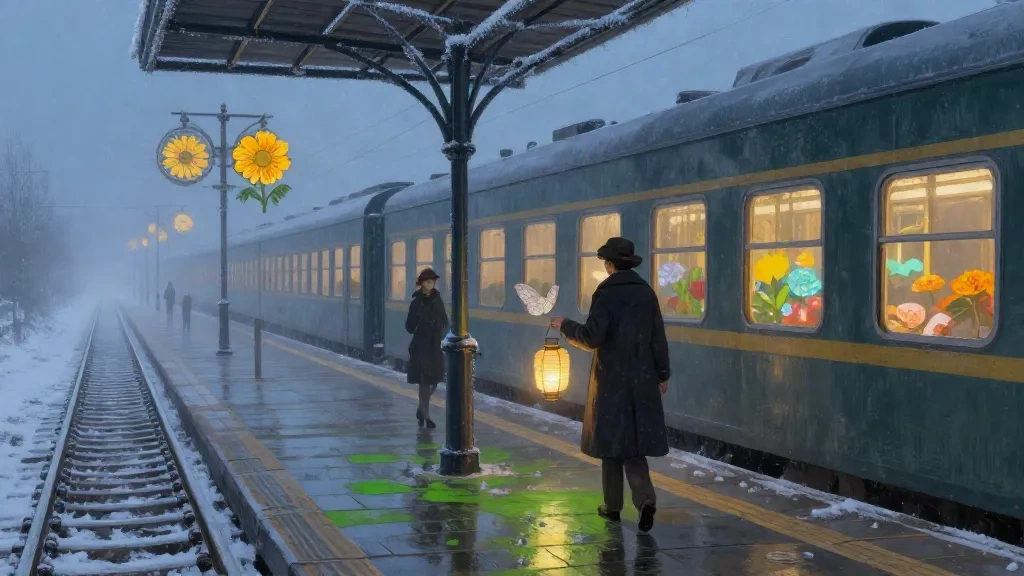
At the edge of the city, where the platforms were roofed in snow, Mara repaired the clocks that governed seasons.
Her workshop stood beside the station’s eastern wall, its windows clouded with frost. Inside, the clocks did not count hours. They counted the length of a thaw, the hour when orchards flowered, the precise day winter surrendered its grip. Each season had its own mechanism: brass petals for spring, silver rain for summer, black iron for autumn, blue glass for winter.
On the night the first seasonal train arrived, Mara received a paper lantern.
It was folded shut, its paper mottled with wet moss green, its rim dark as wet stone. A single flash of marigold showed through the crease. Beneath it lay one moth wing, pale and translucent, veined with gold.
The lantern had belonged to Elian, the stationmaster’s daughter. Elian had made lanterns for travelers lost between seasons, guiding them toward the home that wanted them. For seven years, she had worked in the western workshop, trimming paper into rooms of light.
Then she had boarded the winter train and disappeared before Mara could propose.
Mara wanted only to return the lantern to the woman who had made it. She wanted the answer to the question she had failed to ask: whether Elian had waited for her, or whether leaving had been the only honest way to end a love grown too large for one station.
The Choir Under the Tracks
The station clock struck six. From beneath the tracks came a chord of voices.
They belonged to the memories passengers left behind when they boarded for another season. A mother’s remembered lullaby rose beneath the rails. A child’s laughter argued with the hiss of summer rain. An old man’s warning from a vanished harbor climbed over both.
“You cannot take the lantern back,” the choir sang.
Mara stood beside the platform, the lantern tight in her gloved hand. The moth wing trembled inside her coat.
“It was stolen,” she said.
“Everything left behind is stolen from someone,” the choir replied. “The woman who made it gave it away. The man who carried it lost her. The child who found it forgot the rest.”
The voices turned discordant. One sang that Elian had boarded willingly. Another insisted she had been dragged away by the northbound winter. A third whispered that Mara had arrived too late, as always, with her hands full of mechanisms instead of feelings.
Then the lantern began to smoke.
Mara understood the memories were not lying. They were competing. Each wanted her to choose a version of Elian that made her own absence bearable.
She laid the moth wing on the lantern. Its gold veins lit the paper. Marigold spilled across the platform, vivid as a struck match.
One Season More
The lantern opened.
Inside was not a flame but a miniature winter, complete with frost-blue trees and a station sign whose letters had been rubbed away. Elian stood beneath its sign, younger than the last time Mara had seen her, holding a lantern identical to the one in Mara’s hands.
“You found it,” the Elian inside said.
“You left it.”
“I left it where you would understand.”
“That was never your decision to make.”
For a moment, the little winter trembled. Outside, the choir surged against the rails.
Then Elian smiled, sadly and without apology. “No. It wasn’t.”
Mara reached into the lantern. The paper was cold enough to burn. She touched the small figure’s hand, and the memory opened.
She saw Elian at the western workbench, cutting paper by lamplight. She saw her look toward Mara’s dark window across the tracks. She saw Elian fold a lantern and place the moth wing beneath it, not as a message, but as an invitation.
Then she saw the winter train waiting in the yard.
Elian had meant to board.
But she had left the lantern because she had wanted Mara to choose. The future was hidden inside it, and the future included both of them, if they could survive the choosing.
Mara closed the lantern. The choir fell silent except for one clear voice: her own, singing the first measure of a song Elian had taught her.
The Platform That Held
At dawn, the stationmaster found Mara beside the winter platform, holding a lantern that glowed moss green around its edges.
“You have missed the train,” he said.
“No,” Mara said. “It has missed us.”
She struck the moth wing against the lantern’s rim. The wing burned with a marigold light, and the winter train shuddered to a stop.
Elian stepped down carrying no lantern. Wet snow darkened her hair. She looked at the object in Mara’s hands, then at Mara.
“It is late,” she said.
“For the train,” Mara replied. “Not for us.”
They stood beneath the clock whose hands had stopped at the first day of spring. The choir began again, but its voices no longer argued. They sounded like every memory that had ever survived a departure.
Mara offered the lantern back. Elian touched its paper frame, then closed Mara’s fingers over it.
“Keep it,” she said.
“I made it for you.”
The winter melted from the platform stones. In the workshop, every clock began at once.
Later, no one could decide which season had saved them. Mara said winter, because it had taught her that leaving was not the same as being lost. Elian said spring, because it had waited under the paper all along.
Their first shared season was none of those. It was the brief, wet interval between two departures, when the station smelled of moss and stone, and marigold burned in the lantern like a promise neither of them had to speak first.





