 Netwrck
Romance.
The Weather of Elsewhere
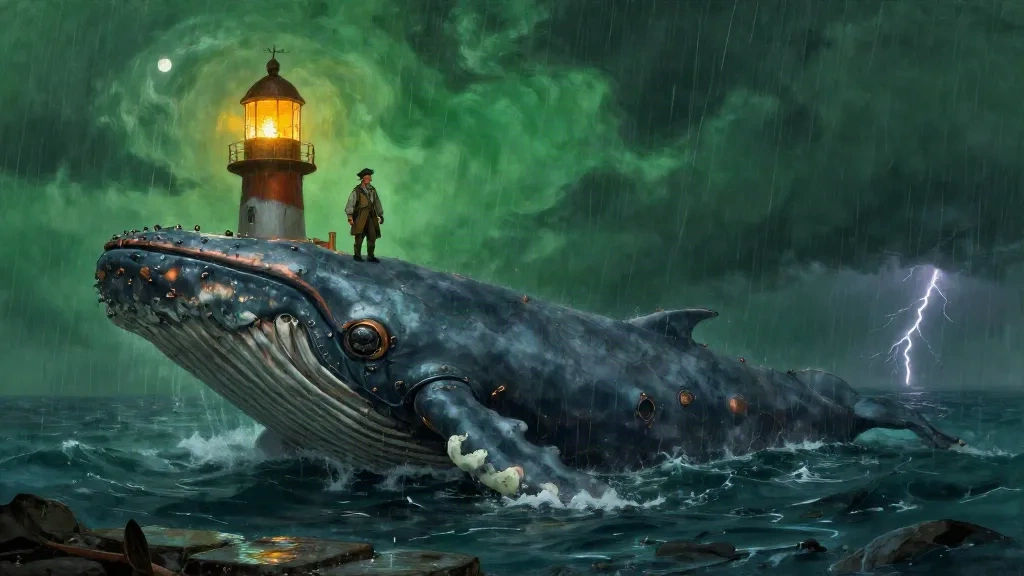
Mara kept the lighthouse on the whale’s broad, barnacled back, where every dawn arrived twice: once through the salt-blue window and once reflected in the whale’s copper ribs. The creature slept beneath the sea, dreaming machinery through its ribs, while the tide lifted its immense head and lowered it again with the patience of a sleeping bell.
Her work was to catalogue weather from other worlds. She wrote each storm in green ink: thunder that arrived without clouds, rain that fell upward at midnight, snowflakes carrying names. A small moon hung inside the lantern room, no larger than a pear, though it cast a cool white glow that belonged to no sky.
Mara had learned the names of lost sailors, the songs of extinct birds, and the final language of a forest that had burned before human memory began. She had never written down a person’s warmth.
Then the whale dreamed of bells.
The Municipal Prohibition
On the third night, a storm rolled over the lighthouse carrying blue rain and the scent of hot iron. It set down a man on the gallery, soaked and shivering. Mara recognized him before he spoke: Iven Sarr, the cartographer who had mapped the unmeasured coast, the man who had left a paper lantern burning outside her door every winter.
He looked at her as if they had met only yesterday.
“The city is forgetting me,” he said. “Not because I died. Because everyone who remembers me has begun to forget someone else.”
By morning, his name had vanished from the harbor ledger. His house stood empty. The woman who had mended his sails claimed she had never known him. Even the paper lantern he had given Mara was turning blank, its folded paper losing the color of flame.
Mara brought Iven below and locked the door. The city’s inspector arrived in a brass skiff, carrying a seal the shape of a closed eye.
“Every impossible thing is technically illegal,” he said. “That includes a storm that returns a forgotten man, a whale that carries a lighthouse, and any weather not recorded in the municipal register.”
He nailed the prohibition to the wall beneath the brass plaque: NO IMPOSSIBILITY SHALL BE ATTESTED WITHOUT PERMISSION.
Mara read it twice. The rule forbade impossible things, not their names. Names were ordinary ink. Paper was ordinary matter. The small moon was merely a moon that had become inconvenient.
A Loophole in the Sky
She opened the catalogue and began writing a new entry.
Weather event: localized dawn, recurring. Direction: toward one person. Legal status: pending.
“You can’t amend the sky with paperwork,” Iven said.
“I can amend what the city calls natural.”
That evening, Mara climbed the lantern room and set the paper lantern beneath the small moon. She poured the blue rain into its folded mouth. The whale shuddered below, and its sleeping eyes opened a fraction, releasing a glow that was moss green and wet-stone gray.
The municipal inspector climbed after her, seal in hand.
“You are attesting to impossible weather,” he said.
“No,” Mara replied. “I’m filing a correction.”
She opened the catalogue. Every entry she had collected—storm, moon, vanished forest, borrowed names—had once seemed separate. Now she drew a line through the page and wrote one sentence beneath them: The world forgets in crowds. It remembers in witnesses.
She struck the inspector’s seal against the paper lantern.
Marigold fire burst from its seams. The light crossed the storm-dark sea, touching the harbor, the rooftops, the sleeping whale, and every forgotten corner at once. Somewhere below, people began saying Iven’s name aloud. His maps reappeared in drawers. His name returned to the ledger in a hand not his own.
The whale turned toward the lighthouse.
The First Thing He Remembered
When Iven woke, the storm had passed. He remembered the coast, his childhood, the cartographers’ guild, and the year he met Mara on a pier where no pier existed. He remembered the lantern.
Mara stood beside the small moon, exhausted but smiling.
“What did you remember first?” he asked.
“That you once made tea for me in a place the rain had erased.”
He reached for her hand. His touch was warm, ordinary, and impossible.
“Does the city know?” he asked.
“The city knows nothing until someone files a correction.”
Below them, the whale began to hum. The sound traveled through the stone floor and into Mara’s old paper lantern, which shone with a small, steady flame.
She did not write down that dawn. Some things, she decided, must remain outside the catalogue so they could go on living.





