 Netwrck
Adventure.
The Clock Beneath the Rib
Every morning, beneath the village of Vey, the watchmaker Mara wound her clocks before sunrise. She wound the one that opened spring with a thread of green wool, the one that loosened summer with a bead of amber, and the one that rang autumn from a hollow hazelnut shell. Winter she kept in a porcelain box, because winter did not arrive politely. It came with cracked roofs, blue shadows, and the sound of the giant turning beneath the earth.
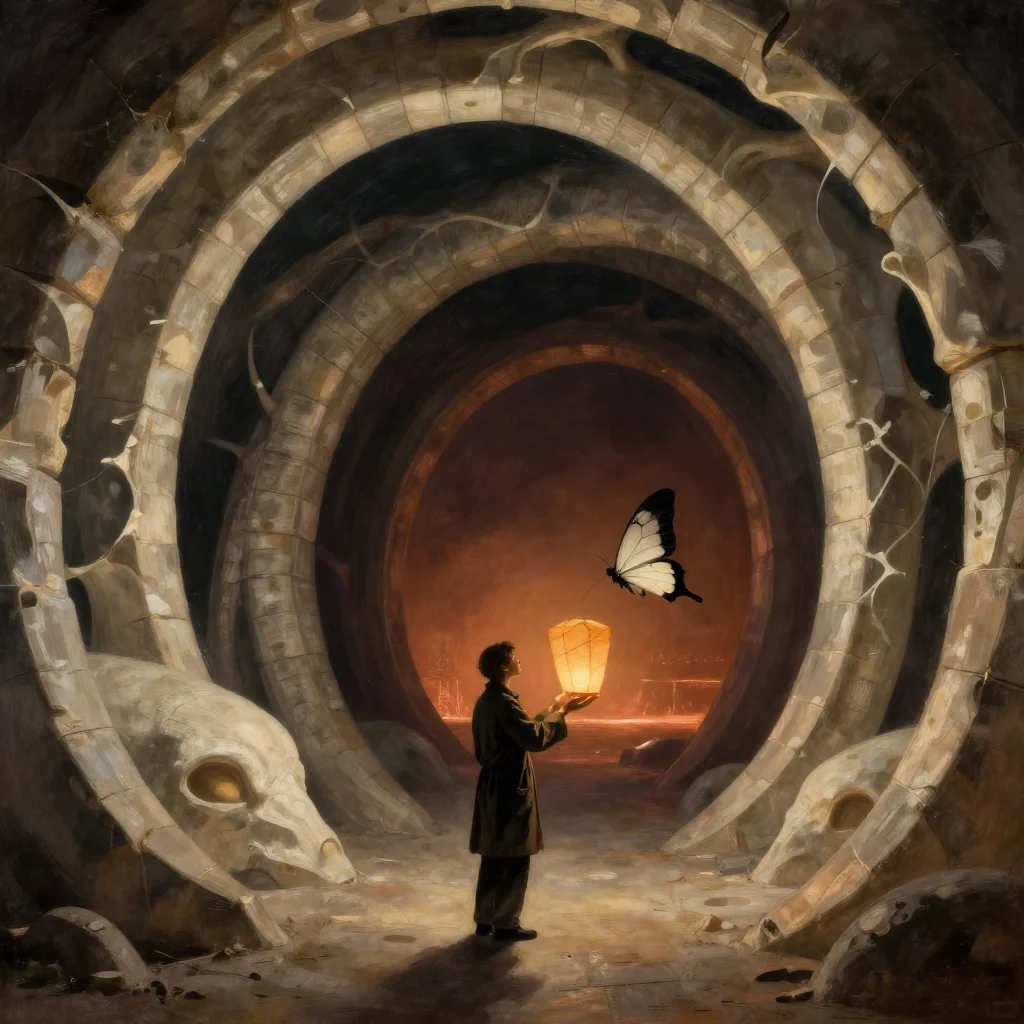
Mara's shop stood between two curved ribs of pale stone, their surfaces polished by generations of sleeves. Above them, the village climbed the giant's chest, bridging bone with black-cherry beams. Smoke rose from chimneys into a copper horizon. At dusk, children swore the horizon was fire. Mara knew it was the giant's buried armor, shining through the haze.
Her father's workshop lay at the center of her life, though he had vanished seven winters ago. His tools remained: files shaped like crescent moons, a hammer with a blue handle, and a paper lantern made from the first light of spring. The lantern had disappeared on the same night he walked into the choir.
That morning, Mara found a moth wing on her workbench.
It was black cherry at the edges, pale stone at the center, and no larger than a fingernail. It had been pinned beneath a scrap of instructions in her father's handwriting:
Return what was borrowed before the sleeping one dreams again.
The Voices Under the Floor
At noon, Mara followed the instruction down through the cellar, past shelves of unwound springs, until she reached the choir chamber built inside the giant's lowest rib. Twelve people sat in a circle, their mouths closed. Their voices rose through cracks in the stone.
One said her father had left willingly.
Another said he had been taken.
A third insisted there had never been a father, only a watchmaker who made clocks for seasons rather than hours.
Mara wanted to scream. The choir did not wait. The voices multiplied: her father laughing, her father bleeding, her father singing a tune she remembered from childhood. Some carried the truth. Some carried convincing lies.
On the chamber floor lay the paper lantern, folded flat beneath a black-cherry beam.
She reached for it, and every voice shouted her name.
The woman who remembered her as a child said the lantern had been made for the giant.
The man who remembered her as an old woman said her father had made it for Mara.
A child's voice claimed the lantern had never existed.
Mara touched the paper. It was warm. A tiny flame appeared inside it, and the moth wing on her workbench vanished.
The flame cast her father's shadow on the wall. He was older than she remembered and younger than the stories. He looked directly at her.
He said, "You came alone."
Mara answered, "You asked me to."
"I asked someone to."
That was how she knew the choir had taken him.
The Giant's Dream
The wing had opened a passage through the floor. Mara descended with the lantern, while the voices followed as a dark flock. The passage twisted between the giant's ribs, narrow enough for her shoulders and wide enough for wings she no longer possessed.
Below lay a dream of the village before it was built. Pale stone floated in blackness. A black-cherry tree grew upside down from the ceiling. The horizon burned copper, though no sun existed.
The choir arrived as silhouettes inside the lantern's flame.
They showed her a winter village with her father at its center. They showed her a summer village with his body beneath the clock shop. They showed her a village where Mara had taken the lantern and caused the giant to wake. Each memory was fluent, sharp, and cruel.
Mara shut her eyes. The moth wing lay against her palm again.
Its surface was not a map. It was a scale, taken from a creature that had lived beneath the giant's heart. When she held it toward the black-cherry tree, the tree leaves turned silver. One branch opened, revealing a narrow stairway.
At the top stood a young man in a watchmaker's apron.
Mara knew him before the voice spoke.
He was her father on the night he made the lantern, before grief had tightened his hands, before time had taught her to distrust beautiful things.
He held out his hand.
"I made this for the village," he said. "The flame remembers the hands that shaped it. You came to give it back."
Then he looked past her, and his face changed.
The giant had begun to dream.
The Hands That Made It
Sleep moved through the stone like a tide. The stairway buckled. The lantern's flame bent toward a vast mouth opening in the darkness.
Behind Mara, the choir argued in every voice at once. One demanded she return the lantern to the giant. Another demanded she keep it. A third whispered that the lantern was the only memory of her father that could survive.
Mara understood the trap. The paper lantern did not contain a soul. It contained a moment: her father's hands, the first morning light, a small prayer for the village. The choir wanted that moment because memories were the only power the sleeping giant could not digest.
She climbed toward the mouth.
Her father followed, not as a ghost but as the shape of a choice in the flame. He could not cross the boundary. He could only stand on the stairway and wait.
"If I give it to the giant," Mara said, "you disappear."
"I am already gone."
"And if I keep it?"
He looked toward the copper horizon. "Then you remember a man the village made, not the man who was."
Mara placed the lantern in the space between them. The paper unfolded in her hands, revealing tiny written names on every crease. Her father had written one line around the rim:
Made for anyone who will not leave the dark alone.
He had never intended the lantern for the giant. He had made it for the choir, so that conflicting memories could share a light without becoming weapons. The choir had torn the intention apart and turned the lantern into a key.
Mara opened it.
Every voice rushed inside. The screaming lasted only a breath. Then the flame became clear, revealing the paper's original pattern: two hands, one giving and one receiving.
Her father smiled. "That is better."
He placed the lantern into Mara's hands. The act completed it. The moth wing dissolved into copper dust, and the dream began to hold still.
What the Giant Kept
Dawn returned Mara to the cellar, with one paper wing folded inside her coat and the lantern burning above her palms. The choir chamber was empty. On the wall, a line of writing appeared in fresh ash:
What is returned may keep its maker's shape, but not its commands.
That winter, Mara made no clock. She repaired the village instead: hinges, shutters, the small brass bridges children used to cross gaps between ribs. At the center of her shop, the lantern hung over a table. It had no flame, yet the room remained warm.
Some nights, Mara heard a voice inside its paper shell. It never told her what to do. It only kept watch while the giant slept.
And when spring came, she wound the green-thread clock with steady hands. The village woke beneath a copper horizon, and the paper lantern turned once in the wind, its pale inner surface bright as stone.





