 Netwrck
Adventure.
The Winter Platform
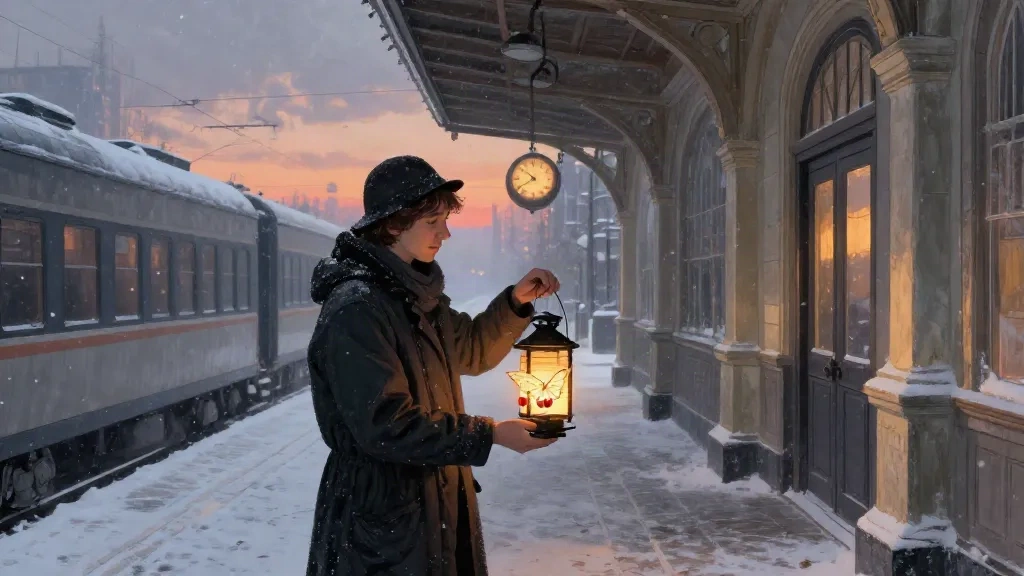
At Platform Seven, winter had been reduced to a thin white noise beneath the station roof. Frost sealed the windowpanes, but each pane showed a different season: peach orchards in one, a burning desert in another, a blue afternoon raining upward. Beyond the tracks, doors stood open in the copper horizon, each leading into an alternate year.
Mira Venn kept her station in a wooden case beneath the departure clock. Her tools were silver, her hands smelled of pine resin, and the clocks she made measured seasons rather than hours. There were clocks for the first thaw, clocks for the long drought, clocks that wound themselves shut when winter had lasted too long.
That morning, a girl arrived carrying a paper lantern. Its paper was black cherry, its wick unlit. On one side, pinned beneath the handle, rested a single moth wing, pale as winter stone.
“I found this in the choir,” the girl said. “They say it belongs to the person who made it.”
Mira knew the wing at once. It had belonged to Elias Ward, the lantern maker who had vanished six years earlier. He had promised to return when the station’s first spring arrived.
Her desire was simple and exact: return the wing to Elias. Not a copy. Not a memory. The wing itself, carrying the touch of his hand.
The Choir of Borrowed Voices
The choir waited beneath the departure board.
They had no bodies, only open mouths in the black cherry shadows. When they sang, the station changed. Snow became pollen. Wet platforms became dry sand. A departing train announced its destination in a voice Mira loved.
“Give us the wing,” the choir sang. “Then we will return its maker.”
“Where?” Mira asked.
Their voices split. One said summer. Another said the year before he vanished. A third whispered wherever you are most afraid to look.
They were memories held by the station, each voice attached to a different version of Elias. One remembered him as a kind father. One remembered him as a liar. One remembered him leaving willingly, carrying the lantern toward a city that no longer existed.
They had taken the wing because Elias had given it away. The choir wanted to keep it there, where every version of the man could possess a piece.
Mira closed her case. “Then I take it back.”
They answered by singing louder. The platform filled with summer heat. A train arrived with its windows sealed in amber. At its center sat a man with Elias’s hands.
246 Steps to the Lost Season
Mira crossed the carriage by counting doors. One. Two. Ten. Fifty.
At two hundred forty-six, the train shuddered. The conductor opened a gate in the wall, and beyond it lay a narrow city beneath a copper sky. Streetlamps shone in summer. Yet every window was frosted. People moved through the streets holding memories of winters they had never lived.
Elias’s workshop stood at the end of Lantern Street.
He was there, younger than when he vanished, carving the ribs of a paper lantern. The moth wing lay pinned to his workbench. Beside it rested a note in his handwriting:
Do not let the station choose which version of me survives.
“You kept it,” Mira said.
“They did,” Elias replied. “I made the lantern, but the choir made me forget. Every memory of leaving became a season I could enter but never finish.”
He reached for the wing. The city tilted. On the platform, the choir began singing Mira’s own name.
She understood their trick. If Elias took the wing, one of them would vanish. The station would collapse the others into a single season, and the train would have no destination.
Mira opened her case and placed a tiny watch inside the lantern. It was the watch she had made for departures that were not really arrivals.
“Then return it yourself,” she said. “Not to me. To the person who made it.”
The Last Departure
Elias lifted the lantern. The moth wing adhered to his thumb. Its pale stone shimmered, delicate as a held breath.
The choir rushed through the street, their memories colliding: a child laughing, a door slamming, rain on a tin roof, a promise whispered in a crowded terminal. For one instant their song became unbearable.
Mira turned the watch’s crown.
All seasons opened at once. Black cherry leaves fell through amber heat. Frost bloomed over copper wires. The workshop dissolved into Platform Seven, and Elias stood beneath its lamps, holding the wing.
“I made it,” he said. “You found it.”
He placed the wing against the lantern. Light entered it, not as fire, but as the small gold pulse of a remembered summer night.
The choir vanished into the departure board, each voice taking its true memory with it.
By morning, the station had lost its alternate doors. Only winter remained, pale stone beneath a copper horizon.
Mira repaired the lantern. Elias boarded the first train, carrying the moth wing with him. Before the doors closed, he placed the lantern on her bench.
“For the next lost thing,” he said.
Mira opened her clock case. Beneath the tools, the seasons had begun again, each one waiting for its proper hour.





