 Netwrck
Adventure.
The Law of Unpossible Things
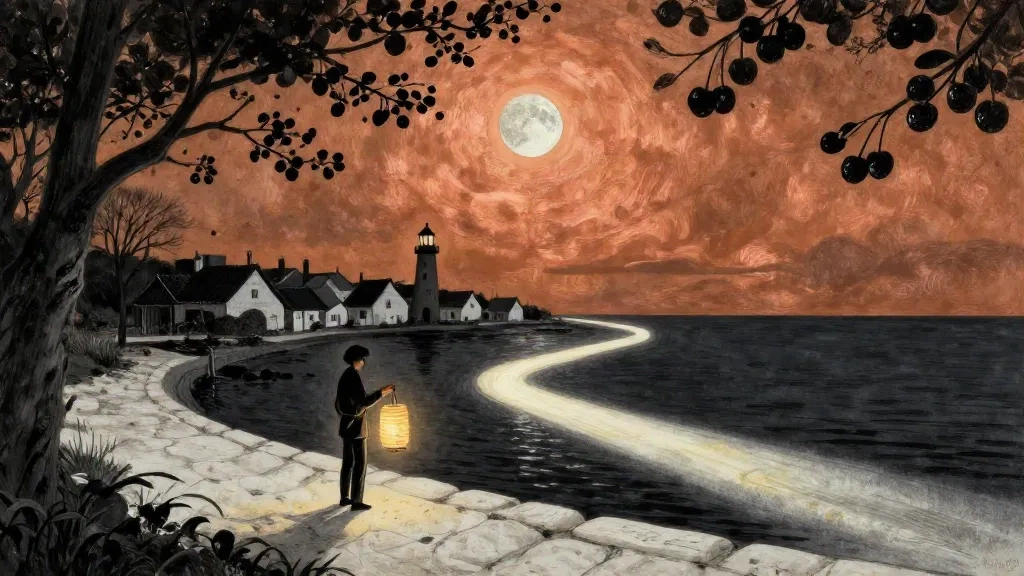
At the Monastery of Clockmakers the bells rang at different hours beneath a copper horizon. The sun rose behind the western towers. Snow fell upward from the black cherry trees and came down again as a faint gray dust on the winch. Only the old lighthouse stood fixed in all of it, its pale stone beam turning over the restless sea with the patience of something that had never once been surprised.
Mara Venn kept the light. Not for the harbor, which had its own lamps and its own opinions, but because the light was the single thing in the valley that obeyed one law without complaint. The bells ran early, the snow ran backward, the cherry trees held their black fruit long past the season for fruit. The beam turned, and turned, and did not lie about anything.
So the ledger went with the light. Mara had kept a weather record for nineteen years, and in it she had catalogued silver rain, thunder that arrived as a flock of white birds, and a fog that carried the scent of cinnamon from a planet with two moons, whose tides were best avoided by anyone with an appointment. Every entry was dated, witnessed, and initialled by whoever had been unlucky enough to see it with her.
Her favorite discovery was the small moon above the monastery. It was no larger than a copper coin and appeared only when a person held up a paper lantern. Mara had entered it in the ledger as a moon for the unpaved sky, which was a lie of a specific and defensible kind, and in the margin she had written the truth: a moon that consents to be looked at.
Then the municipal rule arrived by courier, sealed in grey wax, with a copy of the ordinance for the keeper’s signature.
All impossible things are henceforth illegal. A thing shall be deemed impossible if it cannot be entered in the public record without causing the record to contradict itself. No person shall enter, witness, transport, harbor, or describe an impossible thing. The record is not a description of the world. The record is the world’s only proof, and a proof that proves two things proves neither.
Mara read it three times on the tower stairs, with the courier’s horse stamping below and the small moon nowhere in the sky, because there was no lantern lit. It was, she thought, a very good piece of lawmaking. It had the ring of something true said for the wrong reason. Every sentence in it was correct. Two of them were useful. The third one, the last, was the sort of sentence a person writes at the end of a long afternoon when the reason has gone out of the room.
She signed for the ledger and sealed the courier’s copy in salt, and then she went back to the entry for the moon and drew a single line through it. Not because it was a lie. Because a line through it was now the only safe kind of honesty she had.
The Boy With the Water Map
She had known for some years what the sea was doing, because everyone had known and nobody had entered it. It took one name a year. Not a life — that would have been a kindness, or at least a clean grief. It took the name, and left the person walking.
Her own sister had been its first work that the valley admitted. There had been a standing fog in the winter of the year the western bell rang four times, and after it lifted there were the boots by the sea wall, and no one could say whose they were. The monastery roll for that year listed one keeper. The village remembered that there had been a second, and remembered the shape of the absence the way a mouth remembers a missing tooth: constantly, and with the tongue.
Wren. Mara had the name. She had it in the same way a person has a word in a language they have stopped speaking — whole, and unusable, and no longer attached to anything she could point at.
So the fishing boy Pell found her at sunset with a message from the drowned village and a map drawn in water that would not hold still. The sea was taking one name each year. Next year it would take his sister Elian. He said it standing in the doorway with water running down his sleeves, and he did not say what had happened to their parents, and Mara did not ask, and the not-asking sat between them like a third person in a small room.
“She doesn’t talk about the fog,” Pell said at last.
“No. I imagine not.”
“You had one too.”
“I had a claim on one,” Mara said. “That’s worse. Claims can be wrong.”
She considered refusing him. The ordinance was fresh, the courier was still in the village buying oats, and the definition of impossible had been drafted, signed, waxed, and distributed to every parish on the coast. A woman who took a boy down a road that the law could not describe would not be defying a rule. She would be becoming evidence.
But the map was already in her tower, and the map was a kind of entry. Water on stone, refusing to stay still long enough to be read, is not a thing; it is a thing that has declined to be one. Mara had spent nineteen years learning to read the valley’s refusals. She knew what it looked like when something would rather not be written down, and it looked exactly like a name that had been taken.
She broke the law by letting an impossible weather in. A wind from the moonless world came up the stairwell, where distance had teeth, and it tore the water-map open along its own route and spilled the glowing lines across the floor of the tower like something poured. Pell went down to the harbor ahead of her. Mara went with the lantern, because the map had ended at a place and a locked door, and both of those, she was beginning to understand, were the same shape.
The Drowned Road
The drowned village lay beneath water so transparent it made her dizzy. The houses stood upright in a street of pale stone, their doors sealed with salt, their chimneys full of the same gray dust that fell from the cherry trees when the snow went up. Everything down there had been waiting long enough to stop being ruined and become an arrangement.
At the center of the street, small and furious, Elian beat her fists against a wall of black current. The wall did not notice her hands. Between her and the shore stood the tide made of letters — a slow column of names moving like water, and every name it touched went out of the living the way a lamp goes out when the wick is drawn down. It had already taken Pell from Elian’s memory. She looked at the boy standing beside the keeper and saw a boy-shaped stranger with a kind face, and said, “You’re in the way,” in a voice with no anger in it at all.
Pell’s mouth worked. He said, “That’s me. That’s my brother.”
“I know,” Mara said. ”She can’t.”
The tide turned toward them, and spoke in the voices of missing children, layered, patient, and almost fond.
You cannot cross a name-erased sea. The law forbids impossible crossings. I have read the ordinance. It is very clear. It is the clearest thing in this country.
It had read the rule. That was the cruelty in it, and the joke, and the reason Mara understood in that moment that the sea was not a monster but a clerk: something that had been given a form and a duty and a definition, and had done its duty correctly, for years, without ever being asked whether it had understood the form.
She raised the paper lantern. The small moon appeared above the lighthouse, small as a copper coin, and lay reflected in the drowned street, and where its light touched the salt the water-map showed itself again — the glowing route, brighter now, running not through the village but up through the black current and inland, ending at a locked municipal archive beneath the monastery.
“What is the lock?” Pell asked.
“A fact,” Mara said. “That’s the cruelty of this one. It’s not a door. It’s a sentence that won’t admit anything.”
The Lock That Was a Fact
The archive held everything the country had denied. The drowned road. The second moon. The weather with no local origin — a hundred and forty years of it, bound in cords, shelved like timber. And at the end of the last aisle, a blank page bound in with the rest, headed in a careful clerkly hand: collective forgetting.
The keeper of records was an ancient automaton with copper eyes, a shape like a stooped man folded into a cabinet. It had been built by a clerk named Ansle Doring, who had spent nine years on the definition and had, in the last six pages of his own working copy, written an exemption and then failed to submit it. Mara found the page. Doring had retired to a coastal village and died there without correcting the record, and the definition went out to the parishes missing its final clause, and a country that had spent nine years building a machine for rigor lost nine years of it to a man’s stomach.
Exemption. This ordinance binds upon things. It does not bind upon persons. A person is not a thing. The record of a person is the record of a person, and the record of a person survives the world it was written in.
Mara stood in the dust of the last aisle and felt the whole weight of nine years of somebody else’s careful thinking settle on her like a beam. The law had a hole in it. It had always had a hole in it. It was not being violated. It was being used.
The Custodian would not open the inner door. It walked her refusals on the copper palm of its hand, and the refusals were, it said, unavoidable and mutually exclusive: the sister had never drowned, or the sea had never forgotten, or Pell had never been her brother. All three were true. None could be written on the same page.
That was correct. That was the definition doing exactly what it had been built to do. Mara understood the trap, because it was the trap she had been standing in for nineteen years: you cannot record the sea and the drowned and the brother, because the record is a proof, and three proofs of one event collapse into a proof of nothing.
So she stopped recording the event.
She opened the weather ledger to the last page with a whole number on it, and wrote an entry that was not about the weather at all. She wrote a personnel record. She wrote that on the fourth of Ashfall, at the hour before the bell that rings four times, a person by the name of Elian, resident of a street of sealed doors, had been recorded alive at the municipal archive and had left it walking. She wrote the year. She initialled it as witness, and she wrote the reason for the entry in the margin, because entries without reasons are how a country loses the name of a thing in under a century: Rescued from an impossible crossing. Admitted under Doring’s exemption. Person, not event.
The automaton began to stamp the page. The first stamp denied the storm. The second denied the moon. The third reached the line with the name on it and stopped, humming, with its copper fingers open.
“Stop,” Pell said. “Just — stop, it’s taking her.”
“It can refuse the world,” Mara said. ”It can’t refuse a person. That is the whole of Doring’s exemption and he never thought anyone would need it.” She struck through the denials, one, two, and the stamps came off the page in grey smears, and the page was no longer a statement about what could happen. It was a statement about one girl who had not.
Then the Custodian asked its last question, and it asked it in a voice that was not its own, a young woman’s voice, worn smooth.
The record requires the name the sea took first. Offer it, and the entry is sealed. Offer the new one, and the old one stays in the water. You may file one name. The book is not large.Mara stood very still. Behind the copper eyes she saw, as clearly as if it were written on a page, the terms of a trade she had come down here intending to refuse.
Wren. One word, and Elian went back into the black current, and the water gave up what it had been keeping for nineteen years in whatever form a name takes when it has been left down there that long. One word, and it did not have to be Wren. It only had to be a name, any name, a name the sea was owed and had not yet been given. There were nine hundred names in the tide. The rule had told her so, and the rule had been right, and the rightness of it was the knife.
She thought of a line of names on a monastery roll with a gap in it, and of boots by a sea wall, and of nineteen years of weather written down carefully in a book that was now the only proof there was of anything she had ever seen.
She wrote Elian. The Custodian stamped it. The sound went through the archive like a bell ringing four times.
The Name That Held
The archive cracked along its aisle and the black current came up through the floor with the letters still in it, all of them turning at once, the way a shoal turns. It wanted Elian’s last remembered voice, because a voice is a name that has not finished being itself, and that was the cheapest kind to take.
They went down the drowned road with the lantern ahead of them on the salt. Mara set the paper light against the sealed door and spoke the name, and the small moon came down through the water and laid itself along the street, and Elian heard the voice of the woman from the tower and crossed, and Pell’s memory of her came flooding back into his face like water into a room.
The tide recoiled. It was not defeated. It was confused, and confusion is cheaper than defeat and lasts longer: a rescue that had been entered in no register, witnessed by an office rather than a person, filed under an exemption nobody remembered submitting. There was no column for it. There was no sentence in the ordinance that covered a keeper of records standing in an aisle signing for a girl in salt.
Elian came out of the water and into the harbor, and Pell got both arms around her, and the book in Mara’s hands shuddered once under the weight of what the village had been doing quietly for a hundred years: collective forgetting. For one breath every taken name came up, all of them, grandmother, baker, lamplighter, a child called Sef who had wanted a boat — a bright noise of surfacing in the street, nine hundred people surfacing.
Then the sea took them again. It had to; that was its office. But it took them more slowly, and it took them last, and Elian was on the shore when the black current went back under the harbor, and Elian was not in it.
Only then, at the far edge of the street, something in the layered voice of the tide said a name that had not been in the record for nineteen years. Not Wren. A different shape of the same word, offered without cruelty, in the tone of a clerk who has found the correct line at last and would like it confirmed.
Mara did not answer. She held the lantern higher. Nine hundred names went back under the water, and the lane between the sealed houses went quiet, and the tide went to the end of the street and stood there, correctly, patiently, like an office at the close of a long day.
After the Rule
The municipal rule was still in force at dawn. Impossible things remained illegal, and the weather ledger was taken by a man with grey gloves who read the pages fast and understood none of them and had been told not to ask. The Custodian was sealed in its cabinet, and the archive was re-catalogued, and Doring’s exemption was not found, because no one had looked in a working copy of a definition that was nine years old and shelved with the rest of what the country did not care to keep.
Elian’s name was cut into the lighthouse beam in letters that no clerk has been able to erase, which surprised nobody except the clerks, who expected the sea to be more literal than it turned out to be. She grew up in the village above the harbor. Each spring she brought salt to the tower and stood a while at the base of the beam and did not ask Mara to say anything, and Mara did not say anything, and that was the arrangement, and neither of them ever broke it.
Pell learned to write, badly, from a woman who had spent nineteen years initialling weather. He was not grateful, and there was no reason he should have been. He had asked her to bring his sister back, and she had, and eleven houses on that street had stayed shut, and he had stood on the shore with a ledger under his arm and watched the sea be reasonable. He said so to her once, in the tower, with the awkward precision of a young man who has thought about it for a decade: You filed her. You didn’t file them.
“No,” Mara said.
“Because the book is only large enough for one.”
“Because the exemption only covers one. Everything else would have been an event.” She did not soften it, because softening it would have been a lie, and she had already used up her allowance for those that mattered.
They argued about it for years, in the way of people who have agreed on the facts and cannot agree on what the facts were for. He never stopped coming to the tower. He never once asked her about the name she had not offered in the archive, and she understood, for most of a decade, that he had understood, and that this was the closest thing to forgiveness available to either of them, and that it was not very close.
The country went on. The ordinance went out again the following spring, word for word, and the same clerk drafted it, and the same wax went on it, and no one anywhere read the last six pages of a working copy. Ships stopped coming in wrong. The harbor got duller. Somewhere in the country, an office began quietly losing cases, one at a time, and no one could say why, and the losing had the same shape as the sea’s work but was faster, and had receipts.
And years after that, travelers began reporting a paper lantern burning in the black cherry trees on the nights when the small moon appears above the monastery. It does not guide ships toward shore. It goes down to the drowned street, and it stands a while by a sealed door, and its light does not pass through salt, though the people who have watched it from the road will swear that something on the other side of a wall looks back. There is no register of these visits. There is no entry, no witness, no initials in the margin. Each one is an event, and events, since the rule, cannot be written down at all.
They say the keeper goes down once a year, on the night the western bell rings four times, and carries a book that is not a ledger. They say she reads it on the harbor wall for a long time before she goes in. They say she always comes back up, and never with ink on her hands, and that the girl who went into the water the year before last is not coming back, and that the one who went in the year before that is not coming back either, and that there is a great many doors on that street, and that the sea is very old, and very correct, and keeps excellent accounts.
They say she has never once written her sister’s name.





