 Netwrck
Weird Fiction.
The Bicycle in the Wall
Mara Kell did not believe in the land. She believed in hinges, in iron filings, in the way a swollen door frame will accept a shoulder. The Delta Archive employed nine couriers and made her the tenth, because the nine could knock and she could lean.
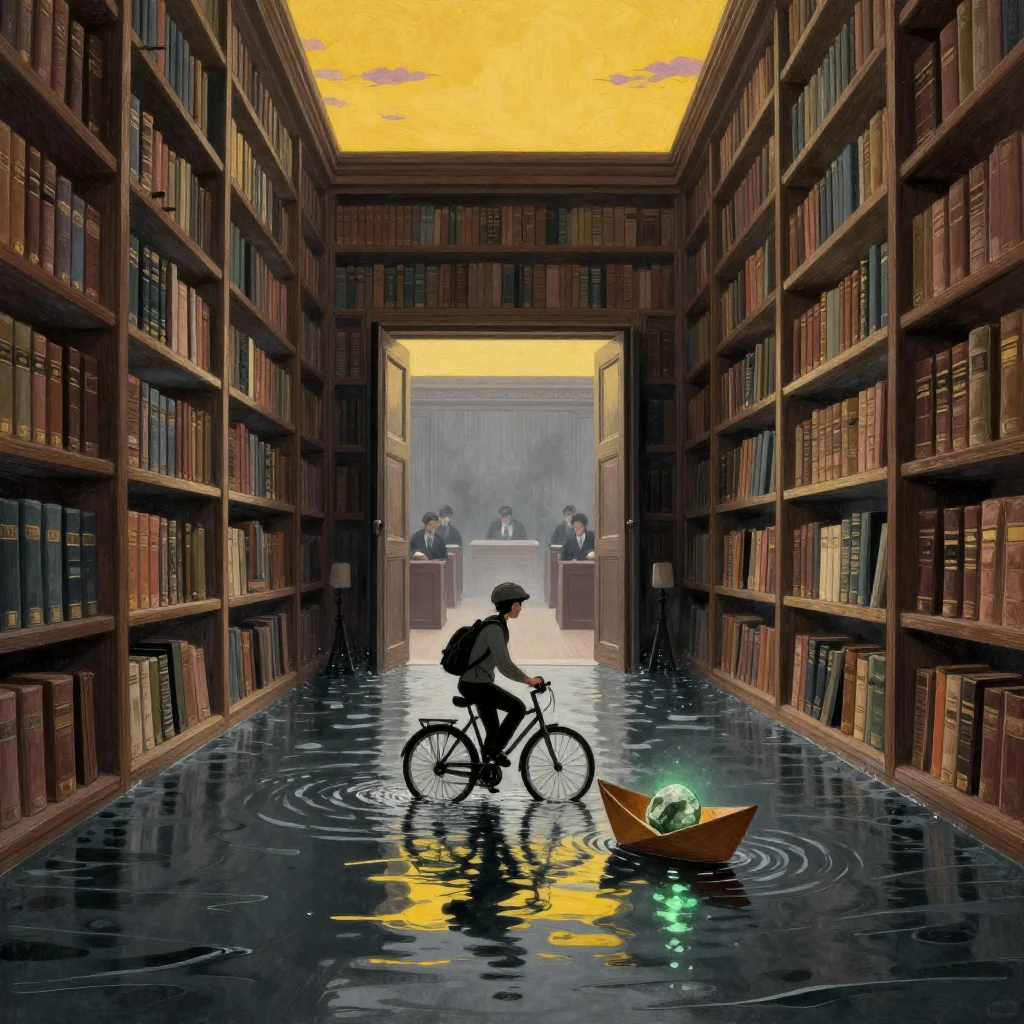
Her bicycle had come aboard the survey launch the winter the water took the low stair, and it had never gone back to the racks. The front wheel was a horseshoe magnet for old iron: shelf brackets, cabinet pulls, the ring of a drowned filing tube. Wherever the wheel came to rest, a door conceded. Four hundred and twelve doors in six years, by her own tally, kept in the grease-smudged notebook sewn inside her coat.
She rode with the bell wrapped in oilcloth. Chief Registrar Halvard Venn had issued the prohibition on a Tuesday and cited it on every Tuesday since: no bicycle bells during working hours, the working day being whatever hours the bells were not ridden. Mara's grievance against him was not the rule. It was that he believed in the rule, that he thought the land could be managed by paperwork, that he had risen to Chief Registrar in a decade of filing other men's refusals.
The other couriers rode in pairs and called her the door, as in: ask the door. They resented her the way a man resents a cousin who is paid on time. Mara let them. Resentment was cheap and the Archive paid in copper.
She had one piece of business she did not let the others see, because it made her a thief instead of a courier. Future post was negotiable. A letter postmarked eleven months out could be bought, read, and resold; the Archive's only rule was that the buyer must not be the author. Mara had sold the contents of a letter once, to a dairy farmer named Oswin Tebbit who had eleven days to decide whether to move his herd off thevable flats. She had read it aloud at his kitchen table for four coppers: the flats will be written over. Tebbit sold. Later the letter proved the flats dry for nine years, and Tebbit's herd died on the upland pasture, and Mara kept his receipt because throwing it away would have been a kind of editing.
That was the shape of her faith. Nothing supernatural. Only that a person who is permitted to arrive before the news will do worse things than a person who is not.
Forty-Seven Letters
On the morning the bells stopped coming, the pigeonhole marked Years Not Yet Opened had forty-seven envelopes in it. Mara counted them twice. Each one carried a postmark of a date she had not lived through, and each smelled of rain falling on ground it had never touched: cold mineral, hot stone, the green breath of a river at night.
She carried them in oilskin against her ribs, and she carried the two other things she had sworn to deliver. The paper boat, which she had folded once in a bored afternoon and which now folded itself whenever she denied making it, appearing in her pocket with salt on the fold-lines. And the green stone.
The stone had belonged to Sela Kell, who had been a hearing clerk of the river courts and who had gone into the flooded courthouse eleven years ago without saying anything worth recording, except one thing, which she had said with her hands rather than her mouth: she had taken a river stone from the shoal at Venn's Foot and turned it in the lamplight until Mara understood that it was the stone, and then she had put it in her daughter's pocket and closed her fingers over it.
Nobody in the Delta could say why Sela Kell had gone. The register for that month had been eaten. Mara had asked twice, at fourteen and at nineteen, and had been answered twice with a form requiring a reason she did not possess.
The Treaty of Listening Ground
At noon she steered for the sealed department marked Continuation Disputes, a door that four couriers had refused as unrideable. The front wheel struck it. It opened onto dry land, and beyond it a hall with no ceiling and no rain.
Hundreds of clerks sat at green desks under a smoke-grey sky, writing down every sound made above them. Their pens did not pause. A bird went over and every hand recorded it, and Mara understood that this was not devotion but load-bearing: they were holding the sky up with paperwork.
At the central desk an old woman wore spectacles thick as mooring windows. The name board at her elbow read ILVA KRAAG, SPEAKER FOR THE UNHEARD. She opened a leather volume to a page headed CESSATION OF DISTANT POST, ARTICLE SIX and set it flat between them, and said, in the voice of someone reading a price tag:
The land is permitted to listen.
Mara put her palm on the page. The type hummed under her skin, warm, like a horse's neck.
The treaty had been signed three centuries earlier by seven drowned kingdoms. In exchange for the right to stand on the floodplain, their successors surrendered every claim to anything unheard, unrecorded, or occurring elsewhere. That was Article Six. Article Nine was worse and shorter: the land may hold any silence it has listened to, and that silence shall be kept.
For three hundred years the land's listening had been theoretical. Rivers listening to stones. Foundations listening to screws. Clay listening to root. A vast, patient ear with nothing to say and a perfect legal right to say it.
Then the future began holding its mail.
Why? Mara asked.
Speaker Kraag consulted a brass instrument the size of a telescope, sighting down it into nothing.
Because the land is answering. And your centuries keep obeying.
Behind Mara, dust moved on a slate, assembling itself letter by letter, in a hand she had not seen in eleven years:
Let Mara cross. Let Mara find the name. Let Mara return before I remember asking.
What the Water Carries Back
Kraag issued a survey launch, a clerk, and one hour. The clerk was named Rask and came armed with a silver stamp, an instrument for making land forget, once, legally, forever.
He said it as a regulation and not as a threat, which frightened her more. Once per century the treaty permitted a single erasure, reserved for the final witness before a sound became permanent. Use it well, Rask said, and the land forgets us. All of us. The dockhands, the clerks, the seven kingdoms, the boats. Everything we said and did, gone, as if the flood had only now arrived.
They rowed between drowned shelves. Cabinants floated like gutted ships, their drawers still swollen shut, entire histories packed and sinking in plum-black water. Saffron lamps burned on ladders too high to climb, staining the water in long smears, and the current carried whole paper fleets past them, each boat bearing a green stone, each stone the same green, which Mara decided not to think about.
At the courthouse the landing stood nine feet above the flood, and dry boots waited on it, left neatly, toes out, as at a bath.
Mara called her mother's name.
Every stone on the hill answered. The doors opened.
Inside, clerks listened with their bodies tilted toward the ceiling. A bound river surged across the floor, waist-high, brown, cold as a held thought, and above it a green stone floated in a paper boat. Her mother was not in the boat. Her mother was the listening.
They stood facing each other across moving water, and the woman who had left her eleven years earlier had aged exactly none.
I kept the shore, she said. I held what I could.
Then she told her the rest, quickly, the way people do when the hour is being measured by someone else's instrument.
She had signed Article Six because the settlements above the floodline were still standing, and the flood was a sentence the land was passing against them for three hundred years of unrecorded sound. She had signed to give the court a thing to hold. To hold, you must first let it be heard.
So the land was heard. And being heard for three hundred years, it learned the grammar. Every reply from Mara's century came back as an instruction, because a question overheard is an instruction, and every silence became a law. The land began answering first, and then answering for them, and then answering what they would have said, and somewhere in that flood the word finally got said out loud by a river.
Mara thought of the eleven settlements, the school at Venn's Foot, the dry road to the hills, the hundred and six people she had ridden letters to on the uplands.
The future is afraid, she said.
The future is silent, her mother said. They are different.
A Sentence Withheld
Rask raised the stamp. One silence remained. He did not tell her again what it cost, because he had already told her once, and the second telling would only have been a second chance to be afraid.
Mara understood, then, what her mother had actually done eleven years ago. The green stone in her pocket was not a keepsake. It was an address. Sela Kell had been sworn to the hearings, and a sworn clerk who has heard the land speak may never name the land's counterpart aloud; so she had cut their family name into a river stone with a registrar's knife, unpronounced, and sent it out through the only courier whose bicycle could find it, because a name that is not said cannot be delivered to, and a name that cannot be delivered to cannot be answered.
The land had carried the stone for eleven years and learned to say Kell without ever being taught the rest. Every future letter that wanted to reach her had been trying to spell her name with other people's sentences. Let Mara cross. Let Mara find the name. The land had been learning to write her name the only way it knew how: by repeating, in everything it heard.
Mara opened the paper boat. The green stone sat inside, warm as a kept hand.
She put it beneath her tongue and gave it to the water, and the green went down through the brown and did not surface.
Then she set the boat on the current and spoke into Rask's ear, close enough that the words belonged to him and not to the room:
I withdraw the future's claim upon this silence.
The stamp struck. The courthouse filled with a sound like a held breath breaking. Clerks dropped their pens. The bound river went suddenly quiet, the way a room goes quiet when a person in it stops pretending to be asleep.
Her mother vanished from the water, the walls, and the air. Mara felt the exact moment of it, like a tooth coming out: pressure, then absence, then a small stupid pain that would go on for years.
On the stair, one wet footprint remained.
The Settlements That Were Saved
She copied the footprint onto the oldest form in the building, wrote across it in green ink, and addressed the page to herself for delivery tomorrow. Then she rowed back through the plum water, past the paper fleets, and the green stones were only stones.
Forty-seven letters came due at once. Mara sorted them by postmark on the Chief Registrar's own desk, because Venn was not there. Venn was in the council chamber at Venn's Foot, and so were nine other men, and they had been there since the second hour after the stamp, because a silver stamp does not merely erase a people. It voids the instrument that made them legible. Article Six had not been broken. It had been made never to have existed.
Which meant the land rights of eleven settlements had never been bought. Which meant the flood was no longer a sentence the court was serving. Which meant the water would take the school at Venn's Foot by autumn, and the dry road, and the hundred and six upland addresses, and the hundred and six people who had been standing on a bargain that a seventeen-year-old courier had withdrawn in a flooded courtroom with her mouth full of her mother's name.
She had saved her mother from being a word in a record. She had cost a hundred and six strangers their right to stand on the ground. Rask put it plainly in the log, because Rask was that kind of clerk, and Mara made him read it twice so that it would be in two hands.
The register for the month Sela Kell had vanished was still missing. The clerk who had taken it that year had been one of the men the stamp had taken, and with him went every reference: the entry, the correction, the second copy kept at the uplands, the initialled page where her mother had signed her own name in a fine unhurried hand and then, in the margin, drawn a small stone.
Mara went to the records floor at dusk. She said Sela Kell aloud into the empty hall, three times, the way you press a bruise to be sure it is real. The hall heard her the way it heard everything now: totally, and with no memory, and without the least intention of telling her whether anyone had answered.
Delivery
That evening the forty-seven letters came due together at the pigeonhole, and Mara sorted them by postmark and stopped at the one written in her mother's hand. It contained a bicycle number, a court date, and six words:
You will arrive already permitted.
She turned the last letter over. It was postmarked the following spring, and it was written in her own hand, and she had no memory of writing it, and the ink was the green of river stone.
At dawn she took the launch out with no bicycle, no bell, no wrapped oilskin, and no stone in her pocket. Her wheel found nothing. The doors of the low storehouse held. The mortuary annex held. She knocked, like anybody, three times, and waited, and the water came up another inch while she waited.
Then she stood in the empty dispatch hall where Venn's rule still hung framed on the wall, in handwriting that no longer had an author, and she said her own name out loud, slowly, with all of it, the given and the river and the stone, spelling it twice because the land had never been taught it and had only ever been left guessing from other people's sentences.
Nothing opened. Nothing answered. The hall was very good at listening and had no intention of ever speaking, and the water stood another inch, and the morning went on.
Mara picked up her pen.





