 Netwrck
Fantasy.
The Tide Theatre
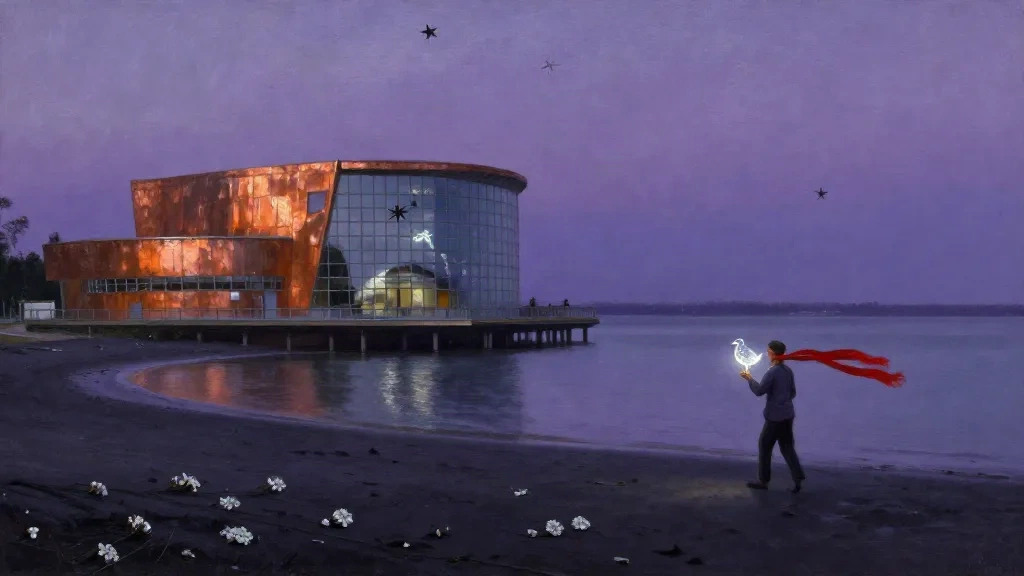
At low tide, the lake surfaced beneath the theatre like a forgotten mirror. Its water was black at the center and violet at the edges, and the ferryman, Neral, poled across it while the gulls watched from the roof of the abandoned dock.
The theatre stood on the western shore, its copper doors green with weather. Every morning it opened for an audience of no one and performed tomorrow’s discarded endings: a king dying before his coronation, a city spared by an earthquake, a woman returning home to find the house rebuilt around her absence. The actors spoke with solemn voices, but never explained who had discarded the endings or why.
Neral crossed the lake because his sister had disappeared there. She had left behind a red scarf, knotted at the neck of his boat, and a glass bird with a cracked wing. He carried both now, though the scarf had never grown warm and the bird had never once sung.
At the theatre, a woman in a cloud-white dress pinned a paper crescent beside the door.
Tomorrow is not a fixed country.
“Then what is it?” Neral asked.
“A stage waiting for a better final act.”
She handed him a map folded from a page of the theatre ledger. Violet lines crossed oxidized copper, ending at an island marked with a small black star.
The Map Against Honest Use
Neral spread the map on the stage floor. The ink shifted before his finger touched it. Roads bent away from the shore. The black star slid north, then divided into seven stars, then became a question mark.
He tried tracing the route with charcoal. The line withdrew from the paper and appeared across the theatre wall.
He tried asking the actors. One claimed the island lay east. Another said west. A third pointed beneath the floorboards and began reciting an ending in which no one ever searched for anything.
Only the woman seemed unsurprised. “A map becomes honest when you stop needing it to lead you,” she said.
“I need it to find my sister.”
“Then it will show you every place she might be, except the one where you can reach her.”
Neral folded the map. When he opened it, the lake had vanished from the stage, replaced by a red line running through a field of cloud-white flowers.
The Ferryman’s Passenger
He returned to the dock as the tide began to rise. The lake climbed around the boat, black water folding over the violet shore. His pole struck something beneath the surface: a small glass wing, followed by the body of a woman in a red scarf.
Neral nearly dropped the pole. The woman opened her eyes.
“You came late,” she said.
His sister’s voice, unchanged by time.
“You went where the lake goes,” he said.
“I went to the beginning.”
The map burst open in his hands. On every page, the black star had vanished. In its place was a white door.
“Who remembers the original world?” Neral asked.
His sister looked toward the theatre. “One person. The one who refused every ending offered to her.”
He rowed toward the copper doors. The lake resisted him, pulling the boat backward. The glass bird woke inside his coat and sang one clear note.
The theatre’s performance stopped.
The Ending Not Chosen
Inside, the audience waited on rows of empty seats. At center stage stood a girl dressed in cloud white. She held a red scarf, though the cloth was whole.
Neral’s sister climbed from the boat. “This is the one,” she said.
The girl looked at Neral. “Your map changed because you kept asking it to bring her back. It could not do that honestly.”
“Can you remember the world before it was rewritten?”
“I remember the choice. Every morning, the theatre offered me an ending. I chose to leave the ending unwritten.”
The copper doors began to close. Neral reached the stage and held the glass bird toward her. Its cracked wing caught the violet dusk beyond the windows.
“Then remember me,” he said. “Not the version that survives. The one who crossed the lake.”
The girl placed the red scarf around his shoulders. The theatre fell silent. Somewhere beneath the floorboards, the lake struck its stones like a bell.
At dawn, no lake remained. Only wet footprints crossed the theatre floor toward the open door, and the glass bird had repaired its wing.





