 Netwrck
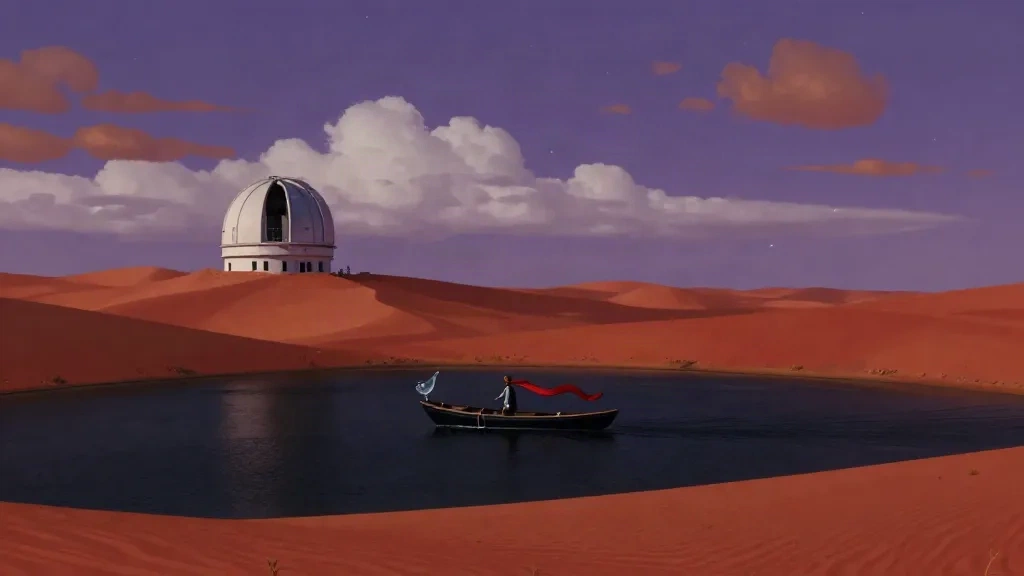
Fantasy.
The Lake at Low Tide
Twice each day, when the violet sun had descended far enough for its rays to turn copper against the dunes, a lake rose in the valley of the Star Observatory. It arrived without rain. Its shores shone pale as bone, and its still water reflected a sky crowded with white stars.
Ilya poled the black boat across it. He was the only ferryman the lake allowed, though some mornings the water carried the ash-scars of other rowers.
His passengers were usually astronomers, pilgrims, or fugitives from the observatories. They named destinations in the sand, pointed toward towers whose bells sounded beneath the earth, or whispered coordinates from books older than the desert. Ilya remembered none of them. The lake remembered everything, and when it was tired, it took the memory into its depths.
That season, Ilya crossed for a woman who had climbed down from the eastern dome carrying a glass bird.
“No fare,” she said.
“Everyone pays.”
She turned the bird in her gloved hand. Its wings caught the last violet light. “Everyone has forgotten something worth taking across.”
On her neck was a red scarf, bright as a wound.
The Honest Map
The woman’s name was Sereth. She had come from the Observatory of First Dusk, where astronomers listened to the messages the stars sent down each night.
“I need one person,” Ilya said, “who remembers the original version of the world.”
Sereth studied the empty western shore. “Then your task is small. Find the First Witness.”
“And if they are dead?”
“Then you will have found a more convenient kind of remembering.”
From beneath her scarf she drew a map stitched with black thread. It showed a crescent of lake, a chain of low dunes, and a line leading toward the Moon Basin. At the line’s end stood a white tower with seven doors.
Sereth pressed it into his palm. “The Witness lies beyond it.”
At dawn, Ilya found himself walking through the dunes. His boat had vanished. Behind him, the lake was already shrinking into the ground, carrying away three distant passengers.
The map showed the same route.
He followed it honestly. At the first landmark, a ridge of black glass, he chose the passage indicated by the stitched line. When he stepped through, the ridge collapsed.
He returned by another path.
The map changed. The stitched line now led east, away from the Moon Basin.
He tried to obey it. The dunes rearranged themselves. The road ahead became the road behind, and the glass bird appeared beneath his feet, though Sereth still carried its twin.
The map would not permit a truthful journey. If Ilya followed it, it betrayed him. If he corrected it, it invented a new destination.
Seven Doors
By the seventh day, his water vessel was empty and his feet were bleeding through cracked boots. Sereth’s scarf had appeared in his pack, though he had not taken it.
He tied it around the glass bird.
The map tore itself in two.
On one half, the Moon Basin lay beneath a star. On the other, the basin lay beneath a sun. Between them floated a thin black line, like a scar through the sky.
Ilya understood then. The map had been recording his intention, not the road. The first world had not been lost because the desert forgot it. It had been lost because every traveler began with a destination and made the world obey.
He folded both halves and placed them inside his shirt.
The lake reappeared.
It waited beside the empty basin, black beneath the cloud-white morning. Sereth stood on its far shore with the glass bird’s twin raised above her head.
“You found nothing,” she called.
“No.” He stepped into the water. It was cold, deep, and utterly familiar. “I found the witness.”
He drew the red scarf from his pack and held it out.
Sereth’s face softened. “That belonged to the person who mapped the first world.”
“And you?”
“I remember the world you cannot reach.”
He rowed toward her. The stars overhead began to send down their messages, one after another, each a voice insisting on what had been.
But Ilya listened for the silence between them.
The Unfinished Version
The First Witness was waiting beneath the white tower, where the lake sank into a chamber cut from moonstone. There sat an old man wrapped in a cloud-white cloak, turning a small blue globe in his hands.
He did not know Sereth. He did not know Ilya. He knew only the first morning: the lake before the lake, the mountains before their names, and the stars before they learned to speak.
“You cannot return to it,” he said.
“I don’t want to return.” Ilya set the map beside him. “I want to remember it.”
The old man looked through the map at the world outside.
“The map changes because it fears contradiction,” he said. “Give it one true thing that cannot be improved.”
Ilya thought of the passengers he had carried, the erased shores, the faces beneath the water.
“I was afraid to arrive,” he said.
The map flattened. Its stitched line disappeared. In its place appeared a short sentence: Here, at first, the ferryman did not know he was home.
Outside, the lake began to glow.
Ilya did not restore the old world. He gave it a place in the new one, an unalterable memory that no honest traveler could erase.
At dawn, the lake returned to its lowest level. The glass bird stood on the boat’s prow, its wings bright with dew, and the red scarf trailed in the wind.
Every ferryman’s map now showed the same blank place.
It was enough to know where the journey began.





