 Netwrck
Science Fiction.
The Low Road
Every bridge in Bellwether was a promise, and every river was a witness. The stone bridge by the market promised to open at dawn. The iron bridge promised to hold through winter. The footbridge over the western channel promised only that grief would not make a person walk in circles.
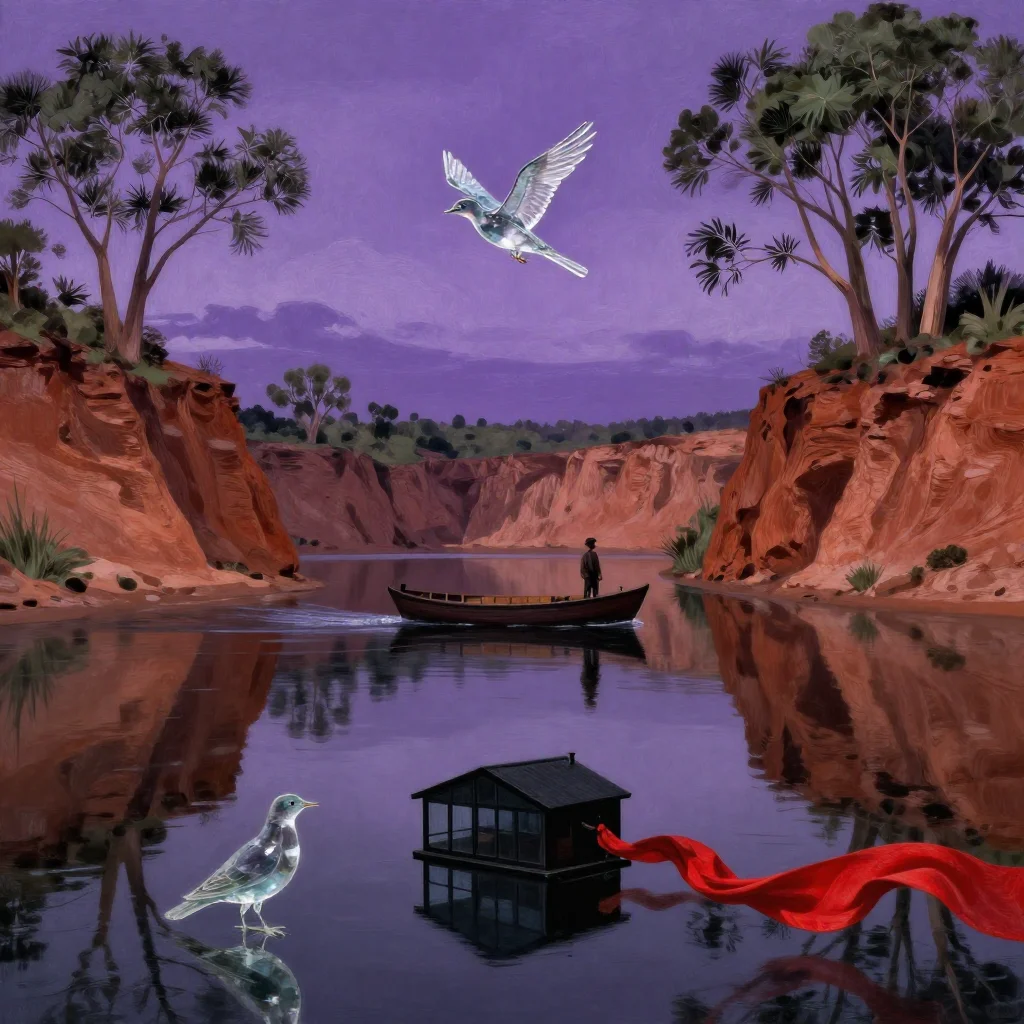
Silas rowed across the lake that appeared at low tide, when the river withdrew far enough to reveal a second country beneath it. The lake had no name on official maps. It arrived silently, smelling of cold metal and eucalyptus, and departed before noon with a sound like a crowd changing its mind.
His boat carried three passengers at most: himself, a brass bell for signaling the shore, and a glass bird given to him by his sister. The bird was no larger than his thumb, its wings sealed with clear resin. Inside its breast, a red feather shifted whenever someone spoke a lie.
Silas had been crossing the low road for nineteen years. He knew which currents pulled toward submerged houses, which patches of mist concealed doors, and which bank would vanish first. Yet he had never found the person he sought.
A Map With a Bad Conscience
The person was said to remember the original version of the world.
Not history. Not the old maps. The original version, before the bridges were given their promises, before the river became a witness, before every useful thing learned to speak in the voice of whoever needed it most.
On the morning Silas found the map, it lay folded inside the hull beneath his seat. The paper was warm, despite the lake's cold. A red scarf had been wrapped around it, tied with a knot he recognized from his childhood.
He spread the map across his knees. It showed Bellwether, the river, the lake, and a small black house standing where no house existed. Silas put his finger on the road leading to it.
The road moved.
He tried again. It bent north, then south, then climbed halfway into the sky before becoming a blue thread stitched between two stars. Every time he tried to use the map honestly, the landscape refused to remain measured.
He tried drawing a straight line. Ink became a black root. He tried marking the house with a coin. The coin rolled off the paper and sank through the boat, though the lake was shallow enough to see its bottom.
Then the glass bird chimed.
Its clear wing turned toward the eastern shore, where a woman in a red scarf stood beside a bridge that had not been there a moment before.
The House Under the Water
Silas rowed toward her. The oars dragged. Each pull carried the boat backward, not physically but in intention, as if the lake had forgotten which direction he had chosen.
The woman raised one hand. The scarf snapped free and flew over the water, landing in the boat. It was not her scarf. The knot was the one his sister had tied around the glass bird before she disappeared.
“You are late,” the woman said.
“I have been looking for nineteen years.”
“That is not the same as remembering where you started.”
He showed her the map. She studied it with the expression of someone recognizing a language they had once spoken badly.
“You cannot use this honestly,” she said, “because honesty is what it changes.”
“Then what does it want?”
“A witness.”
She pointed toward the black house now visible beneath the lake. Its windows shone with terracotta light. Around it, drowned trees lifted their branches like hands.
Silas understood then that the map was not guiding him to the person who remembered the world. It was preventing him from changing the world again. Every honest route would be replaced by a safer lie.
He placed the glass bird on the map. The red feather inside it turned toward the black house.
The Last Crossing
The lake began to rise around them. Bridges appeared in the wrong places, linking moments that had never touched. A bridge made of open hands. A bridge made of burned letters. A bridge of wet stone leading to a house where every window reflected a different sky.
Silas rowed toward the house. The map tore itself in half, then quarters, then became a red scarf knotted around nothing.
At the door, the woman waited.
“Do you remember the original world?” he asked.
“I remember that it was never original,” she said. “It was only unfinished.”
She opened the door. Inside, shelves stretched toward a ceiling of bruised purple sky. On every shelf rested a bridge without a river beneath it.
Silas looked back. The ferry had vanished. The lake was already closing over the eastern shore.
He placed the glass bird in her hand. Its wing unfolded, and the red feather caught fire without burning.
“Then remember it unfinished,” he said.
The woman smiled. Somewhere below them, a river struck a stone once, and the sound traveled upward through the foundations of the world.
By morning, the lake was gone. The bridges remained. People crossed them carefully, making promises they did not always keep.
Only Silas knew that every promise was a bridge, every river a witness, and every map a frightened thing trying to lead a truthful man home.





