 Netwrck
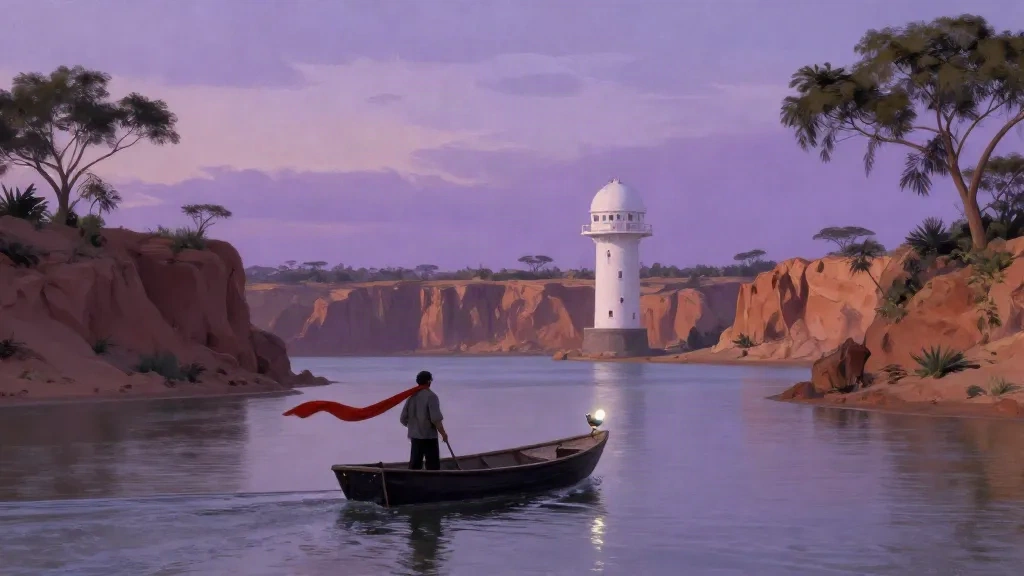
The tide map
At low tide Sami ferried passengers across the lake that surfaced only when the desert forgot its thirst. He stood at the southern bank with his boots sinking into warm mud, waiting for the water to draw back far enough to expose the causeway, and he counted while he waited, because counting was the only work his mind would tolerate. Eleven crossings last season. Nine this. The count was the ledger. The ledger was the job. The job was the reason he had not yet gone north.
His boat was a blackened hull with one silver oar, polished pale by years of hands, and in the bilge beneath the thwarts lay a map painted on vellum. Sami had carried it for six years. He had carried it since the observatory scratched a message onto brass after a night of blue-white flashes in the western stars: Find the one person who remembers the original version of the world.
He did not trust the brass. Maps that came out of the observatory had a habit of correcting themselves, and correction in that building was a form of argument. Sami's mother had taught him that. She had also told him never to argue with a map, which her son considered, privately, the only advice of hers worth taking.
He unfolded the vellum across the gunwale. Terracotta hills shouldered the lake. A eucalyptus grove marked the western shore. Four black strokes laid down the safe crossings, spaced for a boat that drew two feet. A red circle named the destination: the House of First Light, on a lake that was not this lake.
He checked the ink, the way he checked everything about the map, by lying to it. On the first survey it had shown nine crossings. He had needed seven. On the second it had shown three, and he had needed seven, and he had hated it, and by morning it showed eleven. The ink was not a record. It was an appetite with a brush.
Then he set one foot on the first crossing, and the ink ran.
The honest route
The stroke of mud beneath his boot lengthened into a road. The water withdrew another hundred paces with a sound like a long swallow, uncovering low cliffs, pale grass, and a second bank where no bank had stood the day before. Fish lay in the new air, stiff and opal-eyed, and the smell came up off them: cold iron, cut grass, a coldness that had no business in a desert summer.
Sami looked down. The road he had stepped onto was gone from the vellum. In its place the map showed a single narrow line between two faults, running north through the grove and away from the observatory, away from the crossings, away from the people he had ferried and the money he owed the boatwright.
He obeyed it. That was the whole trouble with him. He obeyed the thing that moved, because everything he had ever loved had been the thing that moved: his mother's ferry, the observatory's brass, the last of her voice in the last winter of it. Being faithful had always meant being available. He was beginning to suspect that this was a way of saying yes to things before they had finished asking.
At the second bend the grove filled with voices repeating directions he had not yet chosen. Warm air came down between the trunks in a column, smelling of wet bark. He took one step left because the voice on the left was his mother's, saying his name the way she had when he was small and the boat had begun to swing. He took it, and the ground closed behind him. The road he had come along folded upward with a soft crackle and stood as a vertical wall of red earth, twenty feet high, still warm, still holding the print of his own boot.
Caught on a low branch above the new wall was a strip of cloth the color of arterial blood, flapping in no wind.
The scarf
Sami cut it down. It was not much cloth, a meter of it, frayed at one end in a long loose tear rather than a cut, and he knew that tear. He had watched his mother make it. She had held the ferryman's scarf out over the mud of the bank, both hands, and she had said the one thing she ever said in front of other people: When a passenger does not come back, this is what you have. Put it away where the water can't get it. Then she had torn it in two along the seam, given him the larger half, and worn the smaller one at her own belt until the crossing after the crossing after the one that took her.
It should have rotted. It had hung in a desert for six years. It was warm in his hand, and cold air moved around it without touching it, and its fibers smelled of rain and of iron and of the inside of the boat shed, and the smell was so particular that his knees went and he had to put his palm flat on the new road to stay up.
In the pocket stitched beneath the hem there was something. He drew it out with two fingers and turned it in the flat light. A glass bird, palm-sized, with one transparent wing, chipped badly at the tip so that the broken edge threw a small rainbow onto his knuckles.
She had blown it herself. He remembered the bench, the cane, the way he had been told to hold the glass so the furnace heat would not shock it, and he remembered promising her he would carry it to the observatory if the stars ever spoke again, and he remembered the night they did, and he remembered that he had not come, and that he had written four letters to the observatory explaining that he could not come, and that the fourth letter was true in every particular and false in its heart.
The map, when he raised it, had redrawn itself. All four crossings were gone. The red circle had closed into a solid ring the size of a thumbnail, and the ring sat exactly under the point where his shoulder was.
The witness
He walked until nightfall. The road led him up and out of the basin onto the dry seabed, and the seabed was not dry, it was simply below the water's habit, and the going was soft and tiring and twice he put his hand down into sand that was damp through to the wrist.
The tower was white stone and had no door on the south face, only an aperture at shoulder height where mortar had been laid in a curve. Inside the aperture was a dark circular window, and behind the glass a single figure sat facing away, so still that for a moment Sami thought it was a chair with something draped over it.
You came honestly.
I followed your map.
The map is the trap. It changes when the traveler wants the truth too much.
It did not turn while it said it. Sami crouched and put his eye level with the aperture, and the window gave him a warped, generous version of himself: sun-blackened, thin, forty and looking sixty, holding a red cloth in one hand and a small glass thing in the other like a man who had been interrupted in the middle of a funeral.
Say it without the map in your mouth, the figure said, and I will believe you. I have been sitting in this glass for a long time, and everyone who comes has the map in their mouth.
He had promised to be on the north road by the season's second high water. There had been no second high water. There had been the fever in the crossing, the nineteen-year-old they had carried halfway and left on the lee bank because the boat could not take him to a place that had gone out of the map, the boatwright's debt, the first snow on the hills, and then the second year of all of it.
I am late, Sami said.
Yes.
How late?
Too late to be a fact. Late enough to be a reason.
He set the glass bird on the white floor beneath the aperture and pushed it through the gap with his thumb. The figure turned.
Her face was young. Her hair was white, not silver, white like the inside of a shell, and one of her hands rested on the arm of the chair with six fingers laid out along it, and Sami knew her at once and for a long moment could not say from where: a story his mother had begun at the lamp one night, and had put out like a match by saying, and that is the part we do not tell the child, and he had been the child.
I remember the world before the desert was written, she said. Before the lake learned to hide. Your mother was the ferryman then. She was ferrying the night the water came in and it did not go back out.
She is gone.
I know. That is not an argument against the rest of it.
The original version
Green, she said. Rivers running north because north was downhill then. Three moons, close enough that you could not sleep on your back without one of them in your face. Nine hundred names for the wind. Fruit you could eat in a season's walk. And the water, Sami. The water was in the ground, not above it. The lake was a rumor of a lake.
She looked at him through the glass with the flat patience of someone who had rehearsed nothing.
Do you know why there is a desert? I will tell you, and you will not like it, and I have decided that is my business. Nine hundred years ago there were more memories of the world than the world could carry. It was losing them. A river would be forgotten, and then a road, and then the name of a person, and the land that had been their house would be a place with no one in it and no one who had ever missed them. The observatory — your observatory, your brass, your low window — looked at that and decided to thin the memories. They chose one version. They wrote it down. And they burned everything else out of the water, the air, and the bodies of the people who had carried it, so that this version would be the only one left standing when the writing was done.
Sami listened to the sea come in somewhere below the floor of the tower.
So there was a desert, he said. Before.
There was a flood, she said. The version I am remembering had floods that drowned villages. It had a war over the third moon's name and nine hundred years of a name going back and forth. The people in it starved and lied and loved and were unkind to each other with a thoroughness I would not repeat. It was not better. It was other. Do not put a saint in it. I was there. I have been the only one there.
Why were you left?
Because I would not hold still. I was a child in the flood. They could not take the memory out of me without taking the child, and so they built a room, and then a tower, and then a window, and then a very long time.
He wrapped his hand around the red scarf and felt its warmth, which had never once in six years been the desert's warmth.
If I put it back, he said, what happens to this?
I do not know.
Then you are not the person I came for.
She was quiet long enough for the tower to creak.
No, she said. I am the person who remembers. You came for certainty, and certainty is the cheapest thing in this basin; it costs the person who sells it. I have watched eleven men walk up this seabed. Nine of them wanted the green back because they thought it would be easier to live in. Two wanted their dead ones restored. All of them wanted the world to be a receipt. It is not a receipt. It is a version, and a version has to be spoken, and speaking it is work, and the work is done by somebody's mouth.
The crossing returns
Dawn came up the side of the tower in a thin grey line, and the seabed below it was going under in a sheet of silver. Sami stood on the white stone and watched the water climb his previous steps one at a time, covering the bootprint, the strip of red cloth's shadow, the place where he had knelt.
The vellum had changed again. He unfolded it with the last of his hands' strength. There were no crossings. There was no road, no grove, no red circle. The vellum was blank except for a single point of damp, in the middle, where the ink had gone to sit down.
He understood what it wanted. A map needs a road to be a map. He had spent six years believing the road was the hard part — the honest steps, the folded ground, the cold coming up out of the new air. But the road was only the argument the paper made while it was still winning. The map needed a witness. It needed someone to stand in a place and say out loud, with their whole attention, this is what it was — and to keep standing there, out loud, until the saying was finished. The original world could not be rebuilt by a man who had only ever inherited its absence. Inheritance is a receipt. She had told him so and he had not heard her.
He lifted the bird. The chipped wing took the first sun and shone the color of a bruise, purple going to yellow at the edge, and he thought: I was supposed to bring you to the observatory. I am bringing her somewhere. She is the one who is due.
He wrapped the red scarf around the glass, leaving the broken wing out, and stepped off the tower into the rising water, and he did not pray, because his mother had never once pretended, and he would not begin now on her account.
He said it. Not the whole of it — no mouth has the whole of it — but the parts he had, in the flat workaday voice he used to call fares across a flat lake: the rivers running north, the wind with nine hundred names, the fruit, the three moons, the flood that drowned villages, the war over a name, the people who starved, the unkindness that he would not repeat. He said them as they had been, without improving them, and the water came up to his chest and his shoulders and closed over the top of his head, and it closed gently, the way it closes over a man who has stopped swimming.
Behind him, in the dark circular window, three moons came up.
The far shore
A boy of about fifteen was cutting reeds for a ferryman named Ilan who had a bad shoulder and no way to explain it. The lake was green in the way water is green when it is coming down out of hills, and the crossing took eleven minutes, and the boy had made the crossing four hundred times and could do it in his sleep, and he was not asleep.
On the eleventh crossing a woman came aboard with a piece of red cloth folded in her sleeve, and she sat down and asked him, without preamble, in the voice people use to ask a thing they have forgotten they are asking: What was his name? The one who was here before. The one who used to have the silver oar.
The boy said he did not know. He said it kindly, because she was an old woman and the reeds were in the way. She thanked him and looked out at the water for a while, and then she said, to nobody, the way a person says a thing they have said before, and will say again tomorrow, and the day after, and have said for as long as she can remember:
Sami. His name was Sami, and he was late, and he came anyway.
The ferryman took the red cloth and gave it to her, and it was not warm. The boy rowed. The lake held still under the hull like a thing that had decided to be remembered correctly.





