 Netwrck
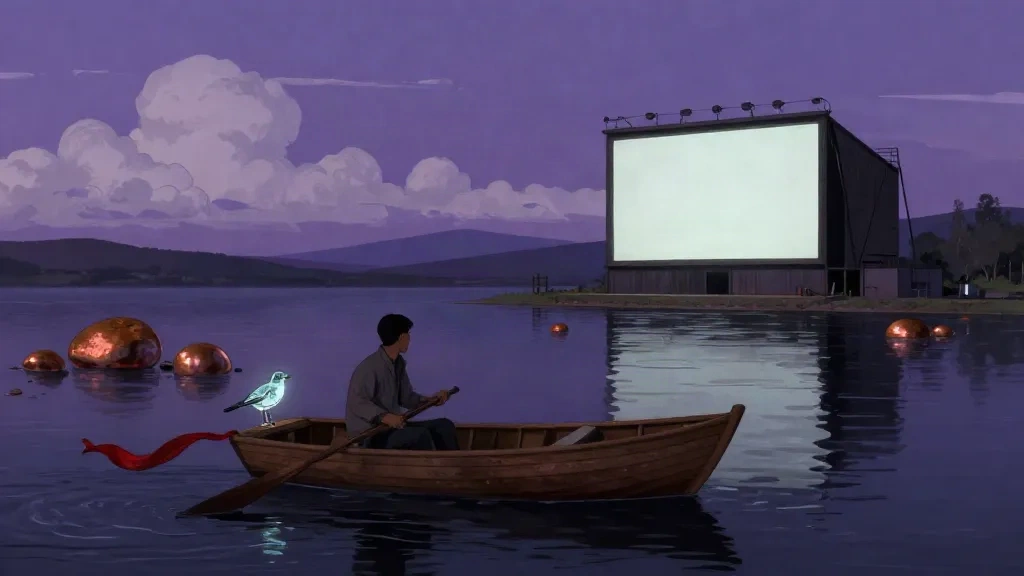
The Last Screening
On the nights when the lake withdrew, Tern rowed beneath a violet dusk across a floor of oxidized copper. The water lay in the ruts of old wagon roads, a thin black sheet over pale stones, and the sky carried a light the color of cloud that does not belong to any season. It came from the cinema and it never moved. Tern had stopped trying to decide whether that made it steady or wrong.
He poled from the near shore to the abandoned cinema, where the last projection still burned behind a velvet curtain. The building had no roof and no reason to have one, and yet the screen held. It always held. On it ran films of futures that almost happened. In one, the city remained standing after the flood. In another, the dead had learned to vote. In a third, a ferryman broke something small and the water forgot to come back for a season.
He never stayed for the endings. He watched for the original world.
That was the work, when the lake was out. He ferried the drowned from the low villages to the far bank, and the fare was never money. A true memory, taken by the wrist, held until the boat touched stone. He had taken a first kiss from a woman who turned out to be a scarecrow. He had taken a dog's name from a man who would go on to raise four more dogs and never once be surprised by the name. He did not keep what he took. That was the second rule, and the second rule was the reason the first one worked.
The rule of the far bank
The first rule: do not look at the far bank. Count the pilings instead. There were one hundred and nine of them, and he had counted them so often he could do it in the dark, in the middle of a crossing, with a passenger's hand dissolving in his fist.
He had broken the rule once. Eleven years ago, on a night much colder than this, a man named Oren had climbed into the boat without paying and without dying, which was already unusual, and said, Take me across, and give me back the night I asked you about.
Tern had looked. The far bank was a bank. Above it stood houses with lit windows, and in one of them a figure that had his shoulders and not his face, and the figure was waving, patiently, the way you wave at someone who is late. The next morning Oren drowned in the shallows by the near shore, cheerful about it, and the red scarf he had been wearing was gone, and no one in the village had ever owned a brother called Oren.
The scarf was under Tern's seat. He had told himself for a decade that he found it there. It was the wool from the high country, dyed the one red that survives rain.
The one time he had seen the original world was a fragment, and it was not long. A red scarf caught on the rail of the ferry, though he had never worn one. At the bottom of the final reel a woman looked directly through the burning screen, through him, through the year, and said, You changed it by looking away.
She was the only person who might remember.
The Honest Map
The map waited beneath the cinema ticket desk, under a drawer that stuck and a ledger of tickets nobody had needed for a long time. It was painted on vellum stained the green of old copper, and its routes shifted whenever someone tried to follow them honestly. Point it toward a familiar pier and the ink slid toward an unmarked inlet. Trace it with a finger and the lake erased the line behind you. Mark a destination and the map redrew itself from a different angle, and the angle was always the angle of a person standing somewhere they had never stood.
Tern had learned to use it dishonestly. He guessed at turns. He ignored the roads. He relied on the glitter of low water and on the way the stones changed color where a channel had once run. Cheating worked, in the way of a man who has decided that a locked gate can be treated as a wall.
On the third evening, the map opened itself.
No wind in the auditorium. No hand on the desk. The vellum simply lay open the way a mouth opens, and a route ran from the empty seats to a white island in the center of the lake. At its end stood a glass bird, wings cracked, one eye bright as a window.
He reached for it, and the map folded shut under his palm. Warm, like something sleeping that has been disturbed and intends to settle again.
The Borrowed Shore
The lake rose as he rowed. Black water climbed over the copper stones and filled the wheel tracks behind the cinema, one rut at a time, without hurry and without sound. He could have turned back. He thought about it the whole way, and the thinking was the part that made it a choice rather than a mistake.
He tied the glass bird to the bow and kept going, using the red scarf from beneath the seat as a signal fire, and he felt the wool go wet and heavy and cold as the light in it started up. Every wave made the bird flash. Sometimes the flash showed a person walking beside him, a stride out of time with his, a coat on the wrong side of the wind. Sometimes it showed only empty water. Once it showed a woman with the red scarf over her head, her face struck by rain, walking three steps behind him and keeping her head down so he could not have it.
He rowed for six hours. His shoulders burned. The light from the bird gave him what a lantern gives, which is not sight exactly but permission to keep moving.
At midnight the cinema screens flared behind him and painted the storm violet, all four of them, and the sound came out flat and enormous, the sound of a room applauding a thing that has not finished happening. Tern followed a strip of cloud-white foam. It curved where no current should have curved it. It curved twice, and the second curve was not a curve at all but a sentence, and he went along it because the alternative was rowing out into nine feet of nothing and being ferried himself.
It ended at a narrow shore of pale stones.
A woman waited there, holding the other end of his scarf.
The Woman Who Kept the Draft
She did not ask how he had found her. She said nothing for a while, and let him come close enough to see the scar along her jaw, and the habit of counting on her fingers when she spoke, and the way she stood with her weight on the wrong foot, as though the conversation were a long stair she had already climbed halfway.
He had buried what he had of her. The funeral had been conducted on the high shore while the water was out, and the minister had used the word original without knowing he was being funny.
She pointed back toward the cinema, far away now, shining under a dusk that had forgotten to end.
The map changes because it refuses to be used as proof, she said. Every honest route proves that the world you crossed is the only world. And then there is no reason to keep any of the others, so it opens another door. It is not lying to you. It is hiding.
Hiding what?
You. She turned the scarf once in her hands. Also you. But you first of all.
He showed her the glass bird. She turned it in the light of its own eye and touched the broken wing, and the lake went quiet the way a room goes quiet when a child finally sleeps.
Show me your hands, she said, and he did, because he had never once been able to refuse her anything that sounded like an instruction.
Eleven years of fares, she said. You have taken a true memory from every soul you ferried and you have forgotten them all. Do you know what a forgotten true memory does? It goes back into the water. The water is where we keep the drafts. The lake is not a lake. It is the world's overwriting hand, pooled wherever a sentence was crossed out, and everything in it is a version that was allowed to stop being true.
He said her name. It came out badly, after eleven years of not using it, like a plank that has warped.
Say it again, she said, and then decide what you came to say.
He said it again.
What the Bird Would Have Cost
She took him out onto the stones, away from the water, and there she told him what the glass bird was, and he understood why she had refused to tell him anything at the village.
The bird was not a message. It was a witness light, and it had been made to be broken, and when it was broken the original world would stand up out of the lake like a man standing in a doorway, and it would be the only world, because a proof that survives is a door that closes.
Everyone currently alive is a draft, she said. Every person you have ferried for eleven years and every one of them who walked away on the far side. They live because the sentence changed, not because you failed to look. Restore what was first written and they do not die. They simply never happened, and the people who love them find other reasons for their hands.
And Oren, he said.
Oren never happened at all. The brother you are grieving is a copy of a copy, one edition down, and he is a good man. He has a limp now. He sells lamps. In nine years he will have a daughter who does not exist, and he will love her past reason.
The light in the bird's eye made no sound. Tern found he had stopped shivering, which was worse.
And me, he said.
She looked at him for a long moment, and he saw her decide not to lie and then decide, afterward, to tell him anyway.
You were the fourth, she said. Your mother made three of you and the sentence kept one. The one it kept was not the kindest. It never is. It is the one who did not ask to be written.
So there it was, the whole shape of the evening: not a rescue, not a reunion, a decision with a body count.
He could unmake a world and be a man who did it, or he could leave a world standing and be a man who let a friend stay dead because the arithmetic of the living was heavier. There was no third door, and she knew it, and she had brought him here anyway, which meant something. She had brought him here to make him refuse her.
Tell me which, he said.
No, she said. I am not here to be right. I have been wrong once at a length of time that would interest you. I am here to be inconvenient, and you have to carry me home either way, and I am not going to make your arm lighter by choosing for you.
The Unforgotten Version
The ferryman broke the bird's remaining wing.
Light spilled out, cloud-white and steady, and it did not rise. It went along the stones at his ankle height in every direction at once, and where it touched the water the water did not retreat. It stayed. It lay down and got quiet and became, for a moment, legible.
And Tern waited for the sentence to complete itself, for the world to snap back into place like a bone, for the millions of drafts to go out like a held breath.
It did not happen. The bird's cracked eye had not been enough. The proof was a witness, and a witness can testify without convicting, and the light went on standing there on the stones, warm, useless, refusing to be a verdict.
In that light, the woman's face became the face from the final reel, young and unaltered, and it did not make her beautiful. It made her exact. He could see the mole she had gotten wrong as a girl. He could see the year.
You could have had the world you wanted, she said, not sadly. You chose the version where the wrong stays on the record.
And you, he said. Which version are you?
She pressed the wet scarf into his hands.
Keep it, she said. Something should remain inconvenient.
Then she was gone the way light leaves a room, and the stones were stones, and he was holding a scarf and a broken bird with light pouring out of it steadily enough to read by, and no one would ever be able to tell him whether he had saved the world or merely prolonged an argument.
At dawn the lake vanished. It went out of the wheel tracks, out of the ruts, out of the copper, leaving the pale stones dry and cold and smelling of iron. He walked back across them with the scarf around his neck and the broken bird in his hands, and behind him the cinema showed a future in which the city was still beneath the water.
He did not look away. He had not looked away for one single second of it, and he understood, walking home, that this was the whole difference he had managed to buy: not the truth, but the attendance. Somebody had stayed in the room for the entire reading.
The Lake at Dusk
The lake came back wrong, and stayed wrong, in the way of a debt that cannot be scheduled.
It withdrew on the low tides still, copper floor and violet dusk and the smell of wet film stock off the water. But it began to withdraw at dusk as well, on nights with no tide in them, which meant the work doubled, and the drowned came out in ones and twos and small bad-tempered families, and Tern took their fares and remembered none of them, as the second rule required.
People from the high shore came down to watch. They had never come down before. They stood at the water's edge and asked him what the light in the boat was, and he said, a lamp I am carrying for someone, and they nodded, because the answer was absurd and the asker had come a long way to be given something to carry.
Some of them started noticing the drafts. A woman in the upper village said out loud, at a funeral, that her son had not always had blue eyes, and the room went very quiet, and the son stood by the door with his hands at his sides and did not deny it. By the second winter there were eleven such rooms in the district, all of them quiet, all of them full. Nobody had a remedy. Nobody had a place to put the fear, so they put it in the water and it lay there on the stones, black and thin, and Tern rowed over it and kept going.
Oren came down in the third spring, on a night the lake was out. He had a lamp under his arm and a limp on the left side, and he sat on the far bank where the figure had stood eleven years before, waving patiently at nothing, for so long that Tern rowed over to ask what he wanted.
He wanted to watch. He said he had walked down because the light was strange and because he had a feeling he could not put anywhere, and the feeling was that I have been here before and did not know it, he said, and I do not think I liked it.
They sat on the stones together and did not say anything for an hour. Tern did not tell him. He understood, with the clarity that only inconvenience buys, that there are people you keep by lying to and people you keep by telling, and that he had no right to know which Oren he was sitting with, and that the fact of not knowing was the sentence he had chosen to keep in the record.
The map stayed folded. He put it back under the ticket desk in the drawer that sticks, and it did not open, and he did not force it. But once a season, when the lake is out and the cinema is dark and no one is on the water, he takes it out and looks, and there is a single route he has never taken, drawn in a hand uncomfortably like his own, running to the center of the lake, where the water is deepest even when the water is gone. He knows what is at the end of it. The sentence is there, in the place where the drafts are kept, folded up small, with the ferryman's name in the corner of it, written twice, one version crossed out.
He does not go. He poled out instead, and took a fare, and came back, and the night after the film he did not watch began there was a new reel running in the roofless cinema, and he sat through all of it with the lamp of a broken bird in his lap and read by the light of his own possible life, and the ferryman on the screen broke nothing at all, and rode out with a woman wearing a red scarf, and the reel ran and ran and never reached the last frame, because the last frame was the one he had not made yet, and the only way to see it was to be in it.
Some memories survive not by being preserved, but by refusing the final edit.





