 Netwrck
Science Fiction.
The tide-bearer
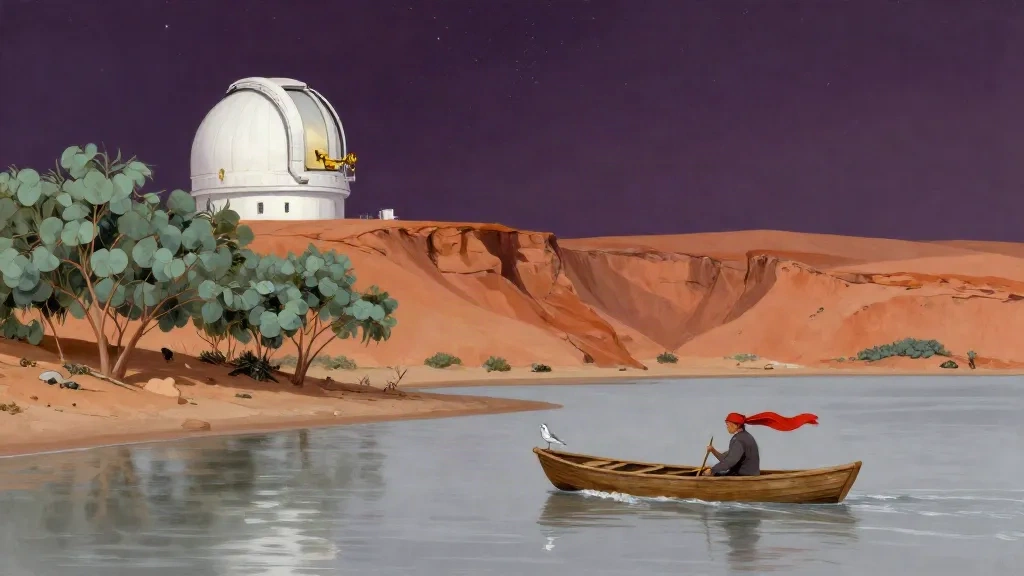
Every morning, when the desert heat withdrew into the eucalyptus trees, Mara tied her glass bird to the stern of her skiff and waited for the lake to appear.
It arrived without water rising. A silver basin unfolded between the dunes, its shore marked by shells, red mud, and the clawprints of animals that had vanished centuries ago. The observatory stood on the eastern cliffs, a white tower aimed at a sky the color of bruised fruit. Each night, its brass receiver turned toward the dark and collected the messages the stars sent down.
Mara did not want to read them. She wanted to reach the one person who remembered the original version of the world: the first night, before the messages began, before the desert had been written over the old country.
That person was said to live beyond the lake, in a village no survey had recorded. Mara carried a red scarf around her neck, though she had no memory of buying it. Its wool was soft from years of being held.
A map that will not settle
The map was painted on the hull of every skiff. Mara’s showed a straight crossing, six hours from the western reed beds to the observatory road. On the first morning, the ink shifted before she reached the gunwale.
The route curved south around a mountain that did not exist. Mara corrected it with charcoal. By noon, the charcoal had moved into the margin and become a small black island. The lake itself seemed to breathe beneath her, expanding its pale surface toward the horizon.
At dusk, a woman in a dust-colored coat sat in the reeds and waved. Mara brought her aboard.
“You are late,” the woman said.
“The map lied.”
“Maps do not lie here. They change when someone tries to use them honestly.”
The woman’s name was Ilex. She remembered the world before the sky learned to speak. She had lived in a green valley with a river, three brothers, and a market where bread was baked in blue ovens. Then the first star had opened above them, and the valley had vanished beneath the desert.
Mara tightened the red scarf. “Will you take me to the person who remembers it?”
Ilex looked toward the observatory. “I am the person.”
The receiver answers
At midnight, the lake turned black except for a narrow line of silver beneath the skiff. The stars lowered themselves into the water, one after another, until the boat seemed to sail through a night sky.
The glass bird on the stern began to sing.
Its voice was thin and human. It recited names Mara recognized from the maps: Mara, Ilex, the old ferryman, the tower keeper. Then it said, “The original world is not gone. It is hidden in the first silence.”
The observatory answered. Every lens in its white crown turned toward the lake, and a beam of amber light struck the water. The black surface opened.
Below it was no water. There were streets, tiled roofs, and trees moving in a wind Mara could not feel. A child stood beneath an apple tree, looking up with her hands over her ears.
“That is not possible,” Mara said.
“It is a memory,” Ilex replied. “The stars can preserve what the world forgets, but they cannot return it. To cross, you must give something the map can hold.”
Mara understood. The red scarf, the glass bird, the ferryman’s name. The map had changed because it was trying to make a truthful route from an incomplete life.
The first silence
She took the scarf from her neck and dropped it into the reflected streets. It fell as red cloth, then as a rope, then as a vein of fire. The glass bird flew down and struck the water.
For one breath, every star went quiet.
In that silence Mara saw the lake as it had been: a green river valley beneath a narrow blue sky. She saw herself as a child, laughing beside three brothers, with no tower behind her and no message in the stars.
Then the vision closed.
The lake became ordinary water. The observatory lights went dark. Ilex remained on the skiff, her face altered by age, while Mara’s hands held only wet rope.
“Did I find you?” Mara asked.
“You found what I kept,” Ilex said.
At dawn, the skiff returned to the western shore. Mara’s map was blank except for a single red mark beneath the first star. She no longer remembered the faces of her brothers, but she remembered the sound of their laughter.
That was enough to steer by.





