 Netwrck
Science Fiction.
The Last Departure
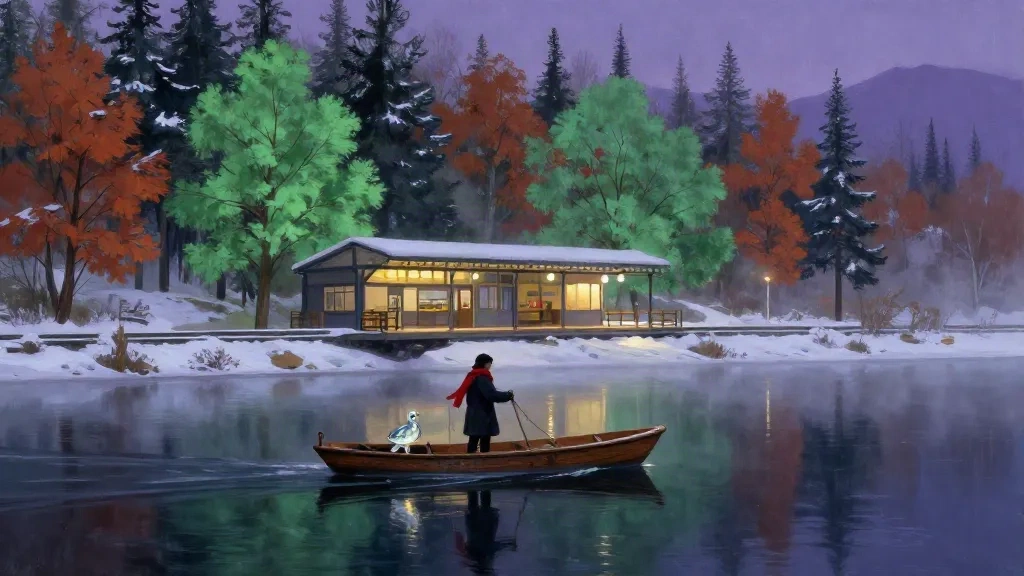
Mara crossed the lake only at low tide, when winter withdrew far enough to expose a road of black glass beneath the water. Her ferry had no engine, only a shallow hull, a lantern, and an oar polished by salt. Around her, the drowned city waited in blue silhouettes. Above it, the winter station floated among fir trees, its lamps burning terracotta against a sky bruised purple and green.
Tonight its boards announced summer, autumn, and a season she had no name for. Each platform offered a different wind. Each train carried people fleeing or returning. Mara had one question for them: Who remembers the world before the seasons changed?
The answer had brought her here. The answer had also given her a map stitched from translucent leaves, useless in rain and warm to the touch. It promised to show the road to its keeper.
The Honest Map
At the waterline, Mara unfolded it. The paper brightened beneath her hands. A silver line climbed from the ferry and crossed the exposed road toward the station. She stepped onto the black glass.
After her third step, the line moved.
It bent eastward, away from the station and across a field buried under snow. Mara stopped. The route faded, then redrew itself toward a narrow cleft between frozen trees.
Honesty, the map's owner had once explained, forces a road to become the road you can actually take. Lies keep their destination. Truth keeps changing it.
Mara tried fixing the map beneath a stone. The stone slipped into a crack. She traced her destination in red pencil, but the graphite spread like frost across the page, swallowing every mark. Each honest correction cost her a detail: the smell of her mother's kitchen, the number of stairs in her childhood home, the sound of her father's laugh.
By sunrise, she had forgotten three people. The ferryman nonetheless carried the map onward, because forgetting their faces did not make their survival less important.
Passengers for Elsewhere
Summer departed first. Its passengers boarded barefoot, carrying jars of sunlight and baskets of warm fruit. When the train pulled away, its coaches rolled through the station wall and became a ribbon of heat across the sky.
Autumn came wearing red leaves. A small girl found the glass bird Mara kept in her coat. It was clear, hollow, and no larger than her palm.
My mother had one, the girl said.
Mara touched the bird. The memory returned with weight: her own hands upon glass, a winter platform, a woman fastening a red scarf around her neck. The woman's face remained hidden by the passing train.
Autumn boarded. The girl waved the glass bird from the window. It did not fly. It watched.
Then the nameless season arrived.
No passengers emerged. Frost formed on every window, though the lake had begun to rise. Mara pushed the ferry from the black road and rowed toward the empty platform.
The Place Before the Seasons
The train waiting there had no destination board. Its lamps were dark. A red scarf hung from the conductor's rail, wet with mist.
Mara took it. The glass bird in her coat began to sing, though it had no throat. Its note opened the station doors, not onto the platforms but onto a kitchen where a kettle steamed and two cups waited on the table.
The woman by the kettle wore Mara's red scarf.
You are the one, Mara said.
The woman looked at the ferry, then at the lake slowly filling the station.
No, she said. I am the one who remembers. You are the one who comes back.
Outside, winter struck the windows. Mara understood at last. The original world had not vanished. It had been pushed beneath the new seasons, sinking into the lake whenever water rose. Its keeper remembered every room, every road, every person who had crossed them.
Mara could not rescue that world. She could only carry the last dry passengers through it.
The conductor blew the whistle. The woman stepped onto the ferry.
Mara took up the oar. Above them, the new seasons thundered across the sky, but beneath the black water, one warm light moved toward shore.





