 Netwrck
Gothic Fantasy.
The Passenger in Red
Winter had come to Waken Station as a white coral frost, delicate as lace across the iron rails. The platform roof held a hundred icicles, and beyond the tracks the fields lay buried beneath ink-colored snow. Passengers arrived carrying seasons in their luggage: a jar of thunder, a branch of green leaves, a summer coat still warm with moth wings.
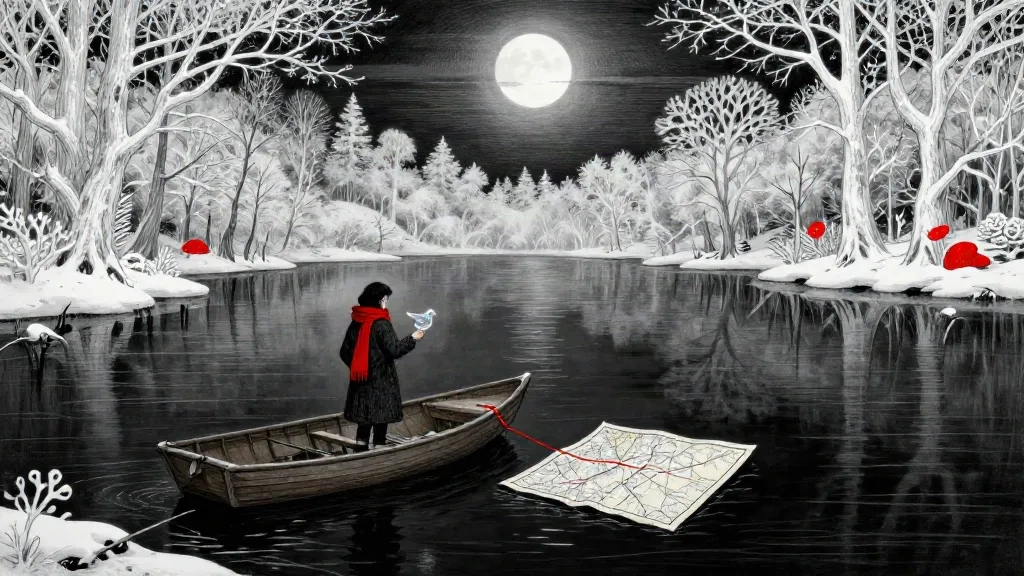
At the end of Platform Three stood Ilyan Vale, ferryman of the low-water lake. The lake appeared only twice each day, when the winter moon withdrew its reflection from the clouds and the earth breathed through a seam in the hills. Ilyan's skiff waited below the embankment, its black hull stitched with red thread.
He had crossed the lake for thirty years, ferrying drowned villages, forgotten gods, and the occasional child who had mistaken the water for sky. Yet Ilyan had one unfinished crossing left in him.
His sister, Mera, remembered the original world.
Not the old stories of it, nor the histories copied into station ledgers. Mera remembered the smell of rain before seasons began, the names of rivers before anyone renamed them, and the single unbroken year in which every living thing shared the same weather. She had vanished during the first winter.
On the platform, a woman in a red scarf waited beside a brass clock that had no hands. The scarf trailed to her boots, though the wind was still. Beneath her arm she carried a glass bird, its wings clouded with tiny fractures.
“You are the ferryman,” she said.
“Everyone waiting here is waiting for someone.”
“Then ferry me across.”
She handed him a map folded from skin. It showed seven stations, seven lakes, and seven roads to Mera. When he touched the nearest line, the ink withdrew. A new road appeared beneath it, leading through a forest where trees hung upside down.
Ilyan folded the map. The roads continued moving beneath the paper.
“This is not a map,” he said.
“No,” the woman replied. “It is a witness.”
Low Water
At dusk, the lake surfaced. It rose without breaking the ice, a black mirror spreading through the valley. The woman refused to board until Ilyan marked the map in white coral, for a route through spring.
He drew the first line honestly.
The ink split. The station disappeared from the paper, replaced by a city of bells sinking into green water. Ilyan struck the map against his palm. A station of summer rose on the shore, crowded with passengers carrying baskets of ripe fruit.
“It changes when you use it honestly,” the woman said.
“Then it knows what honesty costs.”
They launched the skiff. The red thread in its hull tightened as the water rose around them. Ilyan rowed toward the shore shown in ink, but every stroke opened another landscape beneath the boat. Autumn reeds rose like spears. A frozen orchard glittered beneath them. Somewhere, a bell struck twelve times and the water turned white as bone.
The glass bird in the woman's coat began to sing.
Its song carried Mera's voice.
It said one word: Spring.
Ilyan drove the skiff toward the sound. The map unfolded itself in his hands, showing a red thread crossing every route, every station, every blackened wave. At its center lay a platform without a name.
“That is not on your witness,” he said.
The woman touched the bird. One crack spread farther across its wing.
“It is where your sister has been waiting.”
The World Before Weather
They reached the nameless platform as snow began above the water. No rails ran into it. No lamps burned. Only a shelter of winter coral stood at the edge, its walls breathing frost.
Mera sat inside, turning a cup between her palms.
She looked exactly as she had at eleven years old. Behind her, a summer orchard burned without consuming itself.
“You brought the map,” she said.
Ilyan held it out. “Tell me how to cross without losing the road.”
“You cannot.”
She rose. The woman with the scarf moved aside, and Mera pressed her palm to the map. Every line became liquid.
“The world was divided so people could survive,” she said. “Seasons were given away one at a time. First warmth. Then rain. Then the names of things. Everyone believed they were choosing better weather.”
She drew one final line across the paper. It was not straight. It curved around the glass bird, around the scarf, around the ferryman and the girl he had lost.
The station shook. Beyond the shelter, the lake began to drain.
“You can restore the original year,” Mera said, “but the map will take the memory of the person who reads it.”
Ilyan understood then why the roads had fled. The map had not been changing because it lied. It had been changing because truth made every world too costly to hold.
He placed his thumb over Mera's name.
“Read it with me.”
The First Crossing
At low water, the lake showed again. Ilyan and Mera walked onto its black surface, followed by the woman in red. The map opened beneath their feet, no longer shifting, its roads joined into one.
The glass bird flew ahead of them. Its broken wing shed light across the water, and the red scarf lifted as if a wind had returned from the other side of the world.
Mera held Ilyan's hand.
Below them, drowned villages turned toward the light. The station bells rang once, then all together. Summer touched winter's cheek and did not steal it away.
At the far shore, the ferryman looked back. The lake was shrinking, not vanishing, returning to its place beneath the hills. On the map, only one line remained.
It ended at the shore.
Behind him, Mera laughed—the first sound he had heard from the original world in thirty years.
Ilyan planted the red thread in the black earth. Somewhere beyond the fields, the first spring wind began.





